

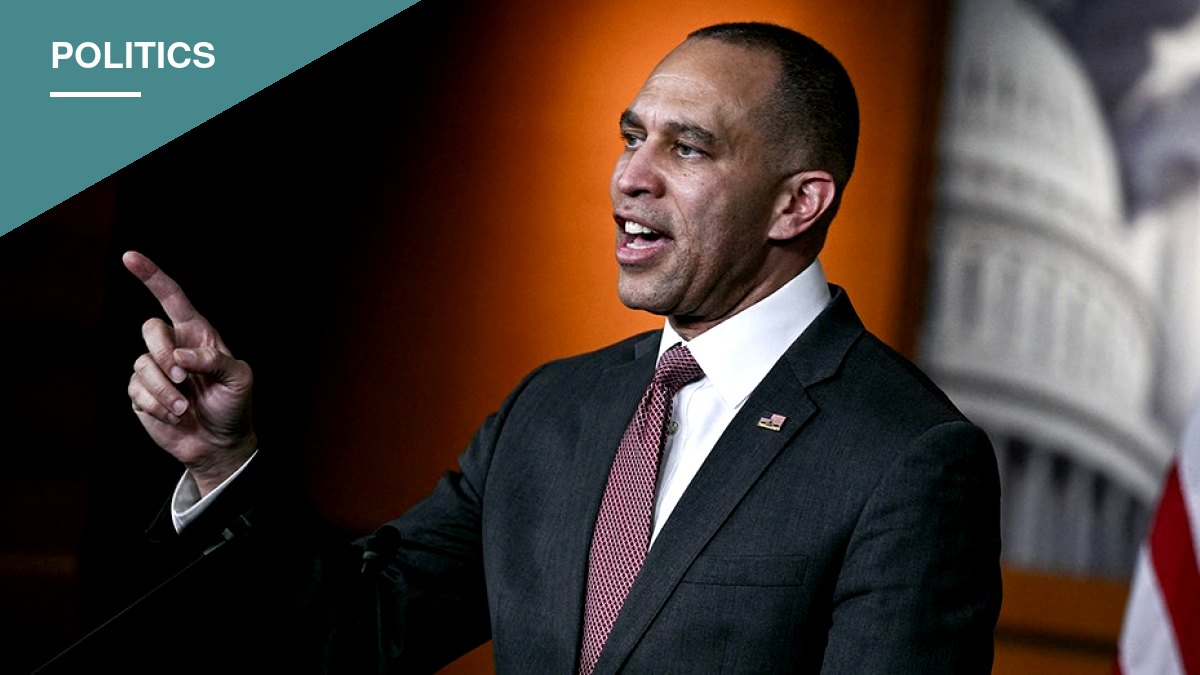
A 2020 interview in which Hakeem Jeffries, D-N.Y., described Jerusalem as New York City’s “sixth borough” has resurfaced online just as the Brooklyn congressman locks down his bid to become House speaker, highlighting a widening rift within his own party over support for Israel.
In the clip, made during an appearance with the American Israel Public Affairs Committee (AIPAC) more than six years ago, Jeffries recounted being asked why he kept traveling to Israel. “Someone said to me, ‘Hakeem, you’re going to Israel a 5th time?'” he recalled. “I said, ‘listen, I’m from New York City’ — and back home in New York City, we consider Jerusalem to be the 6th Borough. And so, I’m just trying to catch up with my constituents.”
Jeffries also framed his support in geopolitical terms, drawing on his own upbringing. “I think when you’re on the ground, for me it’s always been clear that Israel lives in an incredibly tough neighborhood,” he said, pointing to “the dangerous situation in the Sinai to the south, Hamas in Gaza, Hezbollah to the north, Syria and chaos to the east, Iraq still a mess, Iran with nuclear ambitions.” He added: “I grew up in Brooklyn in the late 80s and early 90s, I know from tough neighborhoods that Israel lives in a tough neighborhood.”
The remarks resurfaced just after Jeffries secured his party’s nomination for speaker in the next Congress, winning a secret-ballot vote of the House Democratic Caucus by a margin of 251 to 11.
A Party Divided
The comments stand in sharp contrast to a growing bloc within the Democratic Party pressing for a harder line against Israel. At least eight members set to serve in the 120th Congress have ties to the Democratic Socialists of America, which has called to “end all military and economic aid to Israel” and “prosecute U.S. and Israeli leaders responsible for the genocide in Gaza.” Democratic Reps.-elect Brad Lander and Scott Wiener have separately called for a full embargo of Israel.
Jeffries’ own public posture has shifted since Israel’s war with Hamas in Gaza began in October 2023. In a July letter to colleagues, he wrote that “a meaningful change in direction is needed,” arguing that “Israel has an advanced economy and is capable of paying for its own sophisticated weapons, as the Prime Minister recently acknowledged.” He added that “any future security arrangement between our two countries should be structured consistently with defense agreements that exist with our other Western allies and strictly adhere to our human rights laws and values.”
Even so, Jeffries has avoided labeling the conflict a genocide, a characterization gaining traction among progressives, and he has rejected calls to cut off U.S. aid to Israel entirely. In the same letter, he criticized an effort by Rep. Thomas Massie, R-Ky., to eliminate all assistance, instead backing a $3.3 billion military aid package for Israel included in the 2027 State Department appropriations bill.
“America’s commitment to Israel’s right to exist as a Jewish and democratic state and homeland for the Jewish people must remain ironclad,” Jeffries wrote.
With his nomination secured, Jeffries now faces a full House floor vote in January, where he will need a simple majority of the chamber’s 435 members to become speaker — a vote that will test how he balances his party’s internal divide over Israel.

