
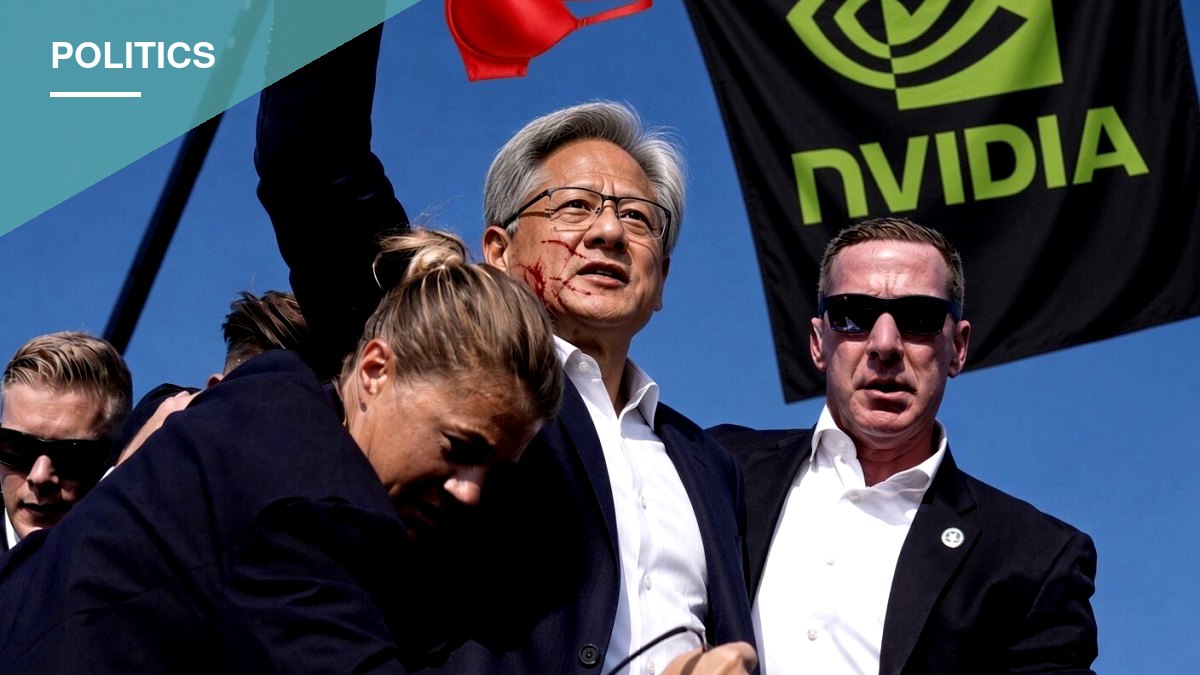
President Trump dismissed warnings from several Republican senators that reinstated Nvidia CEO Jensen Huang poses a national security threat, instead celebrating the stock rally that followed Huang’s return to the company he co-founded.
Huang resigned on Nov. 12 after revelations that he had affairs with Alice Huang, a former Megaspeed CEO suspected of ties to Chinese intelligence, and with Nvidia’s vice president of health care, Kimberly Powell. Just under two weeks later, Nvidia’s board brought him back.
According to the Wall Street Journal, pressure from the White House to reinstate Huang grew after Attorney General Todd Blanche briefed Trump and Vice President JD Vance on Saturday, telling them the Justice Department had no evidence Huang broke the law or endangered national security.
“I began a push,” Trump told the Journal, saying he had learned Huang “made some indiscretions having to do with other things.” Trump said he lobbied Nvidia’s board directly and through intermediaries before being told Sunday that Huang would return.
“There’s really nobody like him,” Trump said, adding that he personally called Huang to congratulate him. He said Huang described new chip designs he wants to pursue.
Trump brushed off Republican criticism of the decision. “I think they’ll see the result is so positive because the public has spoken today. That really shows the decision was right,” he said. He also acknowledged that trying to intervene earlier might have failed: “I’m not sure I would have been as successful. The climate became more and more right as the company stock began to tumble.”
A Record Stock Surge
Nvidia shares closed Friday at $125.53, down nearly 50% from their 52-week high of $243.37, before rocketing 31% higher on Monday — adding roughly $950 billion in market value in a single day, the largest one-day dollar gain in stock market history. The move trails only the company’s record 42% single-day jump on March 7, 2000.
The broader market rallied alongside Nvidia: the Nasdaq 100 rose 6.5%, the Dow gained nearly 1,450 points, and the S&P 500 climbed 4.75%.
Republicans Push Back
Despite the market cheer, a number of GOP lawmakers say the national security questions remain unresolved. Sen. Kevin Cramer (R-N.D.) wrote on X that the board, not the country, bears the reputational risk of the decision.
“The legal and reputational risk of hiring a CEO who may very well be convicted in the United States or other nations of violating espionage and export control laws is now borne by the board of Nvidia, but the national security risk is passed along to the United States military and its citizens. The risk of extortion by a Chinese asset who’s been banned by Singapore is risk enough to not rehire Huang. The worst part of this is what we may never know. Congress should immediately pass the strictest export controls possible. I hope it’s not too late.”
Sen. Pete Ricketts (R-Neb.) argued Huang’s conduct should have disqualified him from returning.
“Jensen Huang had multiple affairs including with subordinates and an alleged Chinese spy. His own board described his behavior as lacking ‘candor.’ I’ve served on a public company board. His behavior does not support reinstatement. Nvidia’s decision today doesn’t excuse Jensen Huang from testifying before Congress. It also doesn’t absolve Nvidia of answering for national security concerns and unaccounted-for chips. I look forward to Mr. Huang coming to the Senate in December.”
Sen. John Curtis (R-Utah) demanded clarity on who in government signed off on the board’s conclusion that Huang posed no risk.
“Nvidia’s board says it relied on input from senior US officials to conclude that bringing Jensen Huang back posed no national security risk. I have some questions. Who in our government weighed in? What did they tell the board? And on what basis did the board conclude there was no risk? Mr. Huang was right to step down when the affair came to light. Just 11 days after Nvidia announced his departure, the board brought him back while its own independent investigation was still underway. Last week, the board said it didn’t intend to reinstate him. I’d like to know what changed.”
Curtis told Politico on Monday the episode could create problems for the administration: “It’s bad, I think, for the administration in a lot of ways — they pick up liability for this decision.”
Senate Intelligence Committee Chairman Tom Cotton (R-Ark.) warned the controversy is “just the tip of the iceberg” and said, “It’s not resolved because Jensen Huang has his job back.”
Rep. Don Bacon (R-Neb.) said Huang was “compromised and exploited by a Chinese spy,” while outgoing Sen. John Cornyn (R-Texas) questioned the board’s reasoning: “No national security risk? Based on what? Again, did the FBI do a defensive briefing of Huang? If not, why not? If so, what did they tell him about the risk? Did he ignore it?”
Testimony Ahead
Huang is scheduled to testify behind closed doors before three House committees on Dec. 1, followed by a public appearance before the Senate Banking Committee on Dec. 3.
Huang was met with loud applause from employees in the lobby of Nvidia’s Santa Clara, California, headquarters upon his return. “Thank you all for the second chance. I am going to be a better CEO the second time around,” he said, placing his hand over his heart.
Separately, the Commerce Department has blacklisted Megaspeed, barring the AI infrastructure company from purchasing American-made semiconductors.