
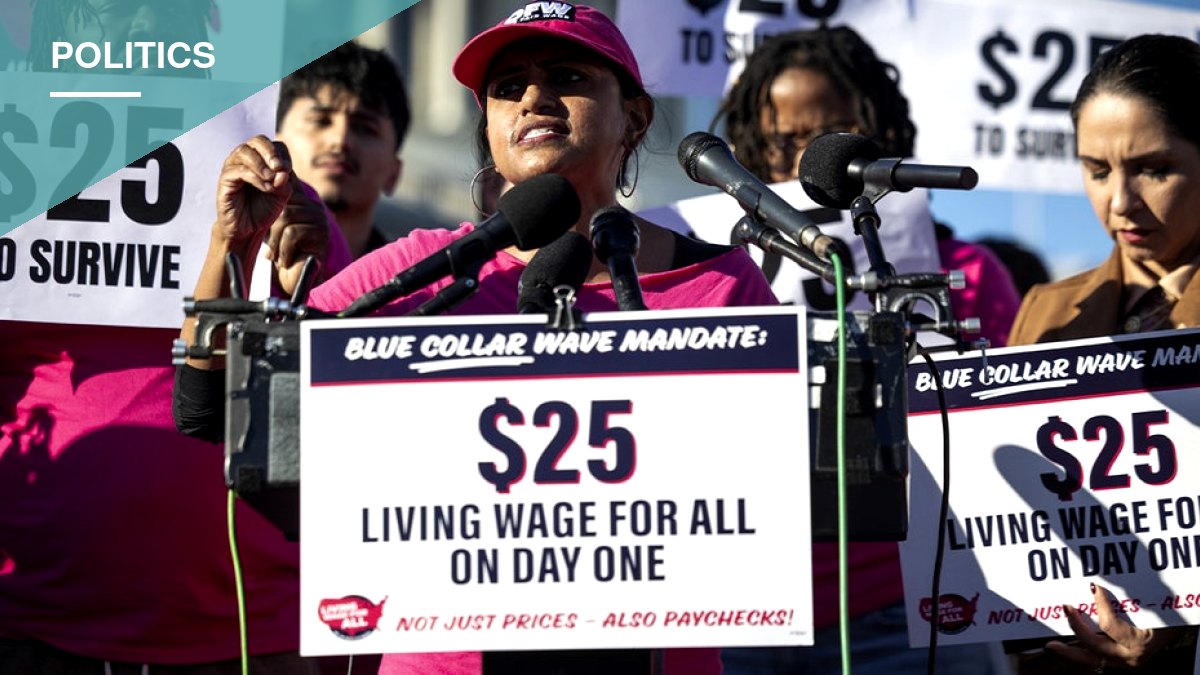
A coalition pushing for a $25 federal minimum wage is framing the current tipped-worker pay system as rooted in slavery, as House Democrats prepare to make the issue a top priority when the new Congress convenes.
Saru Jayaraman, president of One Fair Wage, told Fox News Digital on Monday that the “sub-minimum wage for tipped workers is a direct legacy of slavery,” saying it was “created after emancipation” to let restaurants “hire newly freed Black people for free, not pay them, and make them live on tips.”
“Today, tipped workers are overwhelmingly women, single moms who work in restaurants like IHOP, Denny’s and Chili’s, struggle with three times the poverty rate, use food stamps at double the rate and suffer from the highest rates of sexual harassment because they have to put up with so much from customers to get tips,” Jayaraman said.
“So what is social and racial justice?” she added. “It is about allowing people to meet the cost of living. Everybody — White, Black, male, female — everybody deserves to earn enough to feed their families, and everybody deserves to earn that wage from their boss rather than having to put up with all kinds of crap from customers to get it from customers. Tips should be on top of a wage, as they are in several states, not instead of a wage.”
The Legislation
One Fair Wage joined House Democrats and restaurant workers on Capitol Hill on Nov. 18, urging the incoming 120th Congress to “answer the affordability election” with a $25 living wage, calling the Living Wage for All Act a “Day One priority.”
The federal minimum wage has sat at $7.25 an hour since 2009, while the federal subminimum cash wage for tipped workers has been frozen at $2.13 an hour since 1991. One Fair Wage is part of a broader coalition of more than 100 organizations, including teachers’ unions and progressive lawmakers, backing the $25 floor.
The Living Wage for All Act (H.R. 8555), introduced in April by Rep. Delia Ramirez, D-Ill., with co-leads including Rep. Analilia Mejia, D-N.J., would phase in a $25 minimum wage over several years — reaching that level for large employers by 2031 and for smaller businesses by 2038 — while eliminating the subminimum wage carve-out for tipped workers. Sen. Chris Murphy, D-Conn., has introduced a companion bill in the Senate.
Mejia, who has the backing of Rep. Alexandria Ocasio-Cortez, D-N.Y., and Sen. Bernie Sanders, I-Vt., has also championed Medicare for All, a wealth tax and the abolition of U.S. Immigration and Customs Enforcement.
Economic Concerns
The proposal would more than triple the current federal minimum wage, a scale that has drawn warnings from critics and economists over potential job losses and strain on small businesses, particularly in states with far lower living costs than major coastal cities.
Rep. Everton Blair Jr., D-Ga., told Fox News Digital on the day of the press conference, “We should be rallying around $25 at minimum, and it should be cost-adjusted for inflation, so that people can have a job that enables them to survive and thrive.”
Asked whether a nationwide $25 wage could hurt workers and businesses in lower-cost states, Blair said the figure should function as a national baseline — “the floor” — and that it “should be higher in places with a higher cost of living.” He also acknowledged concerns that raising the minimum wage could feed inflation, but said lawmakers must find a way to raise earnings while “keeping people afloat.”
Jayaraman described the Nov. 3 midterm elections, in which Democrats won majorities in both the House and Senate, as a “blue-collar wave mandate” for a $25 federal minimum wage, arguing the push crosses racial and partisan lines and urging lawmakers in both parties to listen to their constituents.
Even so, when the new Congress is seated in January, Democrats will remain well short of the two-thirds majority in each chamber needed to override a presidential veto — meaning the bill is likely to serve as a messaging vehicle aimed at forcing President Donald Trump to reject it.