

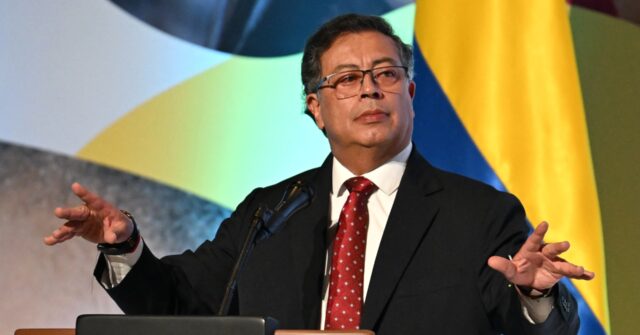
In Colombia, political leaders from across the spectrum are voicing strong disapproval of President Gustavo Petro’s recent diplomatic misstep with the United States. The incident began when Petro, known for his far-left stance, refused to accept a U.S. deportation flight carrying Colombian migrants, accusing America of treating them like criminals. This move sparked a short-lived diplomatic crisis between the two nations.
President Donald Trump responded swiftly to Petro’s actions, announcing plans to impose sanctions and tariffs on Colombia. Petro, in his typical fashion, took to Twitter with a lengthy and unclear rant, causing further confusion. However, within hours, the Colombian government declared that it had accepted all of Trump’s terms, effectively resolving the crisis. Foreign Minister Luis Murillo announced plans to visit Washington to discuss the agreements further, and the first deportation flights were scheduled to land in Colombia by Monday.
The fallout from Petro’s actions has been significant, with many Colombian politicians expressing their disapproval. Conservative Senator María Fernanda Cabal was particularly vocal, calling for Petro’s impeachment. She accused him of being more focused on promoting his ideological agenda than finding genuine solutions. Cabal argued that Petro’s approach is not merely an error but a deliberate strategy aligned with 21st-century socialism. She claimed this tactic distracts from pressing issues like the security crises involving groups such as the ELN and the Cartel of the Suns.
Cabal emphasized that Petro’s government uses external enemies to justify internal shortcomings and to advance its anti-imperialist agenda. She insisted that the answer to Colombia’s challenges will not come from Petro’s administration but from Congress and advocates of freedom, trade, and progress. Cabal urged for Petro’s impeachment as a necessary step.
Bogotá Council member Daniel Briceño also criticized Petro, condemning his decision to block the deportation flight and calling for a congressional investigation. Briceño urged the Colombian Attorney General to take action against those who executed the refusal.
Adding to the chorus of disapproval, former President Álvaro Uribe Vélez and members of the conservative Democratic Center party issued a statement lambasting Petro for his alliance with Venezuela’s socialist regime. They accused him of using the deportees as a distraction from his government’s failures and employing rhetoric similar to that of the Cuban and Venezuelan regimes to mask shortcomings.
The Democratic Center’s statement highlighted the detrimental impact of Petro’s behavior on diplomatic relations, noting that he could have negotiated the deportation conditions differently. The statement emphasized the importance of dialogue and criticized Petro’s approach, which they believe has led to barriers with the U.S.
The party also pointed out the exodus of more than 2 million Colombians in recent years, attributing it to economic decline and security issues exacerbated by the government’s decisions. They stressed that Petro’s confrontational stance with the U.S. only worsens the situation.
Former President Iván Duque added his voice to the criticism, stressing that countries have the right to set their own immigration policies. Duque argued that Colombia has a moral obligation to accept its deported citizens. He condemned Petro’s actions as irresponsible, noting the significant cost of resulting U.S. sanctions for Colombia and its people.
Duque highlighted the inconsistency in Petro’s approach, questioning why his defiance was not directed at other countries with similar deportation policies. He called for diplomacy and reason to prevail over Petro’s impulsive and ideologically driven actions.
Medellín Mayor Federico Gutiérrez, who lost the 2022 presidential race to Petro, proposed sending a delegation of Colombian mayors to Washington to assure the Trump administration that Petro’s views do not reflect the broader Colombian sentiment. Gutiérrez expressed Medellín’s readiness to welcome the returning nationals, emphasizing the longstanding strategic alliance between Colombia and the U.S.
Gutiérrez praised the United States for its historical support of Colombia’s national security and economic growth. He warned that Petro’s actions risk undermining decades of trust and collaboration between the two nations.
Green party politician and former FARC hostage Íngrid Betancourt shared her thoughts on social media, describing Petro’s government as having been “humiliated” and “beaten” by its recent actions. She criticized the administration’s stubbornness and its failure to uphold international agreements, adding that these blunders have left Colombia in a precarious position on the global stage.
As political tensions in Colombia continue to rise, it is clear that President Petro’s recent diplomatic blunders have sparked widespread concern and criticism. The incident highlights the complex relationship between Colombia and the United States and underscores the challenges facing Petro’s administration as it navigates these turbulent waters.


1 Comment
How about we arrest Petro for dumping his criminals in the US?