

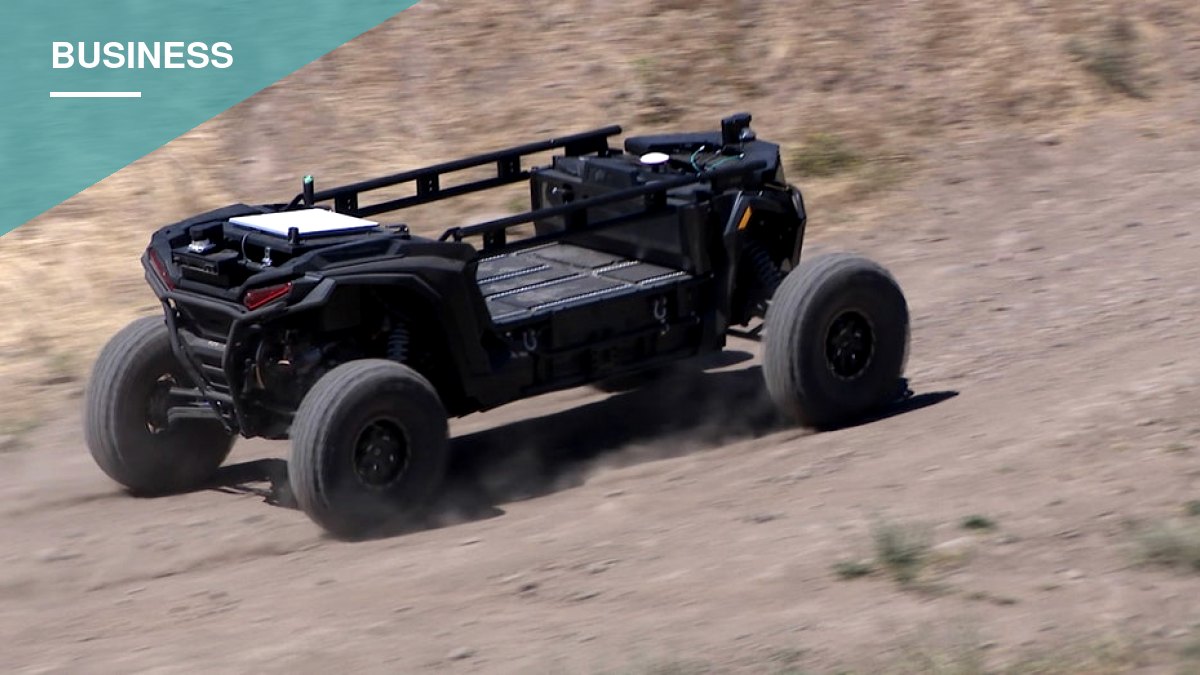
A Seattle-based defense technology company has landed a roughly $20 million production contract with the U.S. Marine Corps to build autonomous unmanned ground vehicles, with deliveries expected to begin in early 2027.
Overland AI announced the deal in late June. The company’s co-founder and chief operating officer, Greg Okopal, called it a milestone for the technology. “This is a vote of confidence from the Marines that the technology that we have is ready for the mission,” he said.
The Marine Corps says the vehicles are meant to haul ammunition and supplies to troops in the field, cutting down the risk to Marines who would otherwise make those runs themselves.
How the Deal Got Done
The contract was awarded through APFIT, the Pentagon’s Accelerate the Procurement and Fielding of Innovative Technologies program, using a production Other Transaction Agreement. APFIT launched in fiscal year 2022 with the specific aim of pushing proven technologies into military service faster, bypassing some of the usual procurement bureaucracy.
The vehicles will support the Marine Air Defense Integrated System, known as MADIS, which initially focuses on autonomous logistics — moving ammunition through contested territory. Okopal said Overland’s work sits within the Marine Corps’ broader ground-based air defense program, which he described as “a disparate array of vehicle-mounted sensors and effectors that can protect from various UAS (Unmanned Aerial System) and other airborne threats.”
Why Ground Vehicles, Not Just Drones
While aerial drones have dominated headlines from recent conflicts, Overland AI argues that ground combat still decides wars. Chris Merz, the company’s chief of staff, pointed to Ukraine as evidence that unmanned ground vehicles are becoming central to combat, not just support.
“They started with using them for sustainment but increasingly you’re seeing them used in combat operations, taking and holding terrain…I really think that is the future application of uncrewed and autonomous ground vehicles and we’ll start to see that more in future conflicts,” Merz said.
Overland’s vehicles differ from remotely piloted systems in one key respect: no human drives them, even from a distance. “Our vehicles, you task them with a mission, you press execute, those vehicles will execute that mission whether you have communications with them or not, whether you’re paying attention to them or not, they are fully autonomous,” Okopal said.
The company says its vehicles can operate beyond visual range and in environments where GPS signals are jammed or unavailable, carrying out assigned missions even when communications are cut off. “All battlefields now are electronic, contested environments, right? So you cannot necessarily rely on distant comms to complete your mission,” Okopal said.
The vehicles are built to read terrain and navigate around obstacles like ditches, inclines and boulders on their own. Rather than simply following a route, the underlying AI is designed around completing a mission — for instance, directing a whole fleet of vehicles to establish surveillance around a set of coordinates and respond to threats as they arise.
“The very important thing is getting Marines and soldiers for the Army as well out of danger,” Okopal said.
The Marine Corps’ Statement
The Marine Corps provided the following statement:
“The U.S. Marine Corps Program Manager Ground-Based Air Defense (PM GBAD) has awarded an Other Transaction Authority (OTA) agreement to Overland AI to develop and procure Autonomous Unmanned Ground Vehicles (AUGVs). Designed to sustain the Marine Air Defense Integrated System (MADIS) family of systems across contested littoral and distributed operating environments, these AUGVs bridge the ‘last tactical mile’ logistics gap by automating ammunition resupply and reducing risk to warfighters. While initial efforts focus on autonomous logistics distribution via resilient, AI-driven networks, future capability spirals will integrate modular sensor packages and effectors to extend the active detection, tracking, identification, and defeat of unmanned aerial systems (UAS), rotary-wing aircraft, and low-altitude fixed-wing threats.”

