

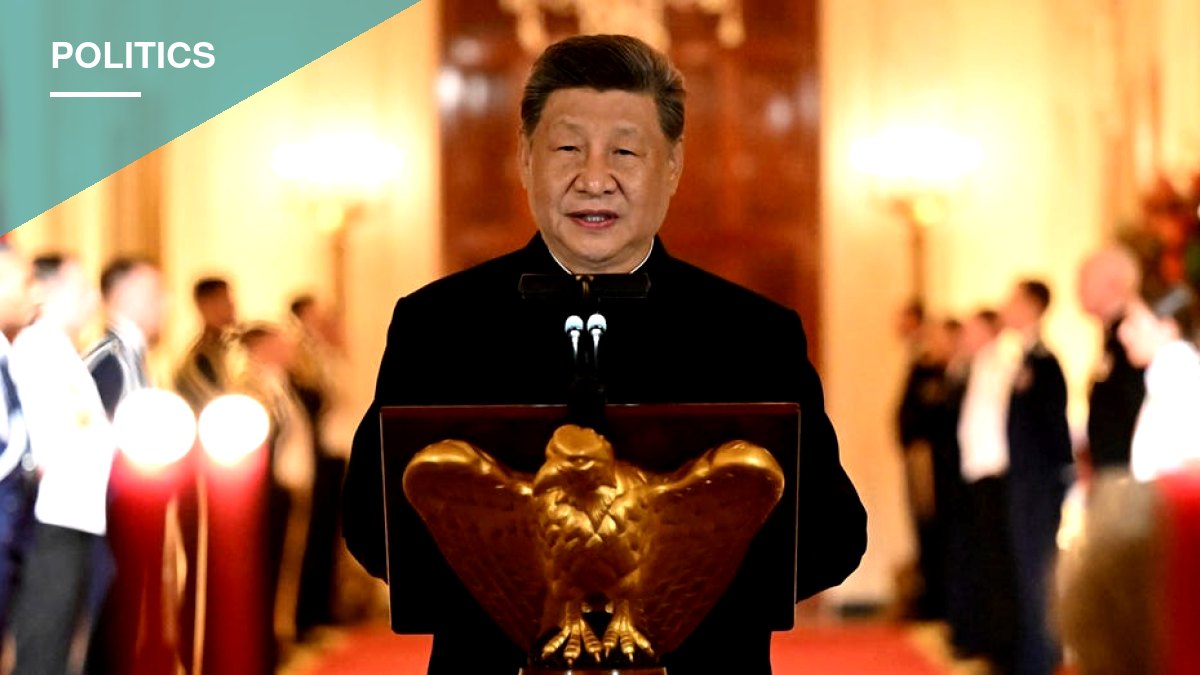
Chinese President Xi Jinping announced Thursday that Beijing will invite 100,000 young Americans to visit and study in China over the next five years, a pledge he delivered during a White House arrival ceremony while in Washington for talks with President Donald Trump on artificial intelligence, intellectual property, trade practices and rare-earth minerals.
The offer builds on a program Xi first floated in 2023, when he pledged to bring 50,000 young Americans to China. That effort, the Young Envoys Scholarship program, is run by the China Education Association for International Exchange and has already produced university visits, summer programs and youth forums. Some trips are fully funded by China; others require participants to pay their own way. The stated goal is to build ties between young people in both countries.
The new, larger pledge has drawn sharp criticism from lawmakers, academics and commentators who say the program risks becoming a vehicle for propaganda or worse.
Critics Cite Propaganda Risk
Daniel Di Martino, a fellow at the Manhattan Institute, argued the exchange is designed to shape how young Americans think about China. “This is clearly intended to indoctrinate young Americans in China,” he wrote on X. He added that if Americans do participate, they should be shown the full picture: “let the DSA members and let them see the Uyghur concentration camps and poor rural villages. Let them speak to the political prisoners. And let them visit and meet Hong Kongers.”
Social media reaction included pointed references to Minnesota Gov. Tim Walz, who taught English and U.S. history in Foshan, China, in 1989 after graduating from Chadron State College. One user wrote, “100,000 more Timmy Walz’s. What could go wrong,” while another predicted the students would “come back as Governor of Minnesota.” A separate commenter warned bluntly: “No! They will brainwash them while over there.”
Conservative commentator Nick Sortor voiced similar unease. “To be honest, I’m not sure I WANT 100,000 impressionable American students sent off to some CCP-controlled propaganda tour,” he said.
A Democrat’s Conditional Welcome
Not every reaction was hostile. California Rep. Ami Bera, a Democrat and co-chair of the Congressional International Exchanges Caucus, said he welcomed the invitation in principle. “I believe educational and cultural exchanges are an important way to build mutual understanding and expertise,” he said.
But Bera tied his support to conditions Beijing has yet to meet. “Those exchanges depend on trust and the ability to study, speak, and engage without fear of harassment or arbitrary detention,” he said. “Right now, American scholar Min Zin remains wrongfully detained in China, and Beijing continues to target scholars, human rights advocates, and diaspora communities whose work or speech it finds unwelcome.”
Warnings From Someone Who Lived It
Isaac Stone Fish, a visiting fellow at the Atlantic Council who majored in Chinese literature in college and spent years living and studying in China, said he could no longer recommend the experience to young Americans. He pointed to China’s growing repressiveness toward foreigners and raised a starker concern: “If tensions worsen between the United States and China, those students could effectively function as hostages,” he said.
Other social media users asked more pointed questions still, including one who wrote simply, “Are they coming back as Communists?”
A Cautionary Precedent
U.S. authorities have separately warned that Americans studying abroad can be targeted for recruitment by foreign intelligence services, and China has been cited in past cases. Glenn Duffie Shriver, a Michigan student who studied in Shanghai in 2002 and 2003, returned to China after graduating in 2004 and was recruited by Chinese intelligence officers. He was paid to apply for positions with the State Department and the CIA in an effort to gain access to classified information on China’s behalf. He was caught before landing a government job, pleaded guilty in 2010 to conspiring to provide national-defense information to Chinese intelligence, and was sentenced to four years in federal prison in 2011.
The Department of Education referred inquiries about the program to the White House. The White House did not immediately respond to a request for comment.

