

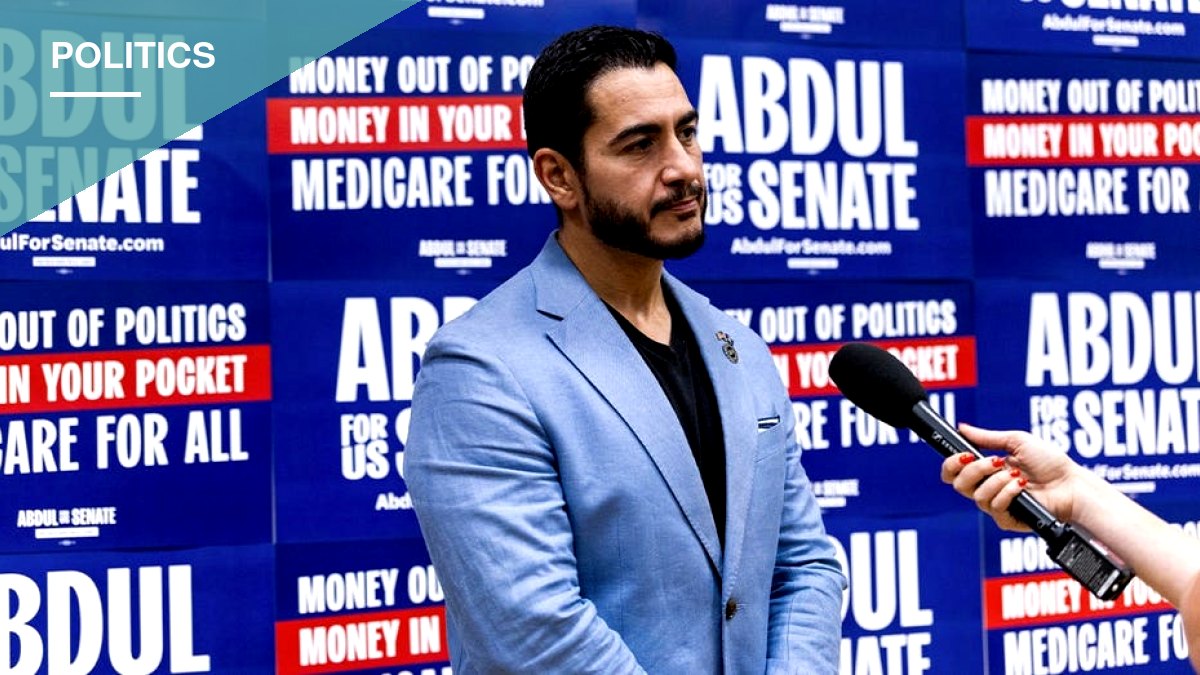
Michigan Democratic Senate nominee Abdul El-Sayed’s campaign has drawn fresh attention to a longstanding quirk of federal law: members of Congress are not required to go through the formal executive-branch security clearance process that applies to congressional staffers and many federal employees. Senators are generally considered eligible for access to classified information simply by virtue of holding elected office.
That rule would apply to El-Sayed if he wins his November race against Republican Mike Rogers, and it has become a point of contention among conservative critics who question his past associations.
Daniel Samet, a research fellow at the American Enterprise Institute, told Fox News Digital that El-Sayed’s ties to controversial figures should disqualify him from office. “Anyone refusing to disavow America-hater Hasan Piker should never be elected to Congress. El-Sayed will use his perch in the Senate to undermine America and empower its enemies,” Samet said.
Critics have pointed to several of El-Sayed’s public appearances and endorsements. In April, he was introduced at a campaign rally by Amir Makled, who has previously referred to deceased Hezbollah members as “martyr[s].” Months later, at a mosque opening, El-Sayed appeared onstage with Sheikh Fadhel al-Sahlani, a cleric who has praised Hamas’s Oct. 7 attack and made comments minimizing the Holocaust death toll. El-Sayed also accepted an endorsement from Osama Siblani, who has spoken favorably of both Hamas and Hezbollah.
El-Sayed’s relationship with Twitch streamer Hasan Piker, who once said America “deserved 9/11,” has also drawn scrutiny. El-Sayed has called that remark “dumb” and distanced himself from Piker without fully disavowing him.
Campaign Pushes Back on Rogers
El-Sayed’s campaign rejected the criticism and turned it back on his opponent. “Abdul’s running to keep Americans safe and bring down costs for Michigan families. Mike Rogers spent his entire career selling out Michigan, and has directly profited off shady business dealings with foreign companies,” campaign spokesperson Cole Wozniak said.
“Rogers made hundreds of thousands of dollars working for companies that partnered with Chinese firms posing ‘national security threats’ to the US, and worked for a Saudi-linked company that pushed for regulations that could have ‘enabled Saudi Arabia to develop nuclear weapons.’ Mike Rogers got rich selling out Michiganders and he can’t be trusted to keep us safe,” the statement continued.
The China reference points to Rogers’s telecommunications-industry work at companies with business ties to Huawei, a firm Rogers criticized while serving in the House. The Saudi Arabia reference concerns Rogers’s work for a Saudi-linked company that faced criticism over efforts to transfer nuclear energy technology to Saudi Arabia. The Rogers campaign did not respond to a request for comment.
Family Ties Also Cited
El-Sayed’s half-sister has faced criticism over a social media post described as an “October 7th blessing,” published on the first anniversary of the Hamas attack. El-Sayed has said that while he loves his sister, the two disagree on foreign policy, and his campaign has emphasized that no one speaks for him but himself.
Heritage Action government relations director Chip Wyatt argued the concerns run deeper than any one candidate. “His affiliation with communists like Hasan Piker who claimed America deserved 9/11 combined with repeated calls to abolish ICE compound these concerns. Senators handle sensitive intelligence with major national security implications; giving someone like El-Sayed access would put American lives at risk,” Wyatt said.
America First Works president Ashley Hayek said the issue extends to a broader slate of 2026 candidates aligned with groups such as the Democratic Socialists of America, the Working Families Party, UnidosUS, and the Party for Socialism and Liberation. “I think it’s a huge issue, and I don’t think it stops at just him,” Hayek said, noting that some of these groups receive funding tied to Neville Singham, whom a 2023 New York Times investigation identified as a major funder of a U.S. activist network with connections to pro-Beijing messaging.
Not Just Hypothetical, Says Legal Analyst
Bryce Poole, a senior legal fellow at Advancing American Freedom, said history shows the risks of a senator mishandling sensitive information are real, pointing to the case of former Sen. Robert Menendez. “It was not that long ago, it was 2024, when Robert Menendez was prosecuted and convicted for being a foreign agent of Egypt essentially and in 2025 I believe he was sentenced to 11 years,” Poole said. “Now, if I recall correctly none of this stuff that he actually shared with the Egyptians was alleged to have been classified, but it was still non-public information that was sensitive information that he only had access to by virtue of his office as a senator. So it’s not that this is just a hypothetical problem.”

