

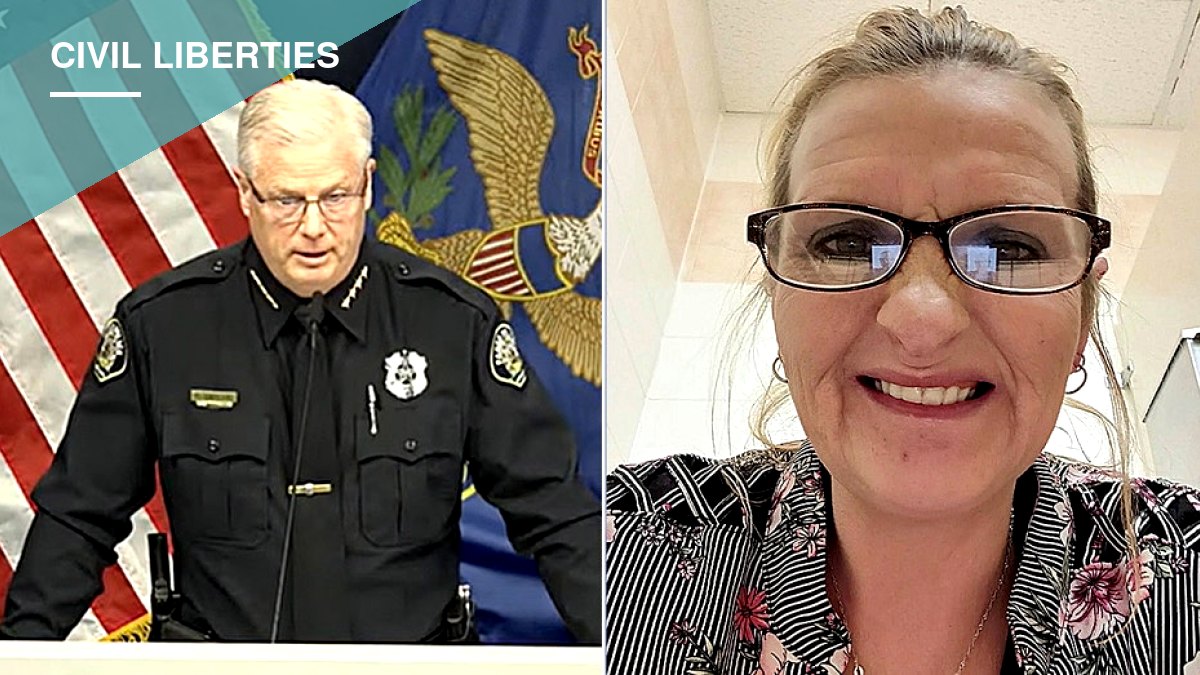
A 50-year-old Tennessee woman is suing a North Dakota city and its police department, alleging she was wrongfully arrested and held for nearly six months after officers relied on a flawed artificial intelligence facial recognition match to tie her to a bank fraud scheme she had no part in.
Angela Lipps of Elizabethton, Tennessee, was watching her neighbor’s four young children in July 2025 when U.S. Marshals surrounded the house and arrested her at gunpoint on a nationwide warrant, according to the lawsuit filed Sept. 15, 2026. She was extradited to North Dakota and held on a $100,000 bond facing eight felony counts, the most serious carrying up to 10 years in prison.
“I sat in a county jail in Tennessee for 108 days,” Lipps wrote in a GoFundMe post. “They said I was fugitive from justice. I had no bail. No one interviewed me. I just sat and waited.”
The Underlying Crime
The case traces back to April and May 2025, when an unidentified woman allegedly used fake IDs and stolen identities to commit bank fraud in Fargo and West Fargo, North Dakota. Rather than using surveillance footage, investigators ran a photo from a fraudulent ID card through Clearview AI’s facial recognition system, according to the lawsuit.
Clearview AI requires that any match be treated only as an investigative lead, not confirmation of identity. But the lawsuit alleges Fargo police presented the AI match as a positive identification without disclosing that it had never been independently verified. The West Fargo Police Department, notably, declined to pursue charges for that reason, and a West Fargo police captain reportedly described AI facial recognition as “close to a last-ditch effort” in investigations.
Evidence Allegedly Ignored
According to the complaint, Detective Lucas Heck never reviewed Lipps’ financial or travel records, which showed she was in Tennessee at the time of the thefts, and never arranged photo lineups with bank tellers who dealt with the suspect. Surveillance video reportedly showed a different build than Lipps and lacked the neck tattoo visible on her.
“Heck ignored, concealed, and misrepresented exculpatory evidence that Lipps did not commit the bank thefts,” the complaint alleges.
Prosecutors dismissed all charges on Dec. 24, 2025, after Lipps produced bank records proving she was in Tennessee during the thefts. By then, according to the lawsuit, she had lost her residence, car and personal property while detained.
City Acknowledges Errors
At a March 2026 press conference following public scrutiny, Fargo officials acknowledged investigative mistakes. “When chief found some errors that were made in this area of where we got our facial recognition and how that worked, we immediately addressed it,” Mayor Tim Mahoney said.
A Growing Pattern
Clare Garvie, deputy director of Technology Law & Policy with the Policing Project, told Fox News Digital that her organization is tracking at least 16 known wrongful arrests nationwide stemming from facial recognition misidentification.
“In many of these cases, it was because additional investigative steps weren’t taken to prove, or in these cases to disprove, the face recognition match,” Garvie said. “We’re asking officers to do a different job now, such that we need to update how we think about these workflows.”
Nate Freed-Wessler, a deputy director at the American Civil Liberties Union, said the problem is not new but is worsening. “We’ve been seeing these kinds of wrongful arrests happening for at least five or six years now out of this kind of AI technology. And the rate of them seems to be increasing,” he said, adding that in some cases “police intentionally avoid making any notes about their use of facial recognition technology or other AI.”
For Lipps, the consequences of an unverified computer match were measured in months behind bars, lost property and a fight in court that continues.

