

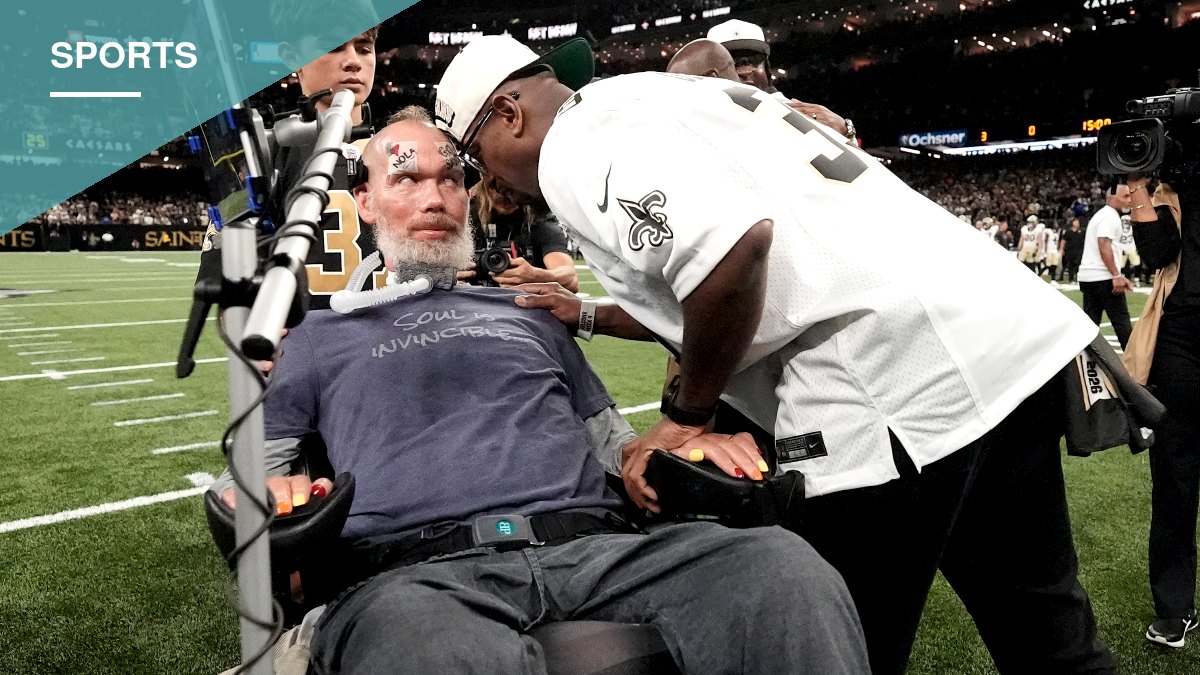
Steve Gleason, the former Saints safety whose blocked punt became a symbol of New Orleans’ recovery after Hurricane Katrina, returned to the Superdome on Monday for “Domecoming,” a ceremony marking 20 years since the team’s return to the stadium.
Gleason led a second line parade through downtown New Orleans ahead of the celebration, which preceded the Saints’ Monday Night Football matchup against the Atlanta Falcons. The Saints lost that game 45-24, but the night’s focus was on history rather than the scoreboard.
In 2006, Gleason’s blocked punt early in the Saints’ first home game back in the Superdome after Katrina led to a touchdown within the first two minutes of play. The moment, now known simply as “Rebirth,” became a lasting symbol of the city’s recovery after a storm that killed 1,300 people.
Gleason, now 49, cannot walk, talk, or breathe without assistance. He was diagnosed with ALS in 2011 and communicates using his eyes and a tablet. He arrived at the Superdome in his wheelchair rather than on foot.
“When I roll back into that stadium, I will not only be visiting a monument to 2006, I will be walking into a mirror, a place that learned how to rise,” Gleason told “Good Morning America” ahead of the game. “I had to learn the same thing. Twenty years later, I can’t wait to be in the room where that love still lives.”
The ALS Association estimates that only about 10% of people diagnosed with the disease live 10 or more years afterward. Gleason has used the time since his diagnosis to build Team Gleason, a charity that has raised more than $65 million to supply people living with ALS with technology, equipment, and support.
“If I do not block that punt, I am another former special teams player, a has-been football guy,” Gleason said. “When the ALS came, I probably fade away quietly and die anonymously. That play made me visible at the exact moment this city needed a symbol. Years later, that visibility became a lifeline.”
Gleason said the relationship between his most famous play and his life since has become impossible to separate.
“The truth I have to live with is this: The same play that helped New Orleans breathe again is a big reason I’m still breathing now,” Gleason said.

