
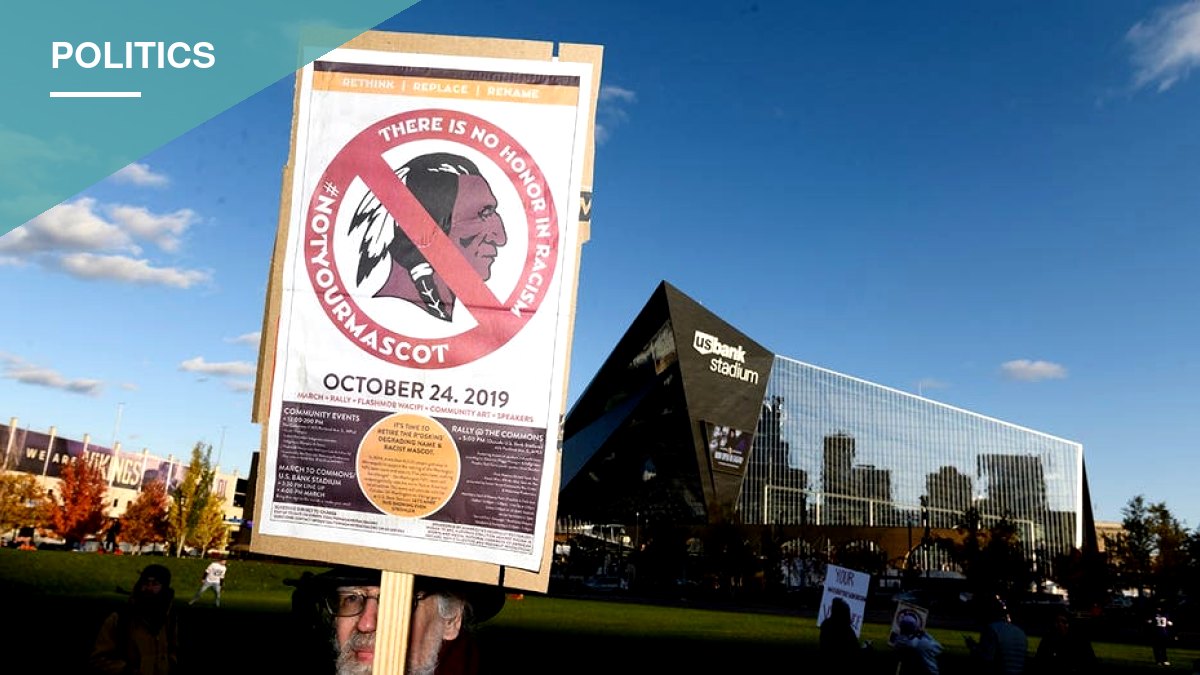
An economist who has studied Native American economic conditions for half a century says the push to retire the Washington Redskins name in 2020 missed the actual problem facing tribal communities: a federal law that still labels Native Americans incompetent until the government says otherwise.
Terry Anderson, an economist with the Hoover Institution, points to the Burke Act of 1906, which allows the secretary of the interior to grant a Native American full ownership of allotted trust land only after determining the individual is “competent and capable of managing his or her affairs.”
“That’s the most insulting thing, I think, you could say to them,” Anderson said.
Much reservation land remains held in federal trust, which Anderson says makes it harder for Native Americans to sell property or use it as collateral for loans to start businesses. He argues this lack of economic freedom, not a football team’s nickname, underlies the hardships many Native Americans face.
Those hardships are stark. Native Americans have the lowest life expectancy, the highest suicide rate, the highest rate of alcohol-induced deaths and the lowest on-time high school graduation rate among the nation’s major racial and ethnic groups, and their poverty rate ranks among the highest. Anderson notes several of these measures have worsened, not improved, since the Redskins name was dropped in 2020.
“The point is not what we call them. It’s how we treat them,” Anderson said. “The activists don’t want to change the way we treat them, but they want to change how we refer to them.”
A Lesson in Montana
Anderson traces his focus on this issue to 1976, when he brought Swiss visitors to meet a member of the Confederated Salish and Kootenai Tribes in western Montana. Expecting rundown conditions, the group instead found a well-kept home near the Mission Mountains, cattle grazing in tall grass, and a library inside.
When Anderson asked the homeowner how he explained his prosperity, the man answered simply: “I own this place.” Pressed further, he repeated the same four words. The exchange prompted Anderson to begin studying land productivity and income on reservations, work that has shaped his career since.
He now cites the Southern Ute tribe in Colorado as an example of what greater economic control can produce. The tribe has developed its natural resources, diversified its investments, and reinvested in its community. Anderson said tribes that gain more economic independence often begin using their native languages more as well, suggesting economic freedom can support cultural preservation rather than undermine it.
Despite that example, Anderson says broad change has been slow. “Hardly anything has changed on most reservations,” he said.
“We Are Competent and Capable”
Anderson also pushed back on the idea that reservations represent an act of American generosity, noting Native Americans built thriving economies long before European settlement. He said he sees some of the same impulse in activism around the Redskins name as in the reservation system itself — a desire by others to feel good rather than to change outcomes for Native Americans.
“It is a way to say, now I’ve cleansed my sins, and I can go on not feeling like I was a bad person or I came from bad people,” Anderson said.
Each year, the Hoover Institution holds a seminar for Indigenous students, many of whom arrive discouraged about their prospects, according to Anderson. At the close of this past summer’s seminar, he had the students repeat a phrase together: “We are competent and capable.”