

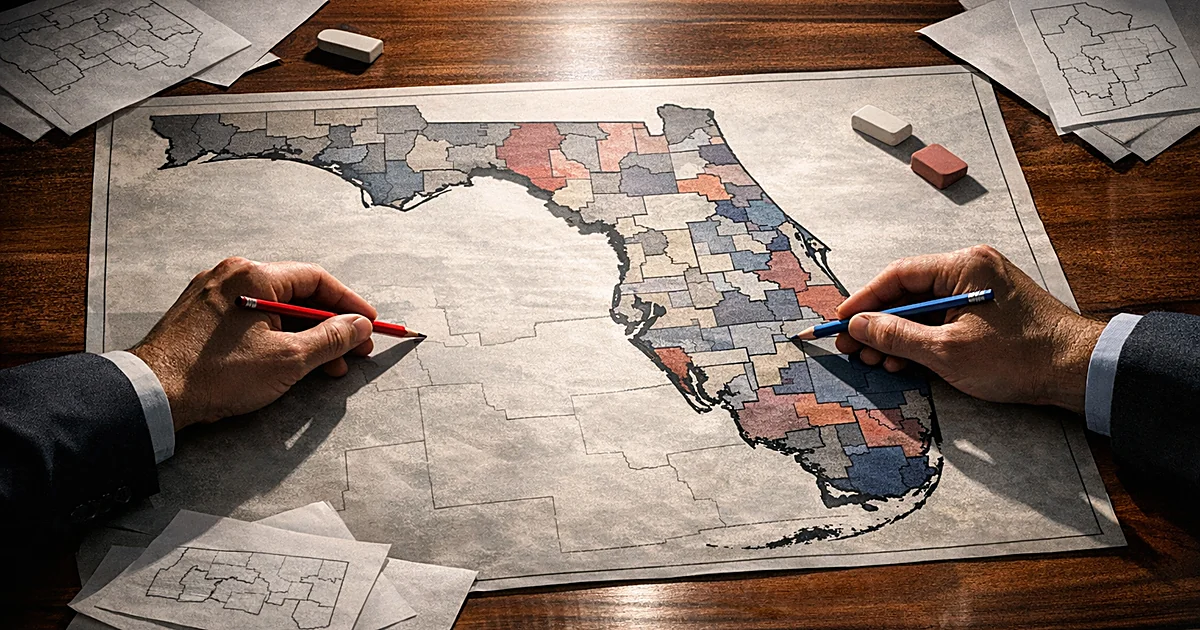
House Minority Leader Hakeem Jeffries seized on a narrow Florida special election win to threaten a redistricting fight, turning a local result into a national story and pinning his warning at Governor Ron DeSantis ahead of a planned special legislative session.
In a Palm Beach County state House race, Democrat Emily Gregory beat Republican Jon Maples by 2.2 percentage points in a district that includes Mar-a-Lago, with Decision Desk HQ providing the initial count. The loss carries symbolic weight because President Trump reportedly carried the area by double digits in 2024, but the race was a low-turnout, localized contest. Republicans had backed Maples and now face a new talking point from Democrats ahead of a high-stakes season.
Jeffries moved quickly, using the result to frame redistricting as a political threat and to aim pressure directly at DeSantis as Florida prepares for a special session focused on congressional maps next month. He posted on X and doubled down on the narrative that redrawing lines would energize Democratic voters. That approach is raw politics: claim a small win as evidence of a broader trend and try to shape the next fight.
“Democrats FLIPPED a state House seat in Palm Beach that Trump won by 11 points in 2024. Mar-a-Lago will now be represented by Emily Gregory, a strong Democratic voice.”
“We will crush House Republicans in November if DeSantis tries to gerrymander the Florida congressional map.”
Those posts come from the leader of a caucus that still faces a 20-8 shortfall in Florida’s U.S. House delegation, a clear structural disadvantage at the federal level. Reports say Republicans are looking to add as many as five seats through redistricting before the 2026 midterms, which explains the urgency on both sides. For GOP lawmakers, the session is an opportunity to align maps with shifting demographics and secure representation for a growing state.
One special election, especially in a district with unique local dynamics, makes for weak evidence of a statewide wave, and that reality is easy to miss when a national leader seizes a headline. Special election turnout is small and variable, and local issues often dominate results in ways that have little bearing on broader map fights. Still, Jeffries is consistent: he spots any opening and uses it to frame redistricting as a crisis for Republicans.
The redistricting fight in Florida is part of a larger pattern around the country where states have moved off the traditional once-a-decade cadence for revising congressional lines. Texas redrew maps in a way that favored Republicans and prompted Democratic-led states to respond, and the momentum has pushed map changes into a broader political arms race. DeSantis now wants Florida to take its turn at reshaping districts, and opponents are primed to make political hay from the process.
Some parties and groups have already questioned DeSantis’s authority to order a mid-cycle redraw, though reporting did not detail every challenger or the legal basis for their claims. Expect litigation and procedural fights as part of the mix; courts will likely be a central battleground after the legislature acts. Those legal questions will determine how far any new maps can go and how quickly they land on ballots for 2026.
Gregory’s 2.2-point margin is legitimate and meaningful to her district, but it is not a reliable national bellwether. Special elections are notorious for producing outlier results because of who shows up and what local issues are in play. Political operatives know how to turn a small win into momentum, but momentum built on a low-turnout special is fragile heading into a statewide or national contest.
Jeffries wants this story to read as a judgement on Republicans and a warning about mid-cycle map changes; that’s the playbook of opposition leaders when they see an opportunity. Still, a single state House flip does not erase a 20-8 congressional delegation gap or the practical power Republicans hold in Tallahassee today. The legal fight over maps and the political consequences in 2026 will depend on what actually happens in the legislature and in courtrooms, not just on social posts.
Democrats point to a couple of recent special election pickups as proof of shifting tides, and Republicans interpret the same results differently, as typical mid-cycle volatility or backlash against the party in power. Past special elections have punished incumbents or governing parties during moments of turbulence without predicting long-term trends. That split in readings is exactly why both sides will lean hard into the narrative that benefits them.
Gov. DeSantis called the special session to tackle congressional lines while Republicans control the governor’s office and hold supermajorities in the state legislature, so the mechanics of redrawing maps are in GOP hands. If lawmakers produce maps that reflect the state’s political distribution and survive legal scrutiny, the practical effect could be to entrench Republican gains. Conversely, if the process looks partisan or overreaching, it could energize Democratic turnout and spark prolonged litigation.
Jeffries’s “crush” rhetoric is designed to rally donors and motivate the Democratic base, and it will play well with national audiences watching the map fight. Whether that rhetoric changes outcomes depends on a sequence of events: what maps are proposed, how courts rule, and how voters react in 2026. Political threats are cheap; turning them into electoral reality is much harder and requires winning under whatever maps are in place.
What is clear is that both sides understand the stakes: control of lines means control of elections, and headlines can influence momentum but not legal authority. Republicans still hold the levers in Florida, and drawing maps that are fair and defensible is the immediate challenge for them. Threats are easy; winning elections on existing maps is the harder, unavoidable task.

