
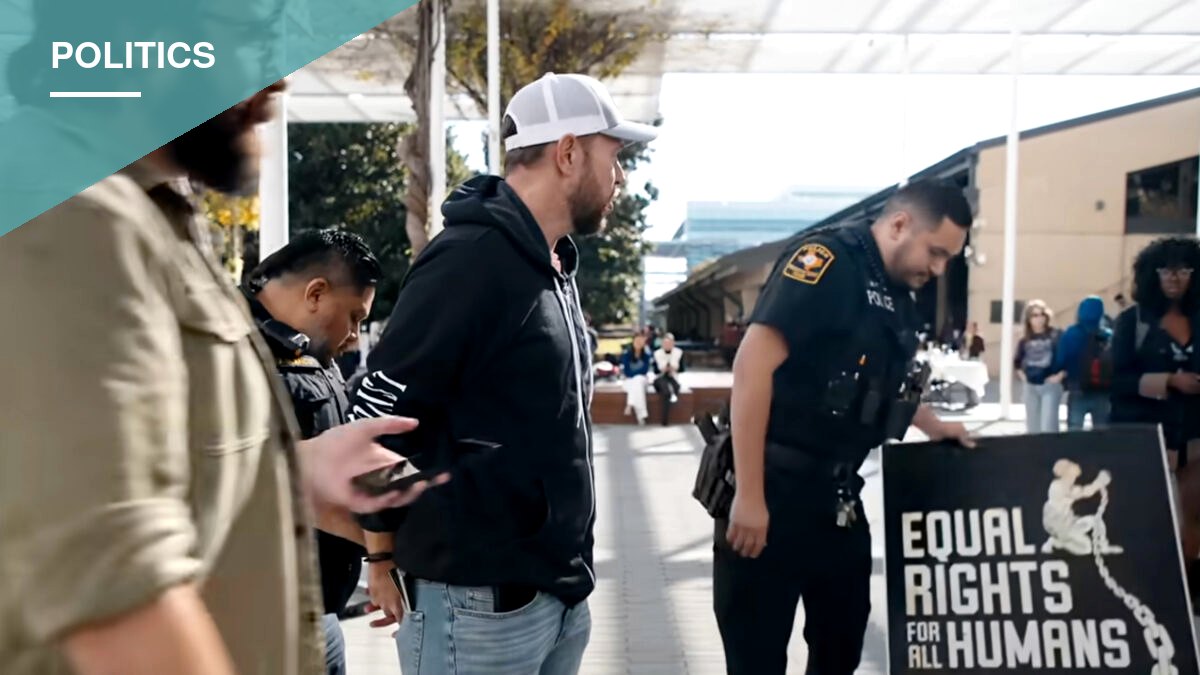
Campus police at the University of Texas at Dallas arrested an anti-abortion activist last week for speaking to people in an outdoor area of the Richardson campus, an incident that has drawn scrutiny to a new state law restricting who may speak freely on Texas public university grounds.
Abortion abolitionist T. Russell Hunter was arrested on November 18. In a videotaped statement afterward, Hunter said he spent the night in jail, referring to it as the “Richardson County jail” — though no such facility exists. He most likely was held overnight in the municipal jail in Richardson, Texas, which sits in Dallas County.
A university administrator identified in published reports as Tricia Losavio, associate dean of Health and Wellness Initiatives, reportedly told Hunter the campus is “not an open campus,” invoking the school’s speech and expression policy.
Five days after the arrest, basic facts remain unconfirmed. Requests for comment to Hunter, his attorney, the UT Dallas media relations office, and the university’s police chief have gone unanswered. A search of court records has not turned up any filing under Hunter’s name, leaving open the central question of whether charges have been or will be formally filed by prosecutors.
Defense attorney CJ Grisham has said on social media that he contacted university police with “a detailed explanation of why they should not file charges,” but has not disclosed any response from the department.
A New Legal Landscape
The arrest follows a significant shift in Texas law governing speech on public college campuses. Before 2025, the state treated all common outdoor areas at public campuses as traditional public forums open to anyone. That changed with Senate Bill 2972, signed by Governor Greg Abbott in 2025, which imposed new restrictions on the timing, manner, and location of campus demonstrations.
The law also narrowed who is allowed to engage in expressive activity on campus grounds at all, limiting it to enrolled students and university employees, while giving individual institutions discretion to set their own rules for speech by outside members of the public.
A federal judge has blocked enforcement of parts of SB 2972, and that ruling is now under appeal. However, the provision restricting expressive rights to students and employees has not been blocked and remains in effect.
UT Dallas’s own speech regulations reflect that framework. The policy states that “students, faculty, and staff have the right to peaceably assemble, to speak, and to attempt to attract the attention of others.” But it goes further for everyone else: “Members of the public may only engage in expressive activities in areas of campus that have been designated as traditional public forums by the Board of Regents. There are currently no areas that have been designated by the Board of Regents.”
In practical terms, that means no part of the UT Dallas campus is currently open to public speech from anyone who is not a student or employee — a restriction that did not exist under Texas law before last year.
It remains unclear whether prosecutors in Dallas County will pursue charges against Hunter. This story will be updated as more information becomes available.