

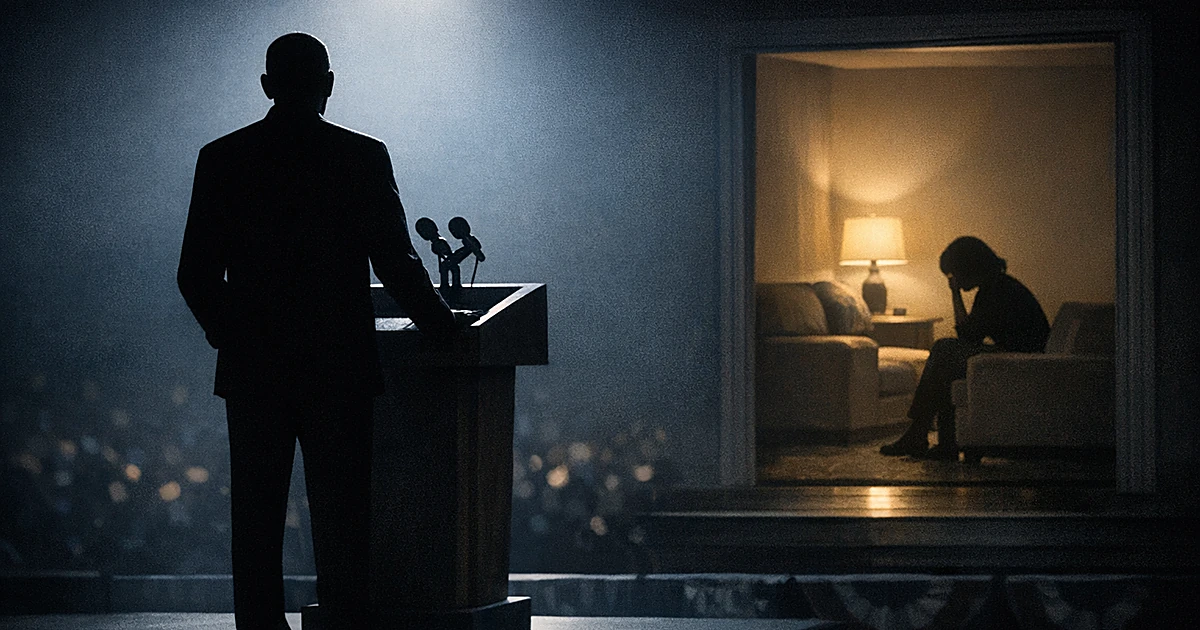
Barack Obama says he keeps stepping back into politics even though it strains his marriage, and the Democratic Party still looks to him as the stopgap face of its national brand.
Barack Obama told The New Yorker that Donald Trump’s return to the White House is the reason he cannot walk away from politics, and that his refusal to step back has strained his marriage to Michelle Obama. He described the friction plainly: his wife wants him home, and he keeps showing up on the campaign trail. That admission is striking coming from someone who’s long managed a careful public image.
He did not shy away from the cost. “It does create genuine tension in our household, and it frustrates her.” Saying the strain out loud makes the private consequences visible in a way the Obamas usually avoid. The fact that he frames it as both real and frustrating changes the usual scripted narrative.
Obama also framed his public life as a nearly constant obligation to his party, not a choice. “No other ex-president was the main surrogate for the party for four election cycles after they left office.” That line reads less like a complaint and more like a recognition that the Democrats rely on him because they have not produced a successor.
The evidence is easy to spot. Recent party posts and visuals reached back to images from his time in office while largely ignoring the most recent occupant of the White House. Choosing decade-old photos instead of highlighting current leaders sends a blunt message about talent development and messaging inside the party. It suggests the Democratic brand still runs through one man.
Rumors and tabloid chatter about the couple’s private life have come and gone, and the Obamas have pushed back on speculation in public. Still, his own words imply the strain is not theater. When a politician admits his political calling has created real marital tension, it matters—especially when the couple has said they expected a quieter phase as empty nesters.
Obama’s schedule underlines the point. He has campaigned on redistricting fights and high-profile races, and he keeps showing up in person for events meant to lift Democratic prospects. On a recent visit to a pre-K in New York, he read to children and joked about his age, saying, “So you’re going to have to all help me get up. Because I’m old.” The line landed as humor, but it also marked how long he has been on the stage.
He entered the White House at 47 and left at 55; at 64 he is still the party’s most familiar draw. Those years since the presidency have not been a retreat. They have been a steady stream of rallies, endorsements, and appearances that place him at the center of Democratic efforts nationwide. That persistence is part pride, part political muscle, and part necessity for a party that keeps turning to him.
Michelle Obama has talked about entering a new, quieter phase, but her husband’s calendar tells a different story. The tension between her expectations and his ongoing public life is as much about priorities as it is about the attention he continues to attract. For a Republican viewpoint, it looks like a party stuck in the past, leaning on nostalgia rather than cultivating fresh leaders.
Framing his activity as a response to Trump is convenient. It makes his involvement feel defensive rather than chosen. But the record shows he was heavily involved in 2018, 2020, 2022, and 2024, three of which came while Trump was out of office. That undermines the claim that his return to the arena is purely a reaction to a single rival.
The media fascination around the Obamas’ personal life fuels endless speculation, from wild theories online to hot takes about public appearances. Still, Obama seems to take it as a compliment that people want more from him. “The fact that people want me to be doing more is a good sign.” That satisfaction is understandable, but it raises a question about whether the personal price is worth the political gain.
The bigger issue may be institutional. A party that keeps dialing the same number every cycle is signaling a weakness, not strength. Obama’s presidential center and library are set to open in Chicago in June, a moment that could serve as a natural pivot toward legacy work. Whether he actually steps off the stage and lets someone else lead remains to be seen.

