

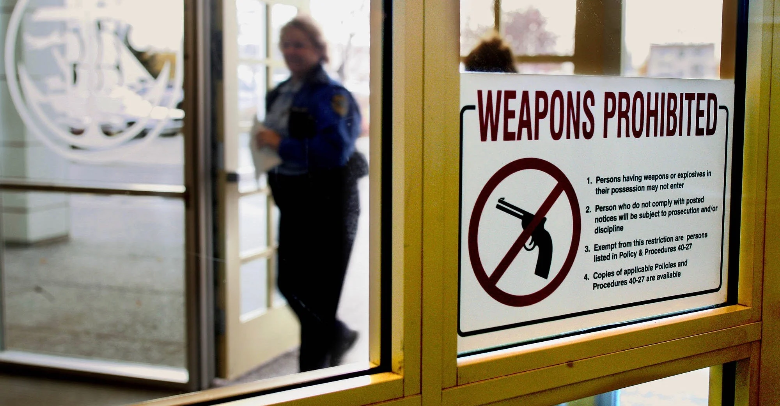
Gun rights advocates are now mounting a significant challenge to longstanding restrictions that classify U.S. post offices as gun-free zones. The Firearms Policy Coalition (FPC) and the Second Amendment Foundation (SAF) have filed a motion for summary judgment in federal court, contending that prohibiting licensed gun carriers from possessing firearms on postal property infringes on Second Amendment rights.
In their 22-page brief, SAF and its partners argue that the tradition of prohibiting firearms in post offices doesn’t align with historical norms or the intent of the Founding Fathers. The brief states, “The Founders did not bar carriage of firearms in Post Offices. Instead, they regulated the improper, threatening, and violent use of weapons in Post Offices.” According to SAF, the historic regulations focused more on preventing abuse of firearms rather than outright banning them on postal property.
Post offices, as public buildings open to citizens, shouldn’t be treated as “sensitive places” where law-abiding individuals must disarm themselves, says SAF founder and Executive Vice President Alan M. Gottlieb. “As we note in our brief, our proposed course of conduct—licensed carry on postal property—falls within the Second Amendment’s plain text,” Gottlieb stated, arguing that individuals should not have to “park their Second Amendment rights at the curb before stepping onto post office property.”
The lawsuit also notes that the gun-free designation for post offices is relatively new, originating from 1972. Contrary to popular belief, this restriction is not a longstanding federal policy tracing back to the founding of the U.S. Postal Service. Rather, it was established in an era of heightened concern over public safety, which critics say did not reflect the intent or practice of earlier American governance. SAF Executive Director Adam Kraut highlighted this point: “Millions of honest citizens visit post offices every day to conduct all kinds of legitimate business, and they should not be required to disarm themselves.”
The debate over gun-free zones was reshaped in 2022 when the Supreme Court ruled in New York State Rifle & Pistol Association v. Bruen. The ruling upheld certain firearm restrictions but noted that “sensitive places,” like courthouses, could merit gun-free status. In its reasoning, the court said such restrictions might apply in places where carrying a weapon could be considered particularly risky or threatening to public safety. Post offices, however, might not fall under the same category, argue gun rights groups, particularly given their role as central public spaces where Americans conduct everyday business.
In their argument, the plaintiffs highlight that while courthouses and similar sites may have legitimate claims to a sensitive status, post offices are different. Kraut stated that post offices “should not be considered sensitive places” under the same criteria as courthouses, given their public nature and the frequency of foot traffic from ordinary citizens. The plaintiffs’ brief argues that historical restrictions on firearms were primarily focused on preventing violence rather than imposing blanket bans on firearm possession in federal buildings.
Cam Edwards of Bearing Arms emphasized that these kinds of firearm restrictions did not exist during the early days of the postal service, echoing the SAF’s argument that such a ban conflicts with historical precedent. According to the lawsuit, it was only in the late 20th century that federal authorities imposed a blanket restriction on carrying firearms in post offices, with the current regulation taking effect in 1972. This relative recency, plaintiffs say, highlights the restriction’s inconsistency with America’s long history of allowing citizens to exercise their Second Amendment rights in public spaces.
The SAF and FPC’s case raises questions about the broad implications of designating places as gun-free zones. If the court rules in favor of the SAF and FPC, it could set a precedent affecting other federal properties with similar restrictions. For example, the designation of post offices as “sensitive” locations could be reevaluated, impacting rules surrounding other federally managed sites.
This challenge also speaks to a broader conversation about whether security concerns outweigh Second Amendment rights in specific public spaces. The SAF, for instance, sees the designation of post offices as gun-free zones as inconsistent with the principle of self-defense. In a statement, Gottlieb said, “Public spaces should be accessible to law-abiding individuals exercising their constitutional rights, and that includes the right to bear arms for personal protection.” Advocates argue that post offices are frequented by many citizens who have undergone training and possess licenses, making them responsible and legally permitted to carry firearms in most other public areas.
This case, if successful, could lead to a significant shift in how gun-free zones are regulated across the United States. If the court decides that post offices don’t meet the Supreme Court’s threshold of “sensitive places,” it could prompt challenges to other gun-free zones, including schools and certain government offices. A favorable ruling for the SAF and FPC could pave the way for licensed gun carriers to exercise their rights more freely across various federally managed sites, expanding Second Amendment rights to additional public spaces.
For now, the SAF and FPC’s legal challenge continues as they await a decision on their summary judgment motion. Both groups maintain that their goal is to restore Second Amendment rights within the bounds of the law, particularly in public spaces. As this case progresses, it promises to reignite the ongoing national debate surrounding the scope of the Second Amendment and the boundaries of government-imposed gun-free zones.


1 Comment
The “Right To Keep and Bear Arms” is not inferior to other rights. We don’t bar speech from Post Offices. We don’t bar voting from libraries. Why is lawful exercise of a right prohibited from anywhere ?