

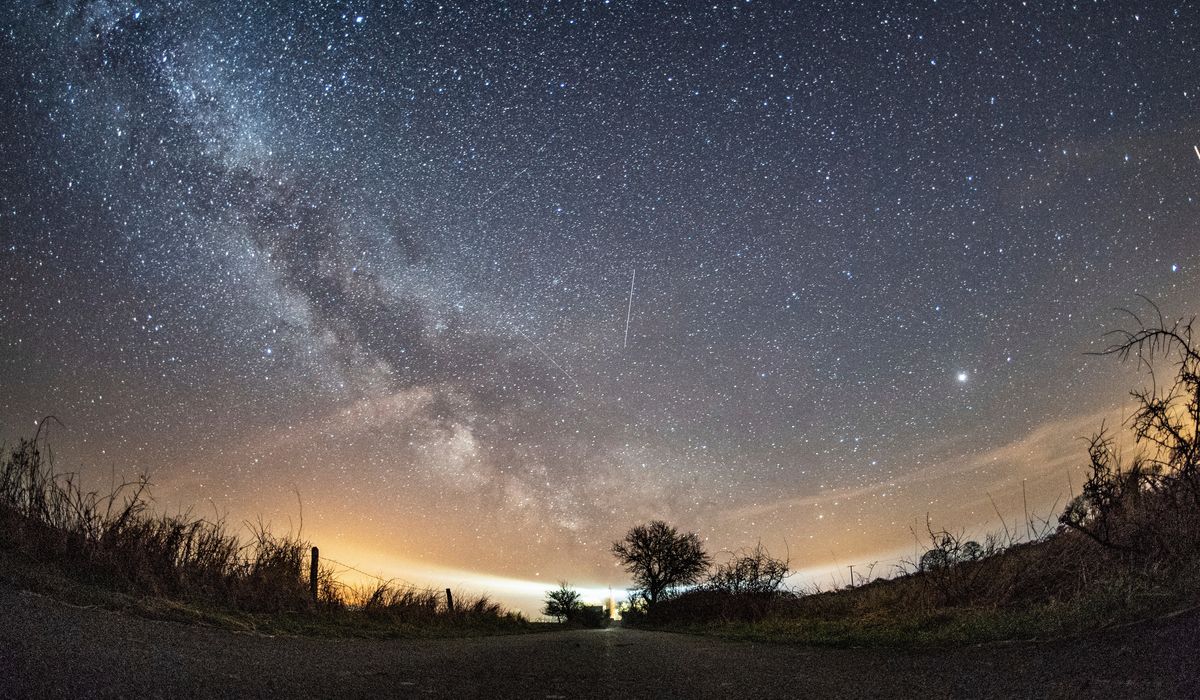
This year’s Lyrid meteor shower gets a boost from a dim crescent moon, and NASA expects roughly 10 to 20 shooting stars per hour moving across the spring sky.
The Lyrids are an annual spring event that often delivers crisp, quick meteors and the occasional bright streak. These meteors come from debris left behind by a long-period comet, and when Earth slices through that trail we see flashes as particles burn up in the upper atmosphere.
NASA’s estimate of 10 to 20 meteors per hour is a useful baseline, but actual counts depend on local sky conditions and exactly where you are in the dust stream. The moon’s phase matters: a faint crescent moon means less glare, so more of the fainter meteors that normally get washed out by moonlight can be visible.
The radiant point of the Lyrids lies in the constellation Lyra, near the bright star Vega, which helps observers know roughly where the streaks originate. Meteors will appear to radiate from that spot, but they can cross a large swath of sky and appear anywhere overhead, so scanning widely usually yields the best results.
Peak activity often lasts only a few hours, with the highest rates concentrated around the shower’s maximum. Viewing after local midnight through dawn tends to improve counts because the part of Earth you’re standing on is rotating into the meteor stream, increasing the number of particles you run into per hour.
Light pollution will cut down on how many meteors you can spot, so darker skies still give a big edge even when the moon is minimal. City observers can still see brighter Lyrids, including occasional fireballs, but they’ll miss many of the subtler streaks that make the shower feel busy under rural skies.
Simple preparation helps: allow your eyes about 20 to 30 minutes to adapt to the dark, face away from bright lights, and give your gaze room to wander across the sky. No telescope is needed since meteors flash across large angles too quickly for magnified views; a wide, unobstructed sky and a comfortable spot to lie back are the practical essentials.
Photographers often use wide-angle lenses and long exposures to capture multiple trails in a single frame, and the darker the sky the better those images come out. Expect randomness: some hours will produce few meteors, while others may surprise with clusters, bright trails, or persistent trains that linger briefly after a strike.
Beyond the spectacle, meteor showers like the Lyrids are a reminder of the ongoing interplay between Earth and the debris left by comets and asteroids. These brief, natural fireworks are a direct consequence of our planet’s orbit encountering tiny particles traveling at high speed, producing visible streaks when they vaporize in the atmosphere.

