

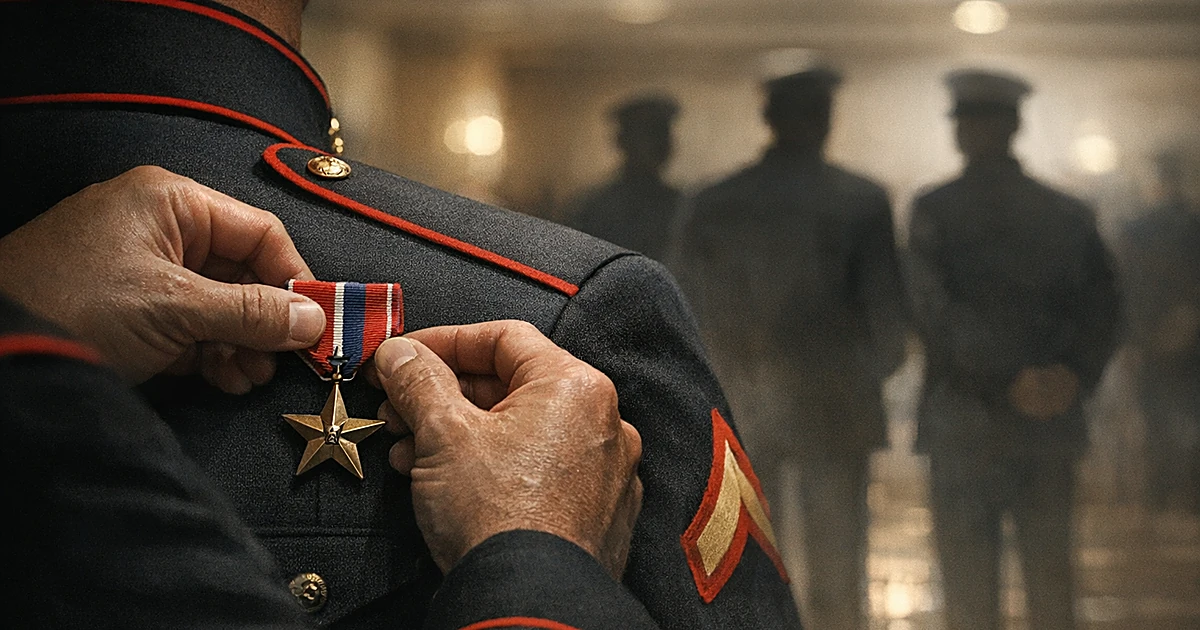
Pete Hegseth formally upgraded valor awards for three Marines wounded in the 2021 Abbey Gate bombing and used the ceremony to call out a five-year failure by Pentagon leadership to properly recognize their actions.
Secretary of War Pete Hegseth pinned Bronze Star Medals with “V” devices on Gunnery Sgt. Jonathan Eby and Lance Cpl. Jordan Houston, and awarded a Navy and Marine Corps Commendation Medal with a “V” device to Cpl. Michael Gretzon. The ceremony happened exactly five years after the ISIS-K suicide bombing at Hamid Karzai International Airport in Kabul that killed 13 American service members. Hegseth made clear he views the delay as a breakdown in institutional will rather than an oversight.
The presentation took place in the Hall of Heroes at the Pentagon in Arlington, Va., a setting meant for this exact kind of recognition. That it took half a decade to bring these Marines into that room was central to Hegseth’s point. He framed the delay as a symptom of a Pentagon that shielded itself instead of honoring those who served under fire.
“For half a decade, this building allowed bureaucratic caution, or maybe politics, to stand in the way of proper recognition.”
Hegseth followed that critique with a short, decisive promise about the future of awards and accountability. “Today, on this milestone anniversary, we declare that those days are over.” That line set the tone for remarks that tied medal upgrades to leadership responsibility.
Marine Corps Commandant Gen. Eric Smith described the Marines’ actions in blunt, direct terms that matched the moment. He detailed how Houston, Eby, and Gretzon kept fighting despite traumatic injuries and chaotic conditions. Gen. Smith offered an emotional assessment that captured the rare caliber of those men.
“I don’t know where we find such men, but I’m not sure we deserve them.”
Houston was about 32 feet from the suicide bomber when the device detonated and was knocked unconscious by the blast. He woke with shrapnel in his body, tended more seriously wounded Marines from an exposed position, and even removed shrapnel from himself before accepting care. His actions fit the military ideal of staying in the fight no matter the personal cost.
Eby, then a staff sergeant, was screening evacuees when the explosion took down his platoon commander and wounded or killed half his men. He assumed command on the spot, rallied the survivors, established security, and helped evacuate casualties. Eby’s citation states his actions “undoubtedly saved the lives of many.”
Gretzon suffered shrapnel to his arm and applied his own tourniquet, then returned to his squad after initial treatment until ordered to the casualty point. He refused to stop working even while injured, a refusal to quit that cost him time and comfort but saved focus in a chaotic scene. Each of the three Marines accepted recognition only after five years of institutional hesitation.
The secretary did not name the specific officials who downgraded the original award submissions, but he left little doubt about his view of why it happened. He accused prior leadership of choosing administrative convenience over proper recognition of frontline courage. That accusation tied the awards issue directly to political and cultural choices inside the Pentagon.
“For too long, leadership in this capital city failed to match that frontline courage with administrative backbone, inappropriately downgrading the original award submissions that these men rightfully deserved.”
“A military that downplays its frontline heroes to avoid uncomfortable political truths only projects weakness.”
Investigators on an Afghanistan withdrawal review panel also announced the recent recovery of classified documents they called “highly relevant” to the Abbey Gate attack and the broader withdrawal. The panel chair said those files should have been disclosed and were instead “stashed and hidden away in safes where they would not be found,” and he added a pointed line about their concealment.
“It became clear why someone tried to hide them.”
Officials have not publicly identified who concealed the documents or revealed their contents, which remain classified. The War Department expects a full Afghanistan review report by the end of the year, and those unrevealed records now hang over that work. If records were deliberately hidden, that concealment becomes part of the story about accountability and choices during the withdrawal.
The ceremony began by anchoring itself to the dead, honoring the 13 service members who died at Abbey Gate. “Today our hearts remain anchored to the memory of the 13 warriors who gave their last measure of devotion on August 26th of 2021,” he said.
Those 13 were Marine Staff Sgt. Darin T. Hoover, Marine Sgt. Johanny Rosario Pichardo, Marine Sgt. Nicole L. Gee, Marine Cpl. Hunter Lopez, Marine Cpl. Daegan W. Page, Marine Cpl. Humberto A. Sanchez, Marine Lance Cpl. David L. Espinoza, Marine Lance Cpl. Jared M. Schmitz, Marine Lance Cpl. Rylee J. McCollum, Marine Lance Cpl. Dylan R. Merola, Marine Lance Cpl. Kareem M. Nikoui, Navy Corpsman Maxton W. Soviak, and Army Staff Sgt. Ryan C. Knauss. Family members later attended public honors, but the survivors waited years for the medals they earned in combat.
Political opponents have targeted Hegseth on various fronts since he took office, but this event underlined a contrast between public recognition of valor and prior institutional choices. Hegseth closed by speaking directly to the three Marines, giving them an official, public affirmation after five years of delay.
“Marines, on this fifth anniversary, your valor is now officially, permanently and properly recognized. You represent the very heart of peace through strength.”
The moment put a spotlight on how awards and records matter in the larger narrative about the Afghanistan withdrawal and Pentagon priorities. When bureaucracies delay the simple act of honoring bravery, the issue looks less like clerical error and more like a statement about priorities and leadership.

