

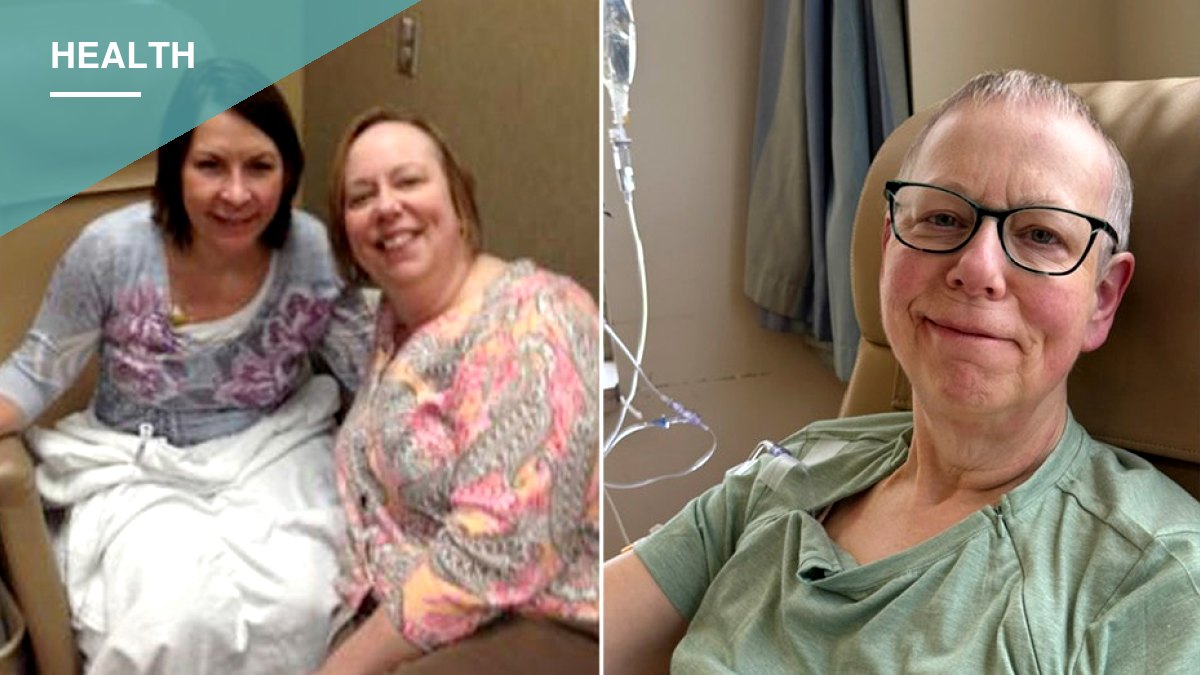
Becky Drexler, of Minnesota, was diagnosed with stage 3B ovarian cancer in July 2018, less than a year after her best friend, Connie Dahl, died from the same disease.
Drexler, now 65, had stood by Dahl through her illness after Dahl was diagnosed with stage 4 ovarian cancer in April 2015 at age 51. Dahl died in September 2017. While supporting her friend, Drexler began volunteering with the Minnesota Ovarian Cancer Alliance (MOCA).
Drexler had retired in 2017 and was planning to travel, garden and spend more time with family when her own symptoms began — frequent urination, constipation, bloating and hip pain. Like Dahl, she initially dismissed the signs as ordinary aging.
“By early summer, I felt I was getting signs from Connie to nudge me along,” Drexler wrote in an essay sent to Fox News Digital. “Dragonflies represent Connie to me since she passed, and I saw them everywhere. I recall one afternoon being on my patio thinking, ‘Should I go see the doctor?’ when a couple dragonflies in my flower garden just wouldn’t leave me alone. I said out loud, ‘OK, Connie, I’ll go in and talk to the doctor.'”
On her 57th birthday, Drexler’s doctor called to say a CT scan had found masses on both ovaries. She had surgery four days later and underwent six rounds of chemotherapy — carboplatin and taxol — from September 2018 to January 2019.
“Those months were difficult but also filled with the support, love and laughter of family, friends, care team and MOCA,” she said. “I knew Connie was part of my team as well — just in a different way.”
A Recurring Fight
The cancer returned in August 2020, prompting surgery to remove a new tumor from her pelvic area. After weighing options with her oncologist, Drexler chose targeted radiation, completed in January 2021, after which she was again considered to have no evidence of disease.
She then began taking Lynparza, a PARP inhibitor maintenance drug. “Something that was not even available for ovarian cancer patients when Connie was dealing with her cancer,” Drexler said. She remained cancer-free on that treatment from January 2021 until February 2026.
In winter 2026, new gastric symptoms led to a PET scan that found a tumor near her small intestine requiring surgery. It was confirmed as a recurrence of her ovarian cancer. In May 2026 she began an 18-week course of carboplatin, taxol and avastin, expected to finish at the end of September. A scan in late July showed the treatment working, with previously visible spots no longer detected and no new ones appearing.
Depending on her next PET scan, Drexler said her likely next step is an antibody drug conjugate maintenance plan, a recently approved targeted therapy she described as showing “exceptional results.”
Throughout her illness, Drexler has stayed active with MOCA, serving on its board, sitting on committees and reviewing grants for ovarian cancer research.
“It does make me think back to when Connie was dealing with her cancer and the treatments that were not available to her but are now available for me and other women,” Drexler said. “I believe I am still here because of the advancements in treatments. Developing a reliable early detection test for ovarian cancer remains one of the most critical research goals.”
Why Symptoms Are So Easy to Miss
Ovarian cancer has long been called the “silent killer” because women often don’t know they have it until it reaches an advanced stage, according to Brian M. Slomovitz, M.D., director of gynecologic oncology at Mount Sinai Medical Center in Miami Beach, Florida. About 75% of women are diagnosed at stage 3 or 4, he said.
Slomovitz noted that researchers now know the disease does produce symptoms, but they tend to be vague — stomach pain, bloating, an increase in abdominal girth, or clothes suddenly fitting tighter. Weight loss and decreased appetite can accompany these signs, and they can easily be mistaken for gastroenteritis or a bad meal. He advised that any symptom persisting or worsening over one to two weeks should prompt a doctor’s visit.
“The early symptoms both Connie and I had were vague, like they are for most women,” Drexler said. “They seem like normal things that we can excuse away — we are aging, we are just stressed, we just need to eat better or lose weight.” She urged women to “advocate for yourself” and, if diagnosed, to seek treatment from a gynecologic oncologist, who has specialized training in these cancers.
There is currently no recommended routine screening test for ovarian cancer in women at average risk, because available tests haven’t been shown to reliably catch the disease early enough to change outcomes, despite decades of research. When caught at stage 1, Slomovitz said, the cure rate approaches 90%.

