

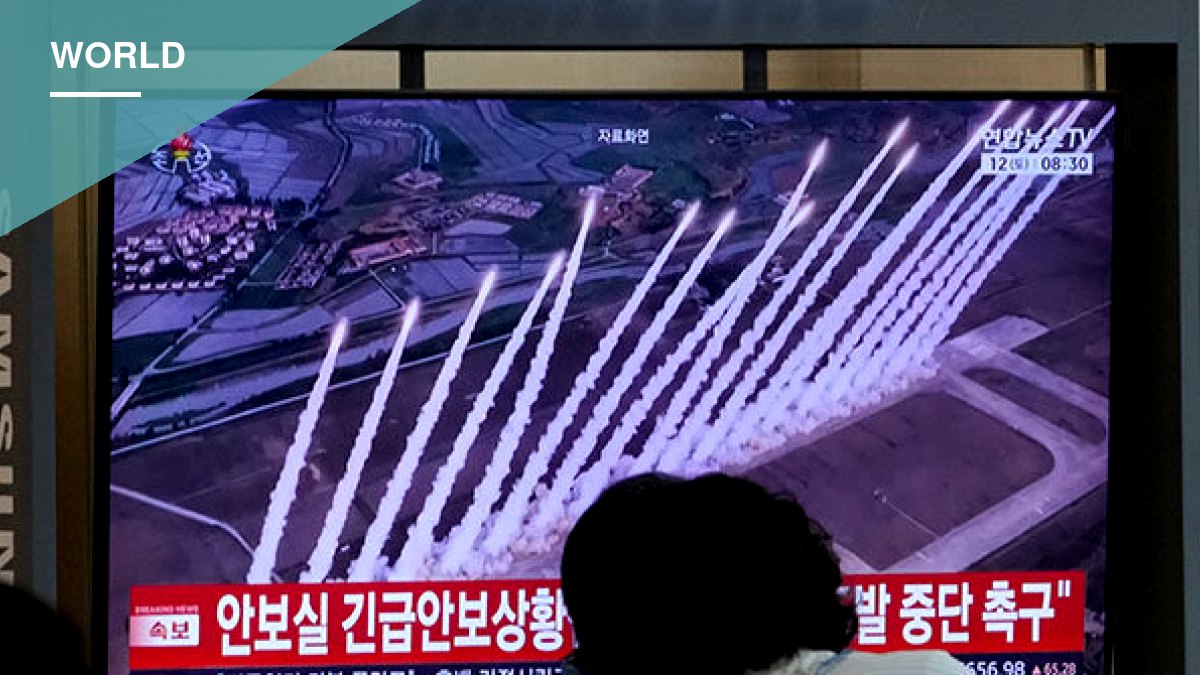
North Korea’s state media said Monday that the country conducted a “joint firepower attack drill” over the weekend involving missiles, drones, rocket launchers and artillery, describing it as a test of how newer weapons systems work together rather than a provocation aimed at any particular adversary.
The Korean Central News Agency (KCNA) reported that dictator Kim Jong-un did not attend the exercise, though the agency called it an important step for the military to practice using multiple weapons systems at once. The announcement came two days after the drill reportedly took place, a delay some South Korean observers read as a sign Pyongyang was trying to avoid inflaming tensions with Seoul or Washington.
KCNA offered little political framing, focusing instead on the hardware involved. “The drill involved new combat systems such as attack drones of various kinds, tactical cruise missile, large-caliber thermal-pressure multiple rocket launcher and tactical ballistic missile,” the agency reported. “All strike weapon systems demonstrated the huge destructive power of concentration fire by hitting the targets with 100 percent hit accuracy at a stroke, ensuring the unity and simultaneity of firepower attack.”
Military leaders overseeing the exercise said it was meant to ensure “the army does what it should do,” boost troop morale, and build experience with specialized weapons. KCNA said the broader objective of such drills is to “bring down the enemy’s armed forces organizationally and structurally once an order is issued.”
Timing raises questions about Russia’s role
South Korea’s Korea JoongAng Daily noted the drill’s proximity to Ulchi Freedom Shield, the annual joint U.S.-South Korean exercise that President Donald Trump recently said he would scale back. Analysts cited by the outlet suggested North Korea may have been demonstrating it could respond to a multi-country attack, while also trying to “manage” tension with Washington — evidenced by the low-key state media coverage and Kim’s absence.
Those analysts also pointed to the use of thermobaric weapons as a possible sign of Russian influence. North Korea and Russia signed a mutual defense pact in 2024, after which Kim sent troops to support Russia’s invasion of Ukraine, reportedly in exchange for assistance with North Korea’s own military technology. “With Russian forces having used thermobaric weapons in the war in Ukraine, it is speculated that North Korea may have drawn on Russia’s operational experience and battlefield lessons,” JoongAng reported.
Trump’s shift and Seoul’s response
The drill follows an August statement in which Trump said he would limit joint military exercises with South Korea, citing his relationship with Kim and North Korea’s recent restraint toward the United States.
“Based on my very good relationship with Kim Jong Un, of North Korea, I am not happy with the fact that the United States has, long ago, agreed to participate in Joint Military Exercises with South Korea,” Trump wrote on Truth Social. “These exercises are not only costly, with much of these costs paid for by the United States of America (as usual!), but send a signal that is totally inappropriate and hostile to a Country that, as long as Donald J. Trump has been President, has been unthreatening and respectful.”
In the same post, Trump criticized South Korean President Lee Jae-myung’s government for hesitating to help keep shipping lanes open in the Strait of Hormuz despite South Korea’s reliance on Middle Eastern oil. Kim did not respond directly, but his sister, senior official Kim Yo-jong, mocked South Korea’s dependence on the United States for its security while calling her brother’s rapport with Trump “excellent.”
Rather than issuing any warning over the weapons test, South Korea’s government said Tuesday it remains open to sending humanitarian aid to the North. The Unification Ministry said Seoul is prepared to deploy emergency medical equipment immediately if North Korea requests it, having already secured a United Nations sanctions waiver to allow such shipments. “It is a ‘ready to go’ approach in which sanctions and funding issues have been addressed in advance so that the assistance can be provided immediately if North Korea agrees to accept the medical equipment,” an unnamed South Korean official told Yonhap.
The United States has not commented publicly on the drill and has made no major statements on North Korea policy since Trump’s August announcement.

