

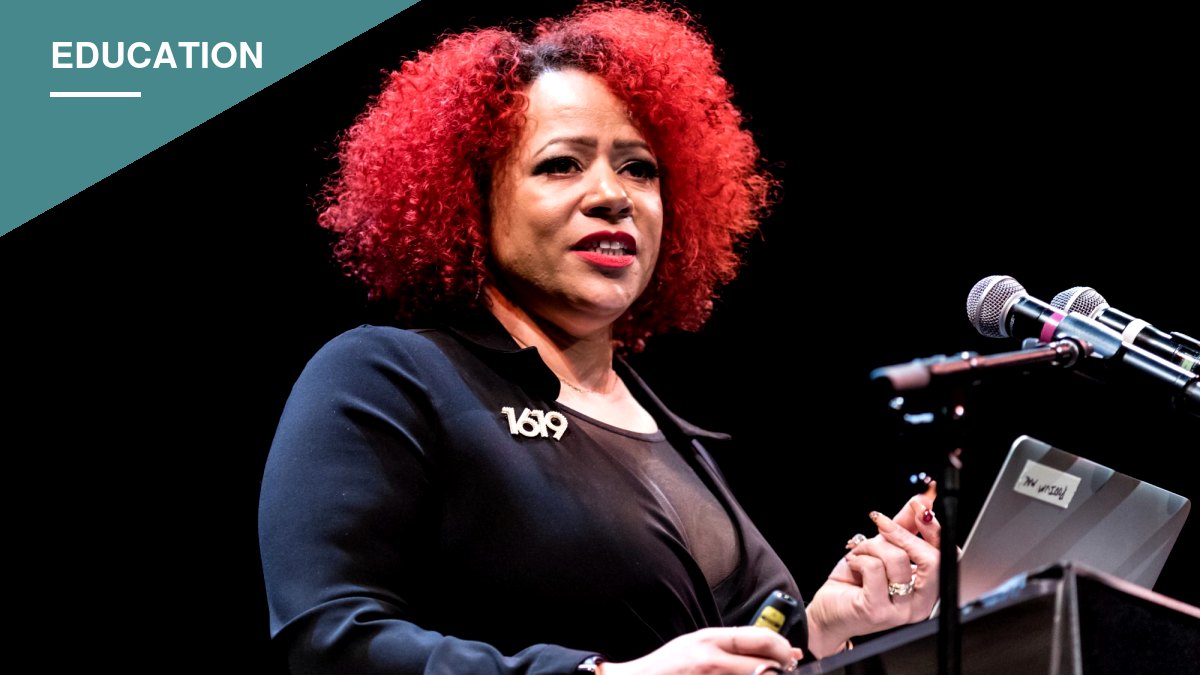
Nikole Hannah-Jones, the journalist behind The New York Times Magazine’s “1619 Project,” has published a personal essay describing how she and her husband, Faraji Hannah-Jones, enrolled their daughter in two struggling Brooklyn schools as part of what she calls her “fight for school equality for all Black children.”
In the essay, Hannah-Jones writes candidly about her daughter’s anger over the decision and acknowledges that the effort largely failed. She describes visiting her daughter’s high-poverty primary school and complaining about chaos in the lunchroom, and emailing administrators and teachers she believed were falling short. According to her own account, those efforts were often met with rejection or silence, and she accepted it.
Throughout the essay, Hannah-Jones attributes the schools’ shortcomings to what she calls “a system of inequality” originating “outside the school walls but… magnified within them,” and to a lack of resources. Critics note, however, that her daughter’s primary school reportedly spends roughly $52,000 per student — a figure that undercuts the resource-shortage explanation and points instead toward staff accountability.
Hannah-Jones has long been a vocal critic of standardized testing, arguing it is used to unfairly judge schools and students. Her essay recounts that she did not review her daughter’s homework closely until it was late in the process, at which point she found it “rife with errors that teachers had never bothered to correct.”
During the years covered in the essay, Faraji Hannah-Jones rose through the New York City school system’s parent-leadership structure, eventually serving on the Panel on Educational Policy, the body that oversees the city’s Department of Education. Faraji Hannah-Jones has defended the couple’s decisions, comparing his wife to Dr. Martin Luther King Jr. as one of the rare “individuals who stood up” for disadvantaged children.
The essay describes a turning point: it was only after their daughter herself pushed for change that she was admitted to a top high school, at which point her parents arranged tutoring to help her catch up.
Hannah-Jones writes of grappling with what she calls the “unearned valor of people commending me for the strength of my choice” — language that suggests she is still working through whether the decision was the right one.
The essay has drawn criticism from commentators who argue that Hannah-Jones’s account illustrates the costs of prioritizing ideological commitments over a child’s individual educational needs, and who point to her past criticism of school choice programs, including public charter schools, as inconsistent with the outcome she now describes in her own family.

