
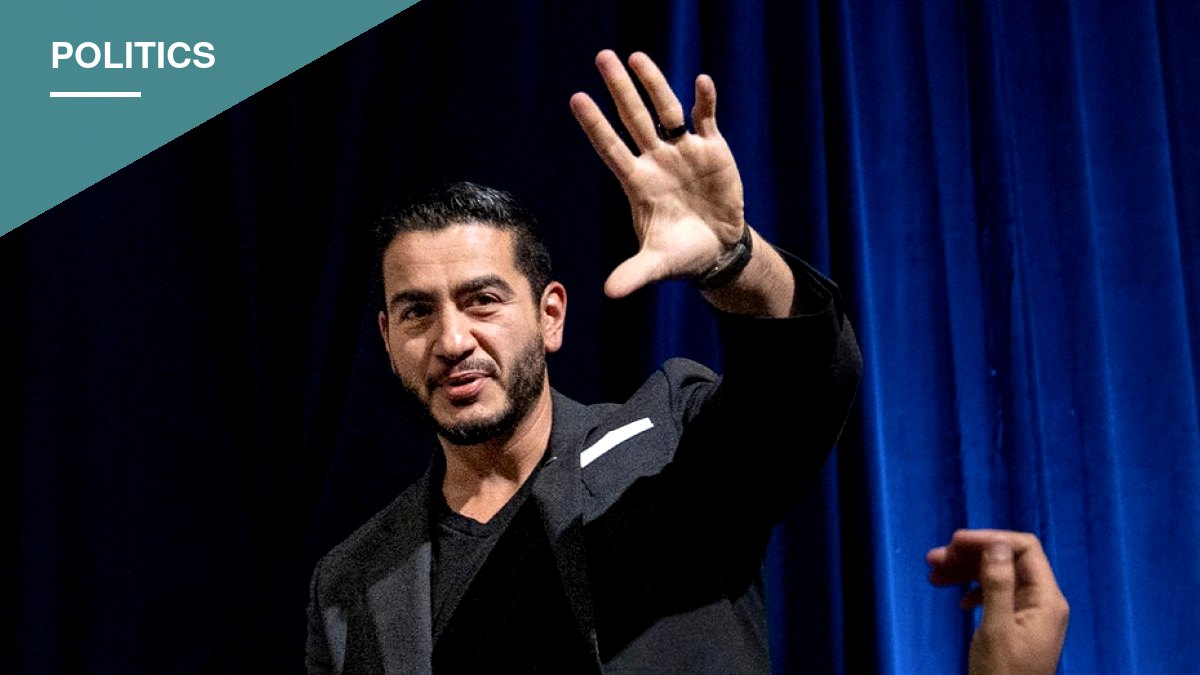
With Michigan’s Senate election set for Tuesday, Nov. 3, South Side Chicago pastor Corey Brooks has published a pointed critique of Democratic candidate Abdul El-Sayed, arguing that his outreach to Black voters in Detroit repeats a pattern Brooks says has failed Black communities for decades.
El-Sayed, a progressive candidate backed by Sen. Bernie Sanders and Rep. Alexandria Ocasio-Cortez, supports Medicare for All and abolishing ICE. He describes himself as a capitalist rather than a socialist, and the Democratic Socialists of America has not formally endorsed him. Brooks notes, however, that El-Sayed spoke at six DSA chapter events between 2017 and 2020, delivered the keynote at a 2019 DSA fundraiser, and has been described by socialist organizers as “a longtime friend of Detroit DSA.” Roughly 50 DSA members reportedly traveled from New York to canvass for him ahead of the primary.
After losing Detroit in the August primary, El-Sayed stepped up his engagement with Black voters, visiting churches, appearing alongside Black pastors, and releasing a policy agenda addressing housing timelines, minority business loans and school repairs.
In September, speaking to faith leaders in Detroit, El-Sayed said: “When it comes to Black communities in Michigan, when it comes to Black communities in America, there are unpaid debts that have long since come due that we are unwilling to acknowledge, let alone pay down.”
Brooks argues that language like this frames Black Americans as a dependent class rather than as citizens capable of self-reliance, and that he has heard this rhetorical approach from White liberals for 60 years. He contends that it causes real harm in the communities he serves through Project H.O.O.D., the organization he founded to provide job training and mentorship on Chicago’s South Side.
Brooks points to historical data in making his case: in 1963, 23.6% of Black children were born to unmarried mothers; by 2023, that figure had risen to 69%. He attributes part of that shift to Great Society-era programs, public housing policy and welfare rules he says discouraged marriage and work.
On the political affiliations swirling around El-Sayed’s allies, Brooks cites the DSA’s 2026 “Workers Deserve More” platform, which calls for abolishing the Senate and the Electoral College and replacing the presidency and Supreme Court with “an executive and judiciary chosen by and subordinate to Congress.” A 2021 DSA convention resolution stated the United States “has never been and will never be a force for liberation,” and Amy Wilhelm, a member of the DSA’s National Political Committee, has said the role of socialists is “to facilitate the defeat of our own nation.” El-Sayed has not signed on to that platform and has instead proposed ending the Senate filibuster.
Brooks also addresses allegations concerning El-Sayed’s family background. In 2012, El-Sayed’s half-sister wrote online about “an amazing talk with my mom about her activism in the Muslim Brotherhood during the early 70s while she was in college.” El-Sayed has said his family has no ties to the group, calling the post “hearsay evidence from a tweet.” Fact-checkers have found no evidence that El-Sayed himself has ties to the Muslim Brotherhood, and he has disavowed the group. Asked about it on “Meet the Press,” he said, “Why is this even a subject of debate?” At a town hall, when a voter asked him to disavow the group, he responded, “Sure, yeah, absolutely,” before adding, “You assume … that because I am Muslim, that somehow I would have some allegiance to something that is not our Constitution.”
Brooks concludes that El-Sayed’s campaign, in his view, relies on the same assumptions about Black communities and the same socialist-leaning policy instincts that have defined decades of liberal outreach, and he is urging Michigan voters to reject that approach at the ballot box Tuesday.