

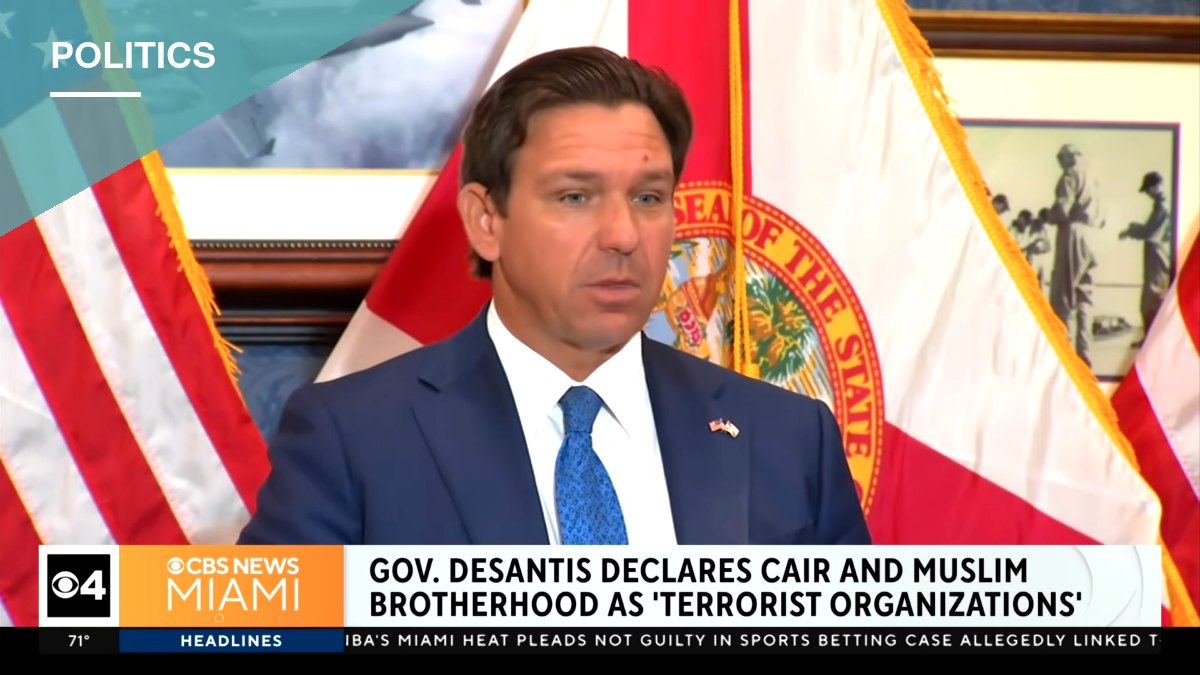
The Tampa office of the Council on American-Islamic Relations (CAIR) closed this week after Florida’s designation of the organization as a terrorist group took legal effect. Staff posted an orange notice on the office doors Thursday announcing the shutdown, while also criticizing Gov. Ron DeSantis and invoking free speech protections.
The closure caps nearly a year of legal fighting between CAIR and the state of Florida. In December 2025, DeSantis issued an executive order designating CAIR a terrorist organization, following similar moves by Texas and the United Arab Emirates. CAIR and its Florida affiliate sued, arguing the order violated free speech and due process rights.
A federal judge moved to block the order in spring 2026, but Florida’s legislature responded by passing a law codifying the governor’s authority to issue such designations. CAIR filed suit again. By October 2026, DeSantis had reaffirmed the designation, a court had dismissed CAIR’s lawsuit, and the designation took effect this week. CAIR has said it plans to appeal.
Texas took a parallel step in November 2025, when Gov. Greg Abbott named CAIR and the Muslim Brotherhood “foreign terrorist organizations and transnational criminal organizations” and restricted their ability to purchase property in the state.
“The Muslim Brotherhood and CAIR have long made their goals clear: to forcibly impose Sharia law and establish Islam’s ‘mastership of the world,'” Abbott said at the time.
Origins Tied to 1993 Meeting
Testimony presented to the U.S. Senate in 2026 by Lara Burns, a senior research fellow on extremism at George Washington University, traced CAIR’s founding to a 1993 FBI-recorded meeting in Philadelphia. According to Burns, attendees connected to the U.S. Muslim Brotherhood’s Palestine Committee, the Texas-based Holy Land Foundation — later convicted of providing material support to Hamas — and the Islamic Association for Palestine (IAP) discussed creating a front group to shield other organizations from scrutiny by the U.S. government and media.
Burns testified that documents from the Holy Land Foundation trial showed that organization became CAIR, established by two IAP leaders who attended the Philadelphia meeting: Omar Ahmad and Nihad Awad. Awad remains CAIR’s executive director today.
In 2014, the UAE designated CAIR a terrorist group, placing it alongside al-Qaida and the Islamic State in that country’s classification. Fox News reported at the time that despite CAIR’s links to Hamas, the organization had held hundreds of meetings with White House officials and sought to present itself as a mainstream Muslim organization.
Funding Questions
CAIR has long said it does not accept foreign funding, but reporting in July 2026 revealed the organization received $7.7 million from the Islamic Development Bank (ISDB) as part of a $30 million project dating to 2013 for “CAIR Plaza” in Washington, D.C. The Middle East Forum has reported that ISDB has long faced accusations of serving as a financing vehicle for Islamism, and the Foundation for Defense of Democracies has described it as a multilateral bank in which Iran holds a seven percent voting share, with credible allegations of corruption, money laundering cover-ups, and assistance to Iran and Hezbollah in evading U.S. sanctions.
A separate George Washington University extremism study, titled “The Long Game,” outlines what researchers describe as a CAIR plan to influence K-12 schools in the United States.
With CAIR’s Tampa office now closed and its legal challenges exhausted at the state level in Florida, the designation stands as a model other states may look to as they weigh their own scrutiny of the organization’s funding, leadership history, and stated goals.

