

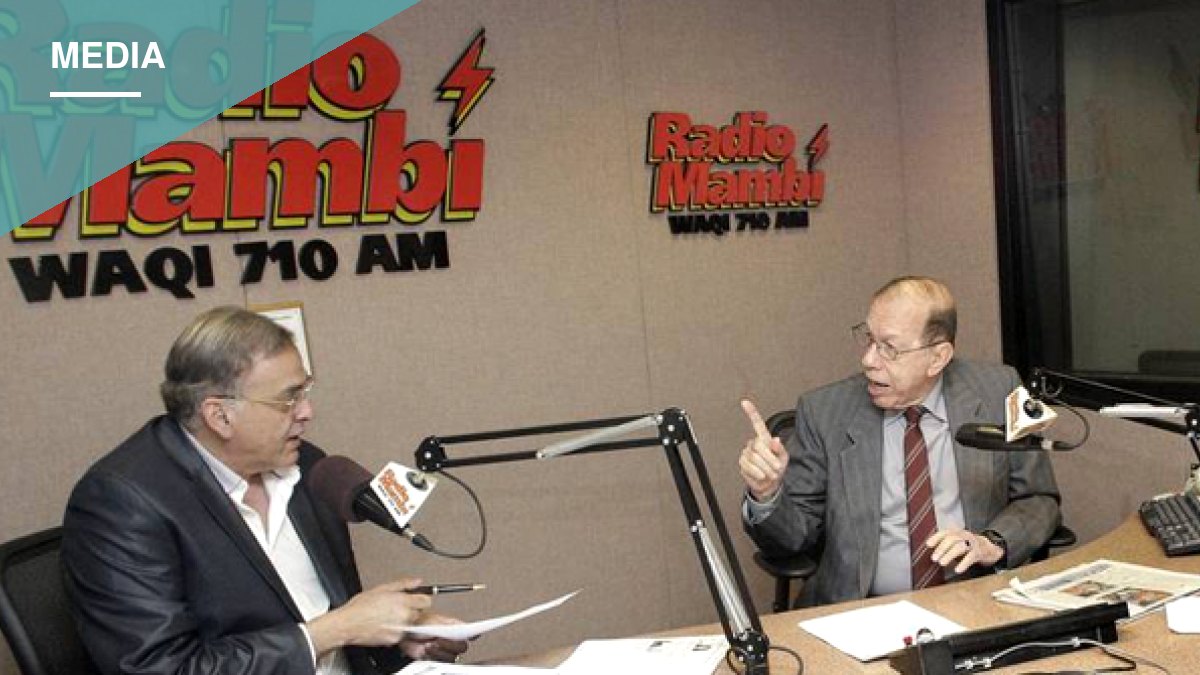
Newsmax has purchased two storied Miami Spanish-language radio stations, WAQI Radio Mambí and WQBA, from Latino Media Network, the organization whose 2022 takeover of a slate of Hispanic-market stations touched off protests across South Florida’s Cuban-American community.
Newsmax confirmed the deal Monday after radio industry outlets reported it over the weekend. FCC filings reviewed by Radio Insight show Newsmax Radio LLC is paying $1.26 million for WAQI and $540,000 for WQBA — a fraction of what Latino Media Network paid when it acquired both stations as part of an 18-station, $60 million package in 2022.
Radio Mambí was for decades a central platform for anti-communist talk radio aimed at Miami’s heavily Cuban and Cuban-American Spanish-speaking audience. Its 2022 sale prompted alarm among exile community leaders who feared the station’s political character would be watered down or silenced altogether.
Those fears were largely borne out. Much of Radio Mambí’s most recognizable talent left after the takeover, and while the station kept some limited original programming, reports indicated its owners had considered ending Spanish-language conservative talk entirely in 2025. WQBA fared worse, dropping original programming altogether last year in favor of simulcasting Radio Martí, the U.S. government-funded Cuban-American news service.
Newsmax, which produces radio content but has not previously owned stations outright, cast the purchase as a recommitment to that audience. In a Monday statement, the network called the deal “a significant investment in South Florida and a renewed commitment to serving one of America’s most vibrant and influential Hispanic communities.”
“Radio Mambí is an institution. For decades, it has been the voice of a community that understands the value of freedom because it has fought to preserve it. We are honored to continue that tradition and ensure Radio Mambí remains a trusted source of news, information, and conversation for generations to come,” said Newsmax CEO Chris Ruddy.
Newsmax said it intends to “restore and enhance” the stations and expand their reach so they become “part of the national conversation.”
A Contested Sale From the Start
Latino Media Network’s original 2022 acquisition made national news, largely because of who was behind it. The group was founded by Stephanie Valencia and Jess Morales Rocketto, both veterans of Democratic politics with ties to the Obama administration, and it raised roughly $80 million for the purchases from backers including Lakestar Finance, a fund reported to be affiliated with Soros Fund Management.
Many of the stations in that deal had previously belonged to Univisión-Televisa, whose leftward editorial tilt after a 2017 ownership change had already alienated parts of its audience. Latino Media Network’s arrival deepened those concerns.
In a 2022 interview with Florida public radio station WLRN-FM, Valencia framed the purchase as a response to “disinformation” in Spanish-language media.
“Latinos are constantly trying to navigate the ocean of information. In some cases that is disinformation, in some cases that is very one-sided communication. In the Latino community radio still plays such an important part, and in places like Florida it obviously plays a critically important part,” Valencia said.
Valencia indicated at the time that the stations would move toward what she described as “balanced journalism” — language that alarmed Cuban exile leaders who viewed Radio Mambí as a vital outlet for anti-communist advocacy.
Silvia Iriondo, head of Mothers Against Repression in Cuba, held a press conference denouncing the sale.
“Latino Media Network is a newly formed business venture led and controlled by social activists who espouse a leftist progressive ‘woke’ political agenda. We have genuine grounded concerns over the silencing and marginalization of radio stations that have historically stood as voices of advocacy for freedom in Cuba and in denunciation of the crimes against humanity perpetrated by the Communist regime in our beloved island,” Iriondo said.
Florida Gov. Ron DeSantis also opposed the sale, running ads on the affected stations urging listeners against it. The FCC ultimately approved the transfer anyway, and the predicted talent losses and programming cuts followed.
With Newsmax now in control, listeners who mourned Radio Mambí’s diminished role will be watching to see whether the network follows through on restoring its original voice — or charts a different course entirely.

