
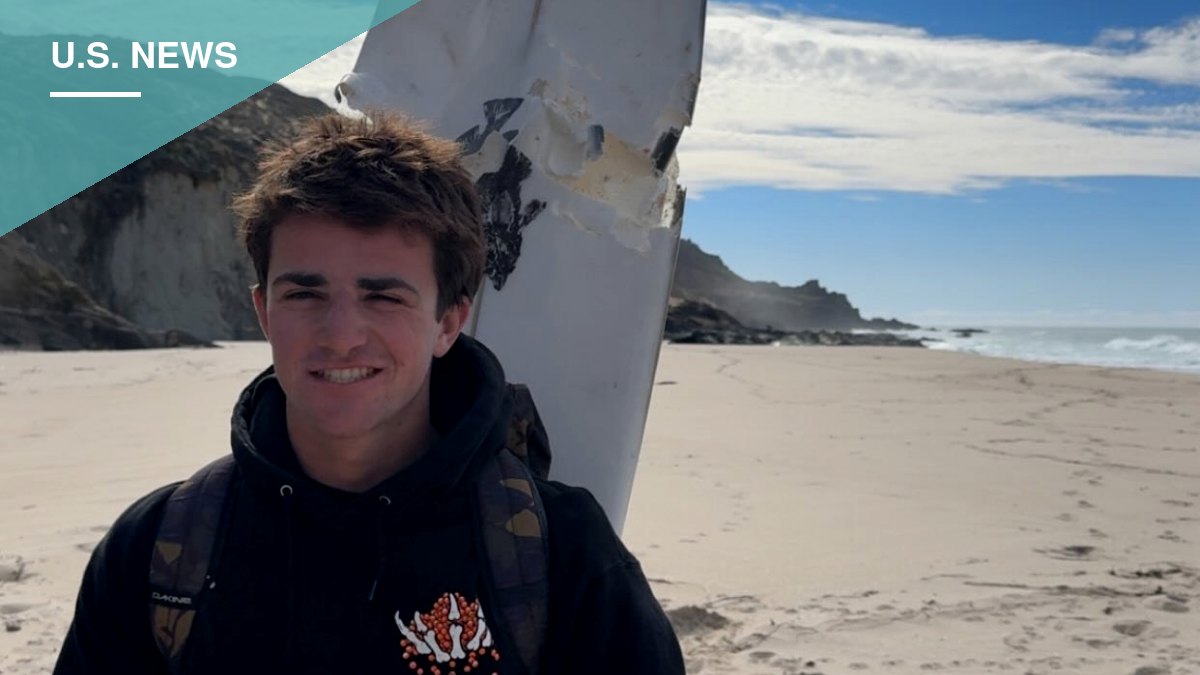
A 21-year-old surfer off the coast of Santa Barbara County, California, is recovering from a close encounter with a great white shark he estimates was 15 to 20 feet long, after the animal clamped down on his board and launched him into the air.
Jack Canigiula said he was sitting in the water off North Santa Barbara County when the shark struck. He described feeling a large, dark shape pass beneath him before the animal surfaced and bit into the tail of his board.
“Welp, pretty rattled,” Canigiula wrote on Instagram, where he posted photos of the board with large chunks torn out of it. “Got smoked this morning by an about 15-20ft Great White surfing North SB County.”
He said the force of the bite threw him roughly two feet out of the water. “Was sitting out the back when a huge dark shape bolted under me and blew up on the back half of my board from underneath,” he wrote. “Thankfully was able to kick my legs forward and away from its mouth.”
Canigiula said he managed to kick the shark away while it still had the board in its mouth. “It had my board in its mouth and I was able to kick it and push myself away from it,” he wrote. “It let go pretty quickly and I was able to get back on my board and paddle to the beach. Super grateful to walk away without a scratch.”
Fellow surfer Dylan Stolley reportedly witnessed the encounter. Canigiula was uninjured; his board was not.
The post drew reaction from prominent names in professional surfing. Eleven-time world champion Kelly Slater commented, “Oh my…,” while Kalani Robb wrote, “glad ur ok dude.” Big-wave surfer Ken “Skindog” Collins offered blunt advice: “No scratch or anything? So lucky. Buy a few lottery tickets.”
A known shark corridor
Great white sharks are the ocean’s largest predatory fish, with females outgrowing males and the biggest adults reaching about 20 feet and weighing several thousand pounds. Most sharks seen near Southern and Central California beaches in recent years have been juveniles — typically under 10 feet and feeding mainly on fish and rays. Adults shift to hunting seals and sea lions, often by charging upward from beneath, the pattern Canigiula described.
Santa Barbara County’s coastline is a well-documented gathering area for white sharks, and experts say juveniles in particular use near-shore nursery waters along the Central Coast. Surf Beach near Lompoc, in the county’s north, has its own history of shark incidents, including a fatal attack in 2010 that killed a UC Santa Barbara student who was bitten in the leg.
Incidents remain rare but are rising
The California Department of Fish and Wildlife has recorded fewer than 250 shark incidents statewide since 1950, across multiple species, with the large majority involving white sharks. The agency uses the term “incidents” rather than “attacks,” noting that scientists generally believe most white shark bites on humans are exploratory rather than predatory — often directed at objects like surfboards instead of people.
Even so, the numbers have been climbing. A CDFW spokesman said the state recorded 10 shark incidents in 2025, the most ever logged in a single year. Officials point to unusually warm waters tied to strong El Niño conditions in the eastern Pacific this year, which appear to be shifting where white sharks congregate along the coast.
The New York Post has reached out to Canigiula for further comment.