

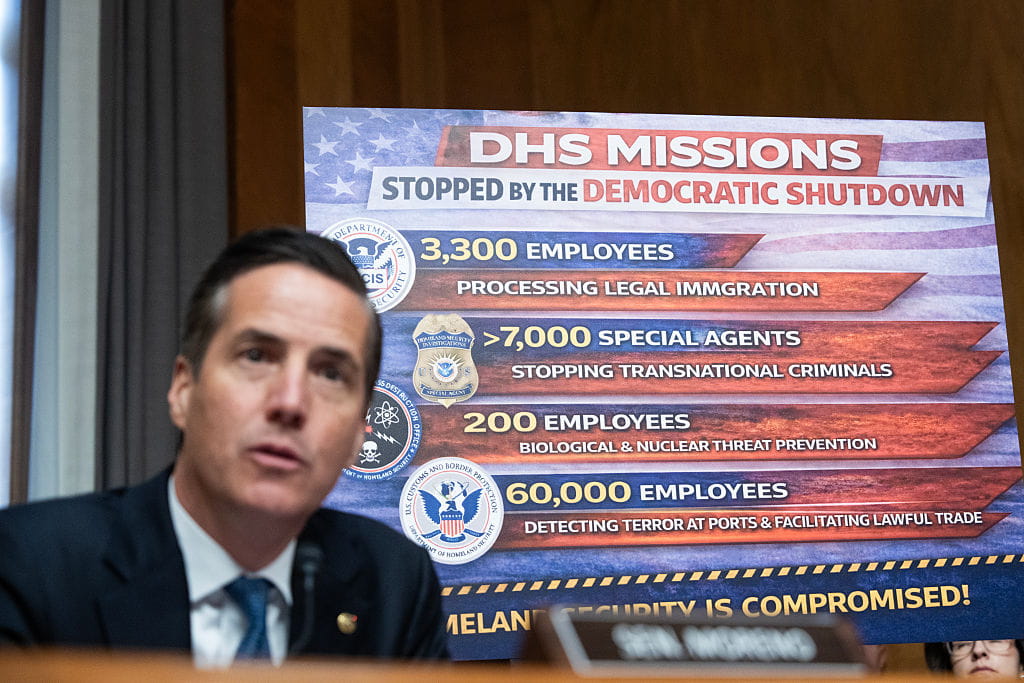
The White House sent a letter to Senate Republicans outlining the Trump administration’s new plan to “improve” operations at the Department of Homeland Security, addressed to Senators Katie Britt and Susan Collins, and framed as a renewed effort to reach an agreement after talks with Senate Democrats stalled.
The letter landing on Capitol Hill is a political push and a policy pitch rolled into one. It signals the administration wants tangible changes at DHS and is asking Republican senators to carry that message into negotiations. The move also puts pressure on Democrats to come to the table with workable ideas instead of blocking pragmatic fixes.
Senators Katie Britt and Susan Collins were named recipients, putting two influential Republicans squarely in the spotlight. Britt represents the conservative wing focused on border security and accountability, while Collins is often a swing voice on Capitol Hill. Sending the letter to both senators makes clear the administration wants buy-in across the GOP spectrum.
From a Republican point of view, this is about restoring common-sense management to a huge federal agency that touches everything from immigration enforcement to cybersecurity. The pitch is straightforward: DHS needs clearer priorities, better deployment of personnel, and stronger accountability to taxpayers. Republicans see this as an opportunity to insist that reforms produce measurable results instead of more red tape.
Democrats, at least in headline reactions, have offered resistance, preferring to keep leverage in broader funding and policy talks. That reluctance helps explain why the administration chose to make its plan public now and put Republican senators in a position to press for specifics. The calculation is political as much as it is technical: if Democrats continue to stonewall, Republicans can point to the administration’s concrete proposals and demand votes.
Operationally, the chorus of complaints from border towns and frontline agents is familiar: staffing shortages, outdated processes, and mission creep have left DHS stretched thin. Republicans argue the answer is not simply more money cast into the same systems, but smarter organization and accountable leadership. The letter reportedly outlines changes meant to streamline decision-making and shift resources to urgent priorities, which is precisely the kind of reform GOP lawmakers say they will back.
The path forward will be negotiation, not shouting matches. Republicans want reforms tied to enforcement and oversight, while Democrats are likely to push for humanitarian and legal safeguards. That tension can be bridged if negotiators focus on outcomes—fewer illegal crossings, faster case processing, and clearer chains of command—rather than ideological victories.
Putting the plan in writing serves another purpose: it creates a checklist Republicans can use in hearings and floor debates. Concrete proposals force elected officials to vote for or against specifics instead of hiding behind vague principles. For conservatives who prioritize secure borders and efficient government, this approach makes the stakes plain and gives them leverage to shape the final deal.
Expect the administration to press hard for a quick, enforceable agreement that emphasizes performance metrics and reallocation of existing resources. Republican lawmakers will likely demand transparency on how any changes translate into better outcomes for communities and taxpayers. If Democrats insist on delay or dilution, Republicans will have a clear message: the public deserves a DHS that works, not one mired in politics.
Ultimately, this letter is a test of seriousness from both sides. The administration has put forward a plan and asked Republicans to help carry it through; now senators must decide whether to collaborate on real reforms or let the status quo continue. The country will judge which approach produces safer, smarter homeland security for Americans.

