

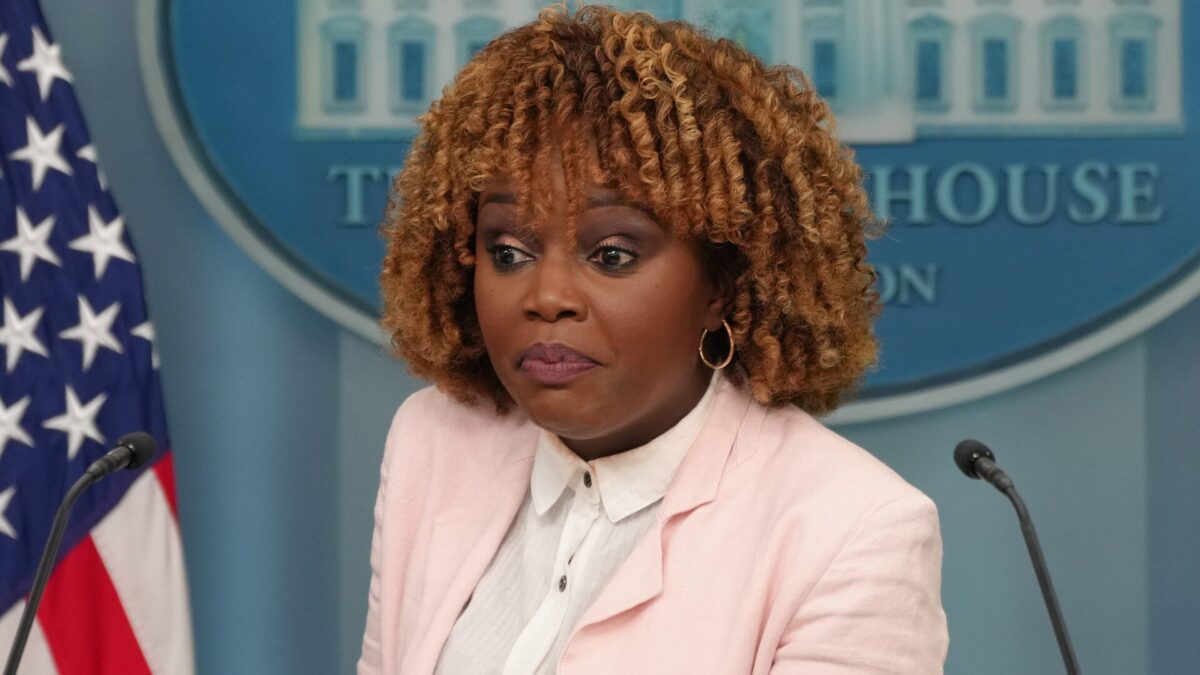
During a White House press briefing, Press Secretary Karine Jean-Pierre engaged in a tense exchange with FOX News reporter Peter Doocy, after he raised concerns that labeling Donald Trump a “threat to democracy” might incite violence against the former president.
Jean-Pierre fired back, accusing Doocy’s question of being “dangerous,” particularly given the current political climate, as reported by Real Clear Politics.
Jean-Pierre stood firm on the administration’s position, emphasizing that the term “threat” was not used lightly. She grounded the administration’s language in the events of January 6th, 2021, when a violent mob attacked the U.S. Capitol. “January 6th, Peter. January 6th! January 6th, 2021.
That is a fact,” she stressed repeatedly, underscoring that the use of the term “threat” was tied directly to the actions and rhetoric surrounding that day.
Doocy, pressing the issue, pointed out that there had been another alleged assassination attempt on Trump just two days prior. He questioned how many more attempts it would take before the administration reconsidered its language about the former president.
Jean-Pierre was quick to dismiss this premise, reiterating that the Biden administration consistently condemns all forms of political violence.
She also highlighted President Biden’s public expression of gratitude for Trump’s safety following earlier incidents, making it clear that the administration stands firmly against violence.
Despite this, Jean-Pierre doubled down on the idea that Trump’s actions on and around January 6th remain at the core of the administration’s stance.
She cited the overwhelming evidence supporting the legitimacy of the 2020 election results, including the confirmation from over 60 Republican judges that the election was lawful.
Jean-Pierre argued that Trump’s refusal to accept the outcome of the election directly led to the attack on the Capitol, and therefore posed a continuing threat to democracy. “If that’s not a threat to our democracy,” she said, “then what is?”
While Jean-Pierre briefly acknowledged the importance of policy debates within a democracy, she quickly pivoted back to the administration’s focus on what she called “dangerous rhetoric.”
Instead of engaging with the broader concern about the consequences of such rhetoric, she stuck to the narrative that paints Trump and his supporters in a deeply negative light.
This approach, however, sidestepped the actual point Doocy was raising—the possibility that the administration’s own words could contribute to an atmosphere of political violence.
By repeatedly labeling Trump a “threat,” the White House might inadvertently fuel the very tensions they claim to condemn.
Doocy attempted to highlight the potential real-world consequences of this rhetoric, but Jean-Pierre remained resolute.
Her defense once again circled back to January 6th, framing it as the definitive justification for the administration’s choice of language.
WATCH:
For this White House, that day remains an all-encompassing rationale for how they speak about Trump, with little acknowledgment of the potential risks their own language may carry.
As the exchange wound down, Jean-Pierre called for caution in how questions are framed, but ironically did not address the inflammatory nature of the administration’s own remarks.
She reiterated the White House’s commitment to denouncing political violence, but glossed over the possibility that their rhetoric could be contributing to the polarized climate.
Rather than acknowledging any responsibility for the current division, the administration continues to deflect, keeping Trump as the central figure in the narrative they’ve built.

