

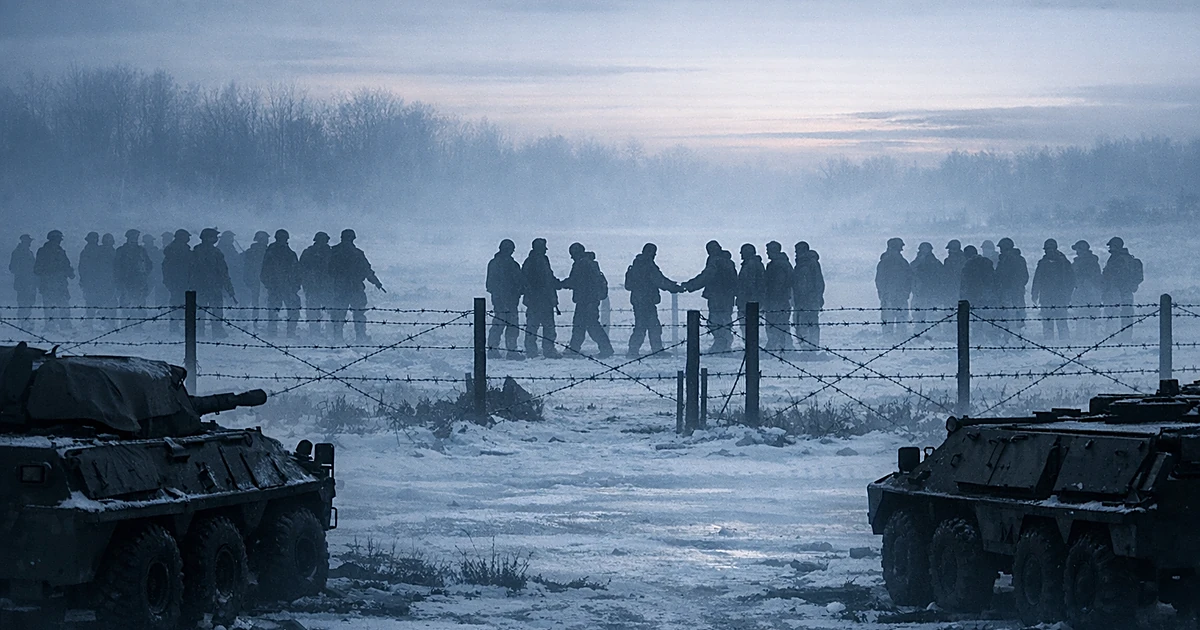
President Trump announced a three-day ceasefire between Russia and Ukraine from May 9 through May 11, paired with a 1,000-for-1,000 prisoner exchange, and cast the agreement as the product of direct, leader-to-leader diplomacy that synchronized the two sides around Victory Day events.
President Trump presented the pause in fighting as a personal diplomatic achievement, saying both Vladimir Putin and Volodymyr Zelensky accepted the plan. The truce is set to cover May 9, 10, and 11, and includes a reciprocal release of 1,000 prisoners on each side, a concrete result that separates this accord from months of vague signaling.
The pause coincides with Russia’s annual Victory Day celebration for the defeat of Nazi Germany, and Trump highlighted that timing. He posted on Truth Social, and his public framing stressed he pushed the idea directly to both leaders to secure a synchronized halt in hostilities.
“The Celebration in Russia is for Victory Day but, likewise, in Ukraine, because they were also a big part and factor of World War II. This Ceasefire will include a suspension of all kinetic activity, and also a prison swap of 1,000 prisoners from each Country.”
Trump said the request “was made directly by me” and said he “very much” appreciates the agreement Putin and Zelensky reached. He has also described the ceasefire as evidence that American pressure, when applied directly, can produce tangible outcomes that other approaches failed to deliver.
Trump told reporters that he had discussed a ceasefire with Putin in a separate conversation in which Putin offered help on Iran and Trump redirected that offer toward ending the war in Ukraine. He also said, “I said I’d much rather have you be involved with ending the war with Ukraine. To me that would be more important.”
That transactional, leader-to-leader approach is exactly the kind of diplomacy Trump’s backers say works when multilateral strategies stall. The President framed his role as one of pressing both capitals at once to make a limited, enforceable exchange possible within a short window.
Ukrainian President Zelensky confirmed Ukraine would take part and made clear the prisoner swap was decisive to Kyiv’s agreement to pause fighting. He put the trade in stark terms that prioritized people over symbolic terrain.
“Red Square is less important to us than the lives of Ukrainian prisoners who can be brought home.”
Zelensky also thanked the U.S. leadership directly and asked Washington to ensure Russian compliance. He wrote, “I thank the President of the United States and his team for their productive diplomatic involvement. We expect the United States to ensure that the Russian side fulfills these agreements,” signaling Kyiv sees American leverage as the practical guarantor.
Russia had earlier announced a shorter, two-day pause tied to Victory Day while warning it would retaliate if Kyiv disrupted celebrations. The president’s framework lengthened that window to 72 hours and added the prisoner swap, which Russia’s initial announcement did not include, effectively synchronizing the two sides.
Caveats remain. Officials have not made public the fine print: where the suspension of kinetic activity applies, what enforcement looks like, and what happens the moment the 72 hours end. History shows ceasefires can be fragile, and the real test will be whether operations actually stop for the full period.
If the exchange holds, it will return 1,000 Ukrainians and 1,000 Russians to their families, a human result that matters more than diplomatic rhetoric. For critics who doubted Trump’s capacity for high-stakes statecraft, the deal is a tangible rebuttal; for supporters, it is proof that decisive personal engagement can produce results others did not.
Three days is not a peace treaty, and the arrangement is limited and loaded with open questions about enforcement and follow-up. Still, the 72-hour halt and the prisoner returns are a moment of American-led action that reflects a willingness to act directly rather than rely solely on multilateral institutions.

