

President-elect Donald Trump has announced he will once again decline the $450,000 annual presidential salary during his second term in the White House, reaffirming a decision he first made during his initial tenure as President. Trump’s pledge to serve without personal financial gain reflects his commitment to fiscal responsibility and leading by example.
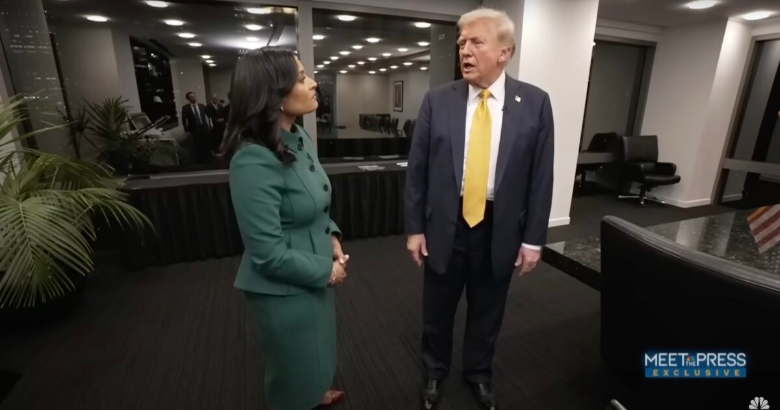
This announcement came during an interview with Kristen Welker, where Trump outlined his reasons for rejecting the salary, highlighting his focus on reducing government expenditure and serving the nation without financial motivation.
During the interview, Welker asked if Trump planned to accept the presidential salary. He responded emphatically, “I’m not going to accept a salary, no. I’m giving up a lot of money.” Trump also noted that aside from George Washington, no other president in U.S. history had refused the presidential salary.
The President-elect reiterated that his decision wasn’t about the money, stating, “I just feel, for me, it’s a nice thing to do.”
Throughout his first term, Trump donated his salary to various federal agencies, including the National Park Service and the Department of Education. These donations were aimed at supporting key government functions and symbolizing a strong commitment to public service over personal enrichment.
During the discussion, Kristen Welker attempted to pivot the conversation to questions about Trump’s pension, asking, “You did accept the pension, correct?” Trump responded that he did not believe he had accepted any form of compensation during his presidency, further emphasizing his selflessness.
Notably, Trump expressed frustration at the lack of recognition for his decision from the mainstream media. “I got no credit for that,” he said. While Welker acknowledged the significance of his choice, Trump remarked that his gesture was largely ignored, despite its importance as a symbolic act of leadership.
Trump’s decision to forgo the presidential salary stands in stark contrast to the financial trajectories of many former presidents, who saw their personal wealth increase substantially during and after their terms.
For instance, former President Bill Clinton entered the White House in 1993 with a net worth of $1.3 million. By the time he left office, that figure had ballooned to $120 million, largely through lucrative book deals and speaking engagements. Similarly, Barack Obama’s net worth grew from $1.3 million in 2009 to an estimated $70 million after his presidency, according to Newsweek.
Trump’s personal fortune, estimated at $2.3 billion, has remained robust despite his decision to donate his presidential salary. By rejecting financial gain during his presidency, Trump continues to set himself apart from his predecessors, underscoring his commitment to public service.
During his first term, Trump redirected his salary to a range of federal agencies and initiatives. Notable recipients included:
- The National Park Service: Trump’s donation contributed to infrastructure improvements and maintenance efforts across the country’s national parks.
- The Department of Education: Funds were allocated to education programs aimed at enhancing access to quality learning resources.
- The Department of Health and Human Services: His donations supported initiatives combating the opioid crisis and addressing public health concerns.
- These acts were not only symbolic but also contributed directly to government programs that benefitted the American people.
Despite the tangible impact of Trump’s salary donations, the gesture has received limited recognition from mainstream media outlets, which Trump and his supporters have frequently criticized as biased.
David J. Harris Jr., a conservative commentator, shared a clip of Trump’s remarks on Twitter, praising the President-elect for his continued dedication to serving the country without financial incentive. “Trump says he again will not take a salary! Man of the people!” Harris wrote.
Trump’s refusal to accept the presidential salary aligns with his broader message of putting America first. For his supporters, it serves as a testament to his commitment to public service and his willingness to prioritize the nation over personal gain.
As Trump prepares to begin his second term, his decision to reject the presidential salary sends a clear message about his approach to governance. By leading by example, he hopes to inspire a greater focus on fiscal responsibility within the federal government.
Trump’s announcement also comes at a time of heightened political division, with critics and supporters debating the significance of his actions. For many, his decision to forgo the salary is a refreshing departure from the norm, highlighting his commitment to serving the American people.
Donald Trump’s decision to once again decline the presidential salary is a continuation of his pledge to lead with integrity and fiscal responsibility. While critics may downplay the significance of this gesture, it underscores Trump’s commitment to serving without personal financial gain—a rare move in modern American politics.
As he steps into the White House for a second time, Trump’s choice sets a powerful example of selflessness and public service, reinforcing his message of putting America first. Whether acknowledged by the media or not, his actions speak volumes about his priorities as a leader.

