

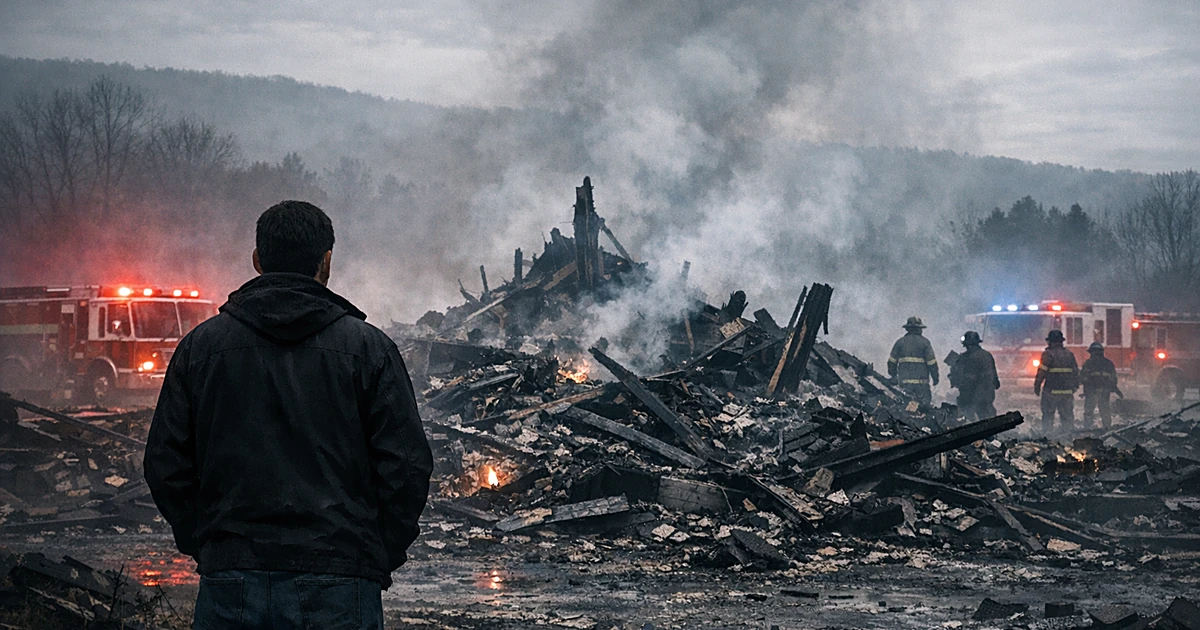
A propane explosion destroyed a family home in Lamar Township, Pennsylvania, killing a 34-year-old mother and her six children and leaving the father as the lone immediate family survivor; state police say the blast is “believed” to have been caused by propane, officials are still investigating, and the community is reeling.
A propane explosion ripped through a family home in Lamar Township, Pennsylvania, on Sunday morning, killing a 34-year-old mother, Sarah B. Stolzfus, and all six of her children. The blast struck around 8:30 a.m., and the father, David F. Stolzfus, was not at home and survived. Fire crews arrived quickly but could not enter because the blaze was too intense.
By the time firefighters got the flames under control the house had been reduced to a charred pile of debris and the bodies of the victims, whose ages ranged from 2 through 10, were found inside. Investigators have described the fire as the result of a propane explosion, using the word “believed” to describe the likely cause. Officials have not released a final cause of death for any of the seven victims, and many basic details remain unsettled.
The Stolzfus home sat in rural Clinton County, roughly 30 miles northeast of State College, in a quiet area where neighbors know each other and news like this lands with a shock. People in the township are now grappling with an event that happened in minutes and erased an entire household. That suddenness is a common and brutal feature of fuel-related blasts in rural places that rely on stored propane.
“I heard a boom and I could feel it and I got up and looked out the window and I could see the flames through the windows.”
A neighbor, Christina Duck, said she felt the explosion before she saw the fire and ran outside to watch the destruction unfold. She described the blaze as moving with terrifying speed, leaving essentially no time for those inside to escape. First responders reached the scene within minutes but were kept from entering by the extreme heat and flames.
“I come running outside and within a minute the whole house was completely engulfed.”
The timeline Duck described—roughly sixty seconds from boom to total engulfment—helps explain why no one inside survived and why firefighters could not make an interior attack. When conditions are that severe there is little crews can do beyond containing spread and protecting surrounding properties. In this case the house itself was a total loss and the human toll was absolute.
PennLive.com reported that David F. Stolzfus was not home at the time and is now the lone immediate family member left alive. Authorities have not said where he was or precisely when he learned of the explosion. The names of the six children have not been publicly released, and officials have withheld the home’s exact street address as the investigation continues.
Investigators have not yet specified where the propane came from—whether a tank, an underground or above-ground line, or an appliance—and have not said whether any recent inspections or service work had been done. State police called the event “believed” to be a propane explosion, language that falls short of a confirmed technical finding. Final investigatory reports in rural fire scenes often take weeks or months when the structure has been so thoroughly destroyed.
Propane is a common fuel source in many rural parts of Pennsylvania where natural gas lines do not reach, used for heating, cooking, and hot water. When a system fails or a leak goes undetected the consequences can be catastrophic and come without warning. Other recent accidents involving gas leaks and explosions around the region have underscored how quickly a fuel-related blast can level a building and upend lives.
Several straightforward questions remain open: Which agencies beyond state police are involved in the probe, and were there any prior complaints or known issues with the property’s fuel supply? Have investigators identified a specific ignition source, or is that still pending laboratory work? Those are the kinds of details that typically surface as evidence is processed and statements are taken.
For now, the community in Lamar Township is left to grieve while investigators piece together what happened. Rural fire response times can be fast but they cannot change the physics of an explosion that engulfs a home in under a minute. The immediate priority for officials will be establishing the technical sequence of events and then sharing answers with a family and a town that need them.
David Stolzfus now faces a reality no parent should ever know: he left with a wife and six children and returned to a debris field and seven funerals. There is no clear policy debate to attach to this loss, just an investigation and a community that wants to know how seven lives were taken so quickly. Seven people are dead. The least we owe them is answers.

