

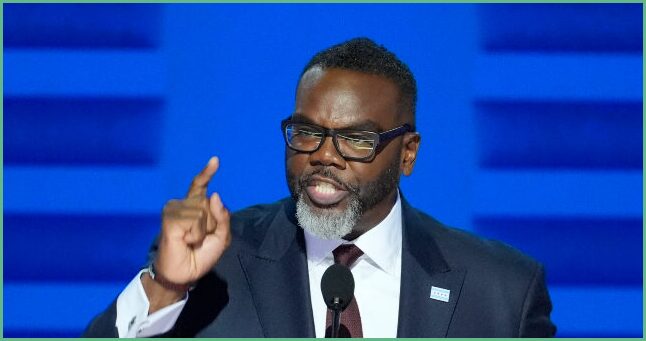
There have been more than 1,500 shooting victims–fatal and non-fatal combined–in Mayor Brandon Johnson’s (D) Chicago thus far in 2025. This figure is not a statistic to bury in a report, it is a daily reality for neighborhoods that are losing people, businesses, and hope. Families are grieving and residents are asking simple questions about safety and leadership.
Walk through the South and West sides and the mood is obvious: frustration and fear. Voters did not elect a mayor to explain tragedies away, they elected someone to stop them. When leadership calls for patience more than action, citizens rightly demand accountability.
Crime statistics do not exist in a vacuum; they reflect policy choices. Years of soft-on-crime experiments and relaxed enforcement send the wrong signal to would-be criminals. A city that tolerates low expectations ends up with lower safety for everyone.
Support for police is essential and practical, not political theater. Officers need clear direction, reliable resources, and policies that let them do their jobs without second-guessing or chronic understaffing. When morale collapses, recruitment and retention collapse too, and streets become less safe.
Victims deserve action that is swift and certain, not promises that never translate into results. Prosecutors, judges, and lawmakers all share responsibility when repeat offenders return to the streets. A public safety chain is only as strong as its weakest link and too many links are frayed.
We also must speak honestly about root causes without excusing violence. Broken families, failing schools, and addiction contribute to crime patterns, but they do not excuse the decision to pull a trigger. Addressing these issues requires both accountability and investment, not slogans.
Good policy balances prevention and enforcement, and Chicago needs both in spades. Community policing that rebuilds trust can draw residents into cooperation with law enforcement. At the same time, prosecutors must seek consequences that deter, not just process the next case.
Economic opportunity is a powerful antidote to hopelessness, and too many neighborhoods in Chicago are starving for it. Conservatives argue for empowering local business, vocational training, and school choice to create pathways out of cycles of crime. When people can see a future that does not involve a street corner, choices change.
Mayor Johnson can pivot and adopt practical reforms that respect law-abiding residents while holding criminals accountable. That means funding evidence-based violence prevention programs, restoring school discipline, and strengthening the tools police need to protect neighborhoods. It does not mean surrender or endless excuses.
Residents are tired of political finger-pointing and want measurable results. City hall should publish clear, trackable goals for reductions in shootings and homicides and report monthly on progress. Transparency builds trust and makes leaders answerable to the people they serve.
Leadership also means partnering with state and federal authorities when local resources are not enough. Gun trafficking often crosses jurisdictional lines and needs coordinated enforcement to stop it. Chicago cannot wall itself off; smart partnerships make enforcement more effective.
At the same time, the spotlight should remain on the victims and their families, not on political spin. Every number in a crime report represents a human life altered forever. Policy debates must be grounded in compassion for those who suffer and in practical steps to prevent the next tragedy.
Common-Sense Paths Forward
Practical reforms are available that respect public safety and civil liberties at the same time. Support for community interventions, mental health treatment, and job programs should be paired with tougher sentences for violent repeat offenders. That combination reduces crime and restores confidence in public institutions.
Chicago’s future depends on leaders who are willing to change course and put safety first. Republicans will push for results-oriented policies, stronger backing for law enforcement, and investments that give people real options beyond crime. For the sake of Chicago’s families, neighborhoods, and businesses, failure is not an option and excuses are not acceptable.

