

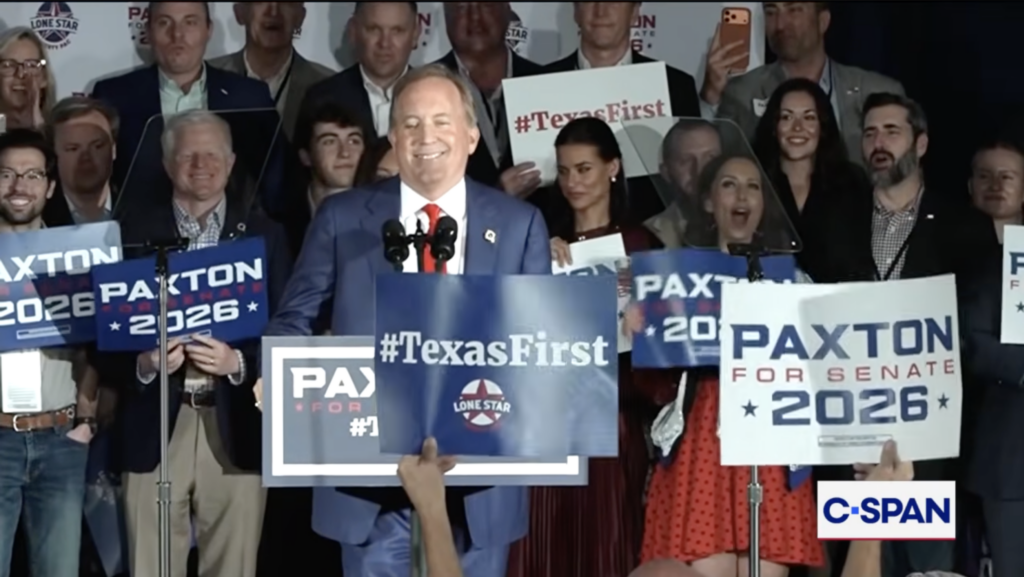
Texas Attorney General Ken Paxton said he would consider dropping his senatorial bid if Congress would lift the filibuster in order to pass the SAVE America Act. Paxton and Sen. John Cornyn are headed to a runoff in May after neither candidate secured a majority of the vote during Tuesday’s primary.
Ken Paxton’s comment lands at a tense moment in Texas GOP politics, where a runoff means every move gets magnified. Saying he might step aside to help pass the SAVE America Act turns a personal campaign into a bargaining point in Washington. That kind of tradeoff is blunt and political, and it forces voters and leaders to weigh principle against practical gains.
The filibuster has become the lever in Paxton’s statement, and Republicans have debated its role for years. For many conservatives the filibuster is an obstacle to decisive action and an invitation to gridlock, especially on measures like the SAVE America Act that parties view as urgent. Paxton framing his potential withdrawal as conditional on lifting the filibuster signals his willingness to make a big political bet for policy wins.
Facing a May runoff with Senator John Cornyn, Paxton’s move adds an unusual twist to a familiar matchup. Runoffs can be low-turnout, high-stakes contests where a single strategic decision can change the outcome. Turning campaign calculus into a potential trade with the Senate raises questions about how candidates balance personal ambition with party strategy.
The SAVE America Act gains attention here because it’s now tied to the filibuster debate and to a high-profile Texas race. Supporters will argue any path that secures passage is worth exploring, while skeptics will worry about precedent and the political cost of dramatic concessions. That argument isn’t theoretical; it’s happening in real time, and it will shape both Washington’s behavior and how Texans view their leaders.
Paxton’s position also highlights how state-level figures can influence federal priorities. As attorney general, he already has a public platform and legal authority that makes his switch from campaign rhetoric to dealmaking noteworthy. Whether voters see that as statesmanship or as political theater will depend on how the next weeks unfold and on what guarantees, if any, accompany his offer.
Cornyn, as the incumbent, represents the establishment wing of the party and brings a long Senate record to the runoff. His supporters will likely press the case that stability and continuity in the Senate matter now more than headline-grabbing stunts. The contrast between an incumbent and a challenger offering conditional withdrawal underscores choices voters will face about tactics versus steady governance.
Beyond the personalities, the scenario puts the filibuster at center stage for a broader audience. If leaders actually try to remove it to pass the SAVE America Act, the consequences will ripple into future legislative fights. Voting rights, judicial confirmations, budget battles and other bills could be reshaped by that shift, and voters should expect intensified debate over both process and policy.
In the short run, the runoff will test which message resonates: a willingness to flip the usual playbook for a specific bill or a preference for a measured, predictable approach to governing. Either outcome will send a message to Washington about what Texas Republicans want from their senators. For now, Paxton’s conditional offer is part strategy and part theater, and it has turned a local contest into a national talking point.
The coming weeks will sort out whether this gambit changes anyone’s mind or simply sharpens the choices for primary voters. Campaign dynamics, turnout, and national attention will all matter as May approaches. Whatever happens, the conversation around the SAVE America Act, the filibuster, and Texas’ Senate seat is now firmly joined and likely to influence both policy and politics.

