

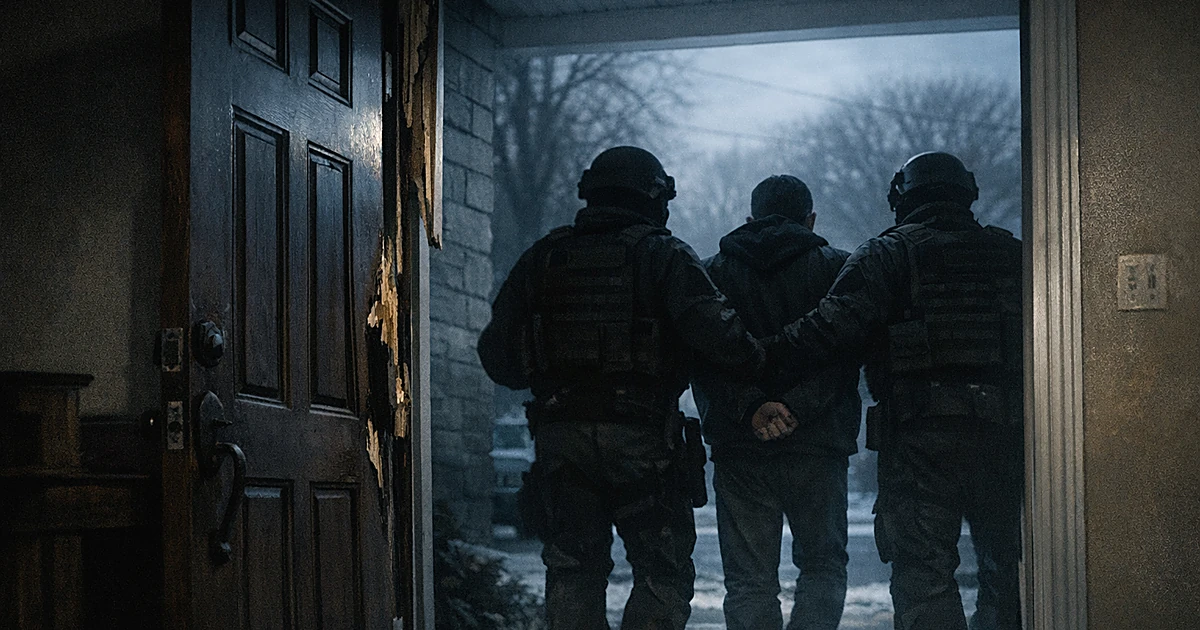
Ramsey County is probing a January federal arrest that left a Hmong American man taken from his home and held for hours, and local officials say the case could amount to kidnapping, burglary, and false imprisonment.
Ramsey County leaders announced a formal probe into the January encounter in St. Paul where federal immigration officers seized ChongLy “Scott” Thao, a longtime U.S. citizen with no criminal record. County Attorney John Choi and Sheriff Bob Fletcher said they will seek records and cooperation from the Department of Homeland Security to determine whether officers broke state or federal law. Local officials and Thao describe a forced entry, the use of guns, and several hours of detention before he was quietly released.
According to accounts from law enforcement and Thao, agents forced open his front door on January 18 and entered with weapons drawn in freezing weather. Thao was led outside wearing only underwear and wrapped in a blanket, then placed into a federal vehicle and driven around for hours before being returned home. Homeland Security later claimed the officers were seeking two convicted sex offenders, but Thao said he had never seen those men and they did not live with him.
“There are many facts we don’t know yet, but there’s one that we do know. And that is that Mr. Thao is and has been an American citizen. There’s not a dispute over that.”
Sheriff Fletcher emphasized that the basic facts are undisputed: a U.S. citizen was taken from his house and transported. He asked whether that is sound law enforcement, calling into question how identity and probable cause were verified before the forced removal. County officials want to know who authorized the entry and whether officers had any warrant or legal authority to seize a citizen in his own home.
“There’s no dispute that he was taken out of his house, forcibly taken out of his home and driven around.”
Choi framed the investigation as a procedural effort to gather the facts and decide whether crimes were committed and can be prosecuted. He insisted the county is not running a political operation but is focused on evidence. Those questions cut to the heart of public trust: enforcement only works if the government can reliably identify the right person before it breaks down a door.
“This is not about any type of predetermined agenda other than to seek the truth and to investigate the facts.”
The Thao matter lands amid a broader clash in Minnesota over a large federal deployment of roughly 3,000 officers that has prompted heightened scrutiny. That surge has coincided with several shootings involving federal officers in Minneapolis, including the deaths of two citizens, Renee Good and Alex Pretti, and a strike-and-counter over access to evidence between state prosecutors and the federal government. State officials have sued to obtain materials they say are necessary to investigate the shootings independently, and federal authorities have resisted sharing files.
The Justice Department opened a federal civil rights investigation into the killing of Alex Pretti, and two officers were placed on leave, while it determined a similar probe into Renee Good’s death was not warranted. Minnesota leaders and prosecutors argue the lack of cooperation leaves state-level accountability hollow, and the standoff raises a practical question: if federal agents are effectively beyond state oversight, how are citizens protected from missteps?
Conservative principles—limited government, respect for the Constitution, and the Fourth Amendment—call for both robust enforcement and strict accountability. Arresting dangerous, convicted fugitives serves the public and should be supported, but that support depends on precision and lawful process. When agents seize the wrong man in his own home, the mistake undercuts both public safety and the political case for aggressive federal action.
Several practical gaps remain in this investigation: what intelligence led agents to Thao’s house, whether a warrant or authorization existed for forced entry, and who verified his identity before he was removed. County officials want a clear timeline of the hours he was detained and an explanation for why DHS has not produced the records Ramsey County says it needs. Those are reasonable, specific questions any competent law enforcement body should answer.
The dispute is not a choice between law enforcement and civil liberties; it is a call for better enforcement that respects constitutional limits. The federal government can and should demonstrate the legality of its operations by sharing evidence when questions arise. Refusal to cooperate only amplifies suspicion and hands critics a stronger case that federal action sometimes crosses legitimate lines.
At stake are more than one man and one warrantless entry. This is about whether federal officers operating in Minnesota can be held to account when things go wrong, and whether conservative principles of government by law and limits on power will be defended consistently. The Thao episode is the kind of incident that demands answers so similar mistakes do not repeat and so enforcement retains public legitimacy.


1 Comment
BOO-HOO!!! ICE doing their job….