

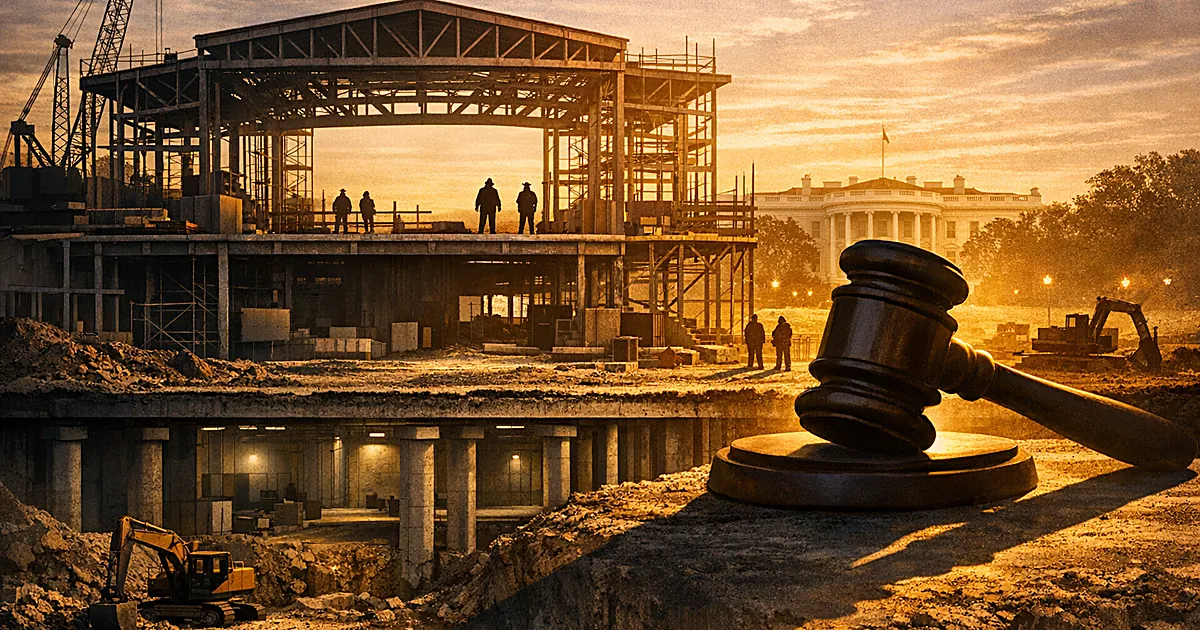
Judge Richard Leon has barred above-ground work on the proposed White House ballroom while allowing below-ground security-related construction to continue, setting a legal boundary between national security claims and congressional authorization for a $400 million project.
U.S. District Judge Richard Leon issued a pointed order stopping any above-ground construction on the planned White House ballroom, saying national security concerns do not give the executive branch unfettered authority to bypass Congress for the $400 million effort. The clarification follows a back-and-forth with the D.C. Circuit that asked the trial court to specify what its March injunction allows and forbids. That back-and-forth left the ballroom’s fate tied to how much authority the courts and Congress will ultimately recognize.
The appellate court had temporarily stayed parts of the injunction while instructing Leon to spell out its scope, and Leon’s response was blunt: above-ground ballroom work is on hold. He made clear that excavation and other subterranean work linked to presidential protection and national security can proceed, and he permitted steps to secure the construction site and protect the president and staff. The order draws a concrete line where the administration hoped broader claims of security would cover the whole project.
The administration argued the safety-and-security exception in the injunction should sweep across the entire 90,000-square-foot project, top to bottom, because elements of the plan are framed as protections against modern threats. That defense leaned on concerns like drones, ballistic missiles, and biohazards as justification for continuing full-scale construction. Leon dismissed that reading as outside the bounds of his order, calling the government’s legal position questionable.
“Defendants argue that the entire ballroom construction project, from tip to tail, falls within the safety-and-security exception and therefore may proceed unabated. That is neither a reasonable nor a correct reading of my Order!”
Leon also accused the government of shifting its position after losing the first round in March, suggesting the administration repackaged its arguments to try to get around the injunction. In March he found the administration lacked statutory authorization to replace parts of the East Wing with a privately funded structure and gave a 14-day window before the injunction took hold to allow for appeal. That window set off the series of appeals and stays that landed this dispute back in front of him.
The White House pushed back, insisting the president has authority over changes to the Executive Residence and that completing the ballroom serves presidential safety and staff protection. The D.C. Circuit’s temporary stay let some activity continue while legal boundaries were clarified, but Leon’s amendment now preserves only below-ground security work and bars the ballroom itself from rising above grade without congressional approval. The practical effect is a split permit: tunnels and bunkers may proceed, but the banquet hall cannot.
“My Amended Order does not, however, stop below-ground construction of national security facilities, work necessary to provide for presidential security, and construction necessary to protect and secure the White House and the construction site itself.”
That distinction matters because it allows excavation and subterranean security upgrades that the administration says are essential, while insisting that a grand above-ground ballroom needs statutory backing. The National Trust for Historic Preservation argued the project must comply with federal law and review processes, and Leon’s order aligns with that view for the above-ground portion while carving out space for genuine security work below the surface. The case now hinges on whether Congress or an appellate court will accept the government’s broader security claim.
The ballroom plan was announced in July, with the president saying the project would be funded “100% by me and some friends of mine.” Initial estimates mentioned roughly $200 million before filings and reporting landed on a $400 million figure, and demolition and site preparation had already begun before the March injunction stopped above-ground work. A rendering of the proposed ballroom surfaced on Truth Social in February 2026, but the East Wing was already partly demolished by late 2025, so physical changes are in place even as the legal fight continues.
When Leon issued his March injunction he left a clear invitation to lawmakers: “It is not too late for Congress to authorize the continued construction of the ballroom project,” Leon wrote at the time. That language signals one clear path forward for the administration if it wants to keep building above grade without prolonged legal battles. The appellate route remains open, but Congress has the power to resolve the authorization question with a single vote.
Procedurally the case is messy: Leon issued an injunction, the administration appealed, the D.C. Circuit granted a temporary stay and sent the matter back for clarification, and Leon narrowed the injunction. The administration can return to the appellate court and will likely do so, but the immediate legal posture is now a carve-out for underground security work and a stop to above-ground construction pending either congressional approval or further court rulings. The central conflict is focused and legal: whether the executive can proceed without explicit authorization from Congress.
Leon’s language underscores the limits he sees on national-security claims used to justify otherwise prohibited projects. He wrote, and then quoted, a principle that shapes his decision and signals what courts may scrutinize as similar disputes arise. That doctrinal line could affect future presidents’ ability to modify the White House complex without clear statutory authority, depending on how the D.C. Circuit and potentially the Supreme Court respond.
“National security is not a blank check to proceed with otherwise unlawful activity.”
Questions remain about the specific statutes and review processes involved, why cost estimates shifted from $200 million to $400 million, and what the next appellate moves will look like. For now, the ground-level reality is simple: excavation tied to security can go forward, but the above-ground ballroom cannot rise without either an appellate reversal or Congress stepping in to authorize the project. The legal fight is far from over and the next stops are likely the D.C. Circuit and Capitol Hill.

