

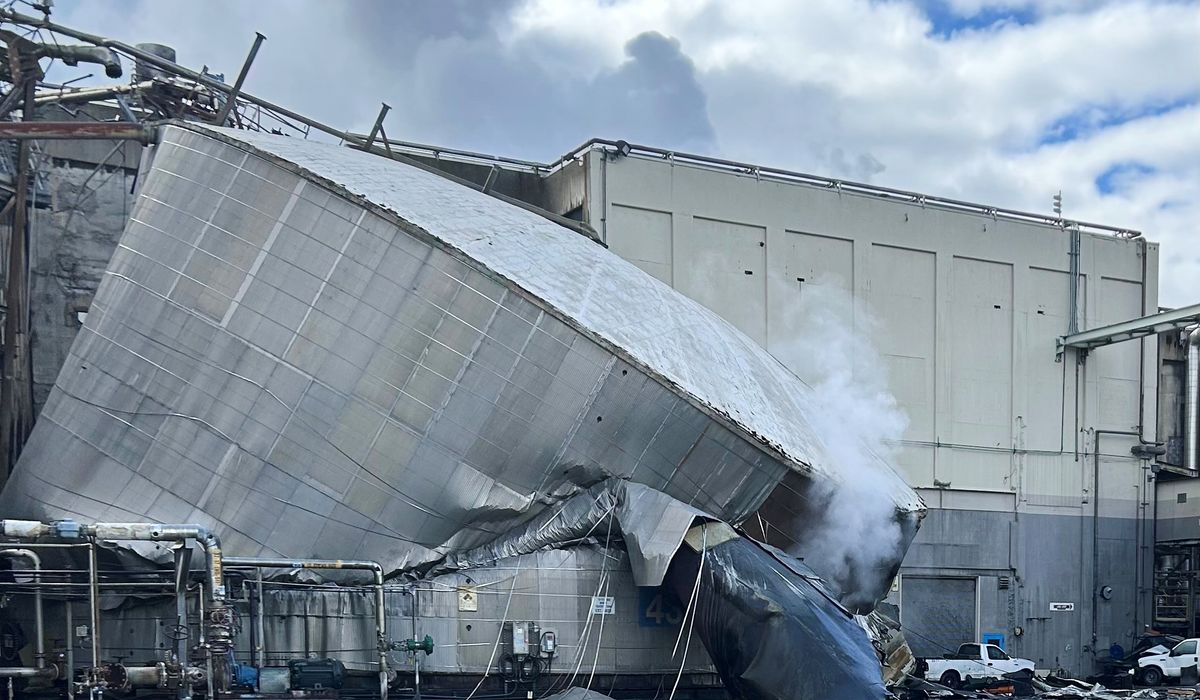
A massive chemical storage tank at a Washington paper mill imploded and collapsed Tuesday, releasing nearly a million gallons of a highly corrosive liquid, killing at least one worker and leaving nine others.
The collapse happened at a paper mill facility in Washington, where a roughly one-million-gallon tank gave way and imploded under unknown stresses. Workers on site experienced a sudden structural failure that sent metal and chemical vapors into the surrounding yard, and emergency crews arrived quickly. Officials confirmed at least one fatality and acknowledged that nine others remain part of the ongoing account of the incident.
First responders set up a perimeter and worked to establish safe zones while hazardous materials teams evaluated the spill and airborne risks. Residents and workers nearby were asked to avoid the area as a precaution while crews monitored air and water for contamination. Local emergency management resources coordinated with the mill to prioritize rescues, medical care, and containment measures.
The tank held a highly corrosive liquid, and the sheer volume—nearly a million gallons—raised immediate concerns about environmental and public health impacts. Containment booms and absorbent materials were deployed where runoff threatened nearby drainage and waterways. Officials emphasized that the priority was stabilizing the site, protecting responders, and preventing the spread of the corrosive substance.
Company spokespeople and regulatory agencies said investigations would probe the cause of the implosion, including structural integrity, maintenance records, and any signs of corrosion or failure. Inspections will likely review design specifications, last maintenance actions, and whether pressure or temperature factors played a role. Regulators typically seek to reconstruct the sequence of events to determine responsibility and recommend fixes.
Workers and families affected by the accident faced uncertainty as the response unfolded, with medical teams treating injuries and counseling available for those impacted. Hospitals received several people for evaluation of exposure and trauma, and authorities continued to account for all personnel. The community was left with questions about worker safety practices at heavy industrial sites and the adequacy of safeguards for large chemical storage tanks.
Environmental monitoring will continue in the days ahead to assess soil and water contamination risks, and cleanup will likely be lengthy given the corrosive nature of the released material. Contractors skilled in hazardous waste cleanup will be involved in neutralizing residues and removing contaminated equipment. Long-term monitoring plans are common after incidents like this to ensure that remediation is complete and that there are no lingering risks to public health.
Investigators will also look at the mill’s emergency preparedness, including alarm systems, evacuation protocols, and communications with local authorities during the collapse. Lessons learned from such incidents often lead to updated safety rules, stronger oversight, or changes in industry practices. For now, attention remains on rescue, containment, and providing accurate updates to the public as more information becomes available.

