

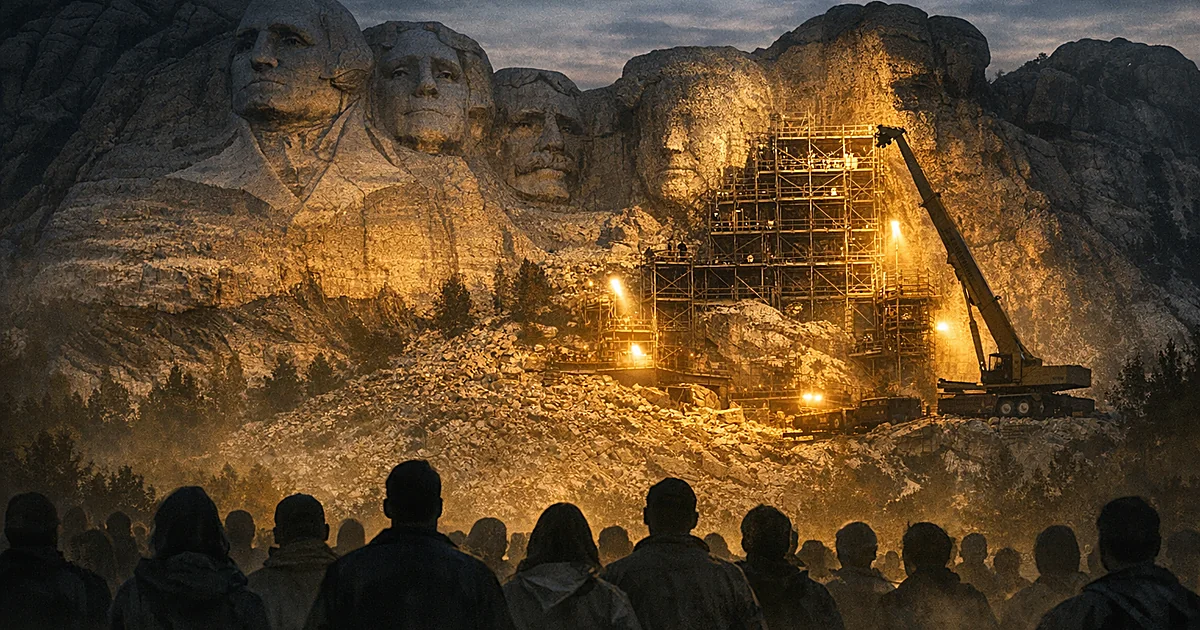
President Trump used a high-profile July 4 event at Mount Rushmore to send unmistakable signals—an AI video, themed treats, and an official statement combined to suggest he wants his likeness added to the monument while his public remarks stayed ceremonial.
The celebration at Mount Rushmore turned theatrical before a single line of the speech was delivered, when an AI-produced clip showed a gold-edged rendition of the memorial with President Trump’s face added to the right. The video included a direct voiceover that left little to interpretation. It grabbed attention by design and set the tone for a night that mixed pageantry with presidential positioning.
“I will be the greatest president for many, many years to come. And we’re gonna have a lot of fun tonight.”
The White House amplified the same message with novelty cookies distributed on Air Force One, each stamped to imply a fifth face belongs on the Black Hills granite. Those cookies read, in the commemorative style used for the event, “Mount Rushmore National Memorial. Black Hills, South Dakota. Five Presidents.” The combination of visual, edible, and written cues made the point without formal policy paperwork.
“There would be no better addition to the iconic Mount Rushmore than the 45th and 47th President of the United States, Donald Trump.”
This is not a random impulse; it fits a long pattern of talk, partial denials, and rhetorical nudges that date back to his first term. He has floated the idea in rallies and interviews, sometimes joking, sometimes coy, and occasionally declaring it a dream. The back-and-forth has been part of a broader approach to branding a presidency through spectacle and grand visuals.
At times Trump has been deliberately self-aware about the stuntmanship. In one early exchange he deflected a direct question by framing the suggestion as a media setup and promising not to volunteer it. In another post he denied suggesting the plan while immediately conceding it “sounds like a good idea” based on his record. That mix of denial and embrace has been a consistent rhetorical strategy.
“If I did it joking, totally joking, having fun, the fake news media will say, ‘He believes he should be on Mount Rushmore.’ So I won’t say it, okay? I won’t say it.”
Despite the theater, the speech delivered at the monument struck a different note, focusing on legacy and national character rather than personal addition to stone. The president praised the four faces already carved into the cliffside as reminders of American virtues and achievements. The ceremonial language was tuned to a July 4 audience and leaned on symbolism more than on policy specifics.
“Their faces are engraved on these bluffs, not only because of what they did, but to remind us forever who we are.”
He followed that line with a broader reflection on what those leaders represent, using language meant to evoke continuity and identity rather than controversy. “These heroes exemplify what is timeless, enduring, eternal about the American character, and in the end it has always been that character, our distinct and unique identity.” The contrast between the pre-show pageantry and the measured address was striking.
The legal and logistical reality of altering a national monument remains untouched by the signals. Mount Rushmore sits on federally managed land, and adding a fifth visage would pose steep engineering, regulatory, and political hurdles. No formal process has been launched, no authorization credited, and state officials have not been publicly quoted as endorsing the idea.
Beyond the cliffside conversation, the evening highlighted a broader theme: using high-visibility moments to shape the public narrative. Whether through architectural restorations, White House decor, or public ceremonies, this administration has repeatedly employed visual statements to reinforce a message. The Mount Rushmore sequence simply elevated that tactic to a national stage with gilded imagery and deliberate fanfare.
The optics worked exactly as intended; critics and supporters alike reacted, and the visual stunt dominated headlines and social feeds. One reporter summed up the in-flight treat with a wry observation that captured how the administration blends symbolism and showmanship. The spectacle ensured the conversation revolved around the president and his place in American memory, at least for now.
“The cookies served to the first family and to the press aboard Air Force One today were… different.”
For all the signaling and stagecraft, unanswered questions linger about whether the gestures amount to genuine policy aims or are chiefly an exercise in attention management. The administration’s mixture of art, confection, and an official statement created a clear public posture, but it did not map out a path forward. In Washington, the line between performance and policy often blurs, and this episode made that ambiguity unmistakable.

