

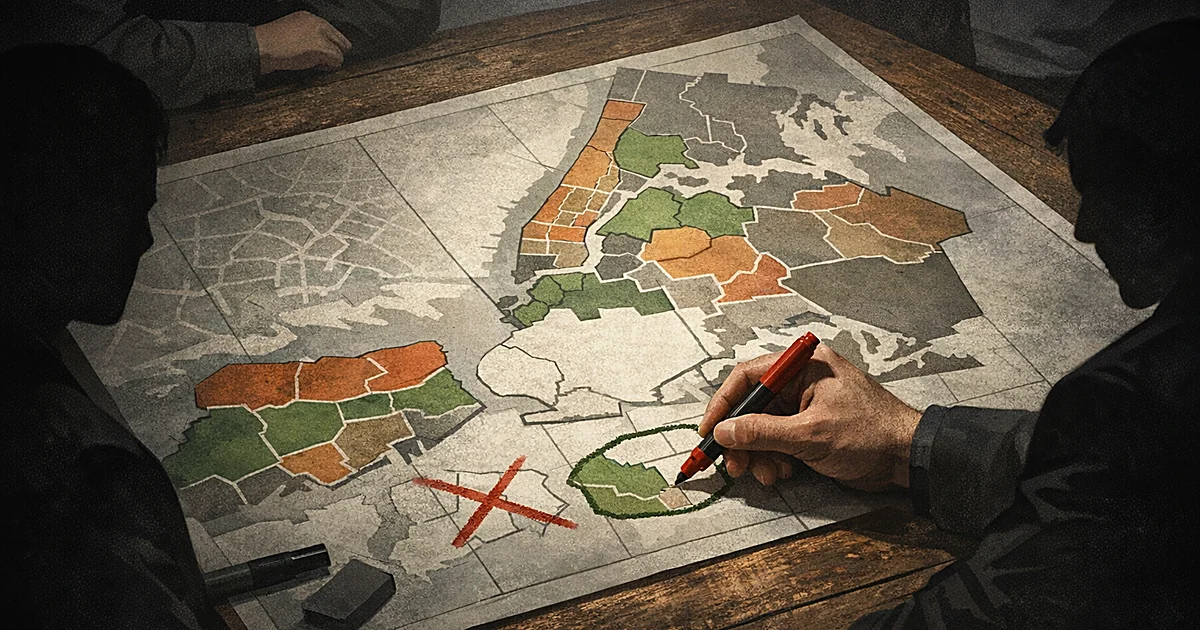
New York City’s mayor faces backlash after his administration released a citywide immigrant-enclave map that left out Little Italy and other historic European neighborhoods while adding neighborhoods labeled Little Palestine, Little Bhod-Tibet, and others; critics call the omission cultural erasure and question the mayor’s claim that he simply inherited the map from the previous administration.
When the mayor’s office published an “NYC Immigrant Enclaves” map that highlighted roughly 30 immigrant communities across the five boroughs, some of the city’s best-known, long-standing neighborhoods were missing. Little Italy, along with historic Irish and Jewish enclaves, did not appear on the map, sparking surprised and angry responses from community groups. The choices on the map have become a flashpoint for criticism of the current administration’s judgment and priorities.
Italian-American advocates responded quickly and forcefully, saying the omission went beyond a mere oversight. The Italian-American Civil Rights League made its displeasure public and its president spoke in blunt terms about the wider implications. That pushback has forced the mayor into damage control just as new questions about the map’s origins came to light.
“This is not a clerical error. This is cultural erasure.”
The League framed the omission as part of a pattern where Italian-American culture is only visible when it’s useful for photo ops, tourism, or fundraising. Their leader, Mike Crispi, argued that recognition matters and accused City Hall of treating Italian-American neighborhoods as a backdrop rather than a living community. That critique resonated with residents who worry local history is getting short shrift.
“Our culture is good enough for their photo ops, our food is good enough for their fundraisers, and our neighborhoods are good enough for tourism dollars, but when it comes time to recognize Italian Americans, they erase us.”
The League added fuel to the story by noting the administration denied their permit for Unity Day 2026, and they announced plans for a rally in Little Italy while demanding a public apology. That denial has turned a mapping dispute into a broader dispute over access and civic respect. The unfolding protest plans mean this will not fade as a one-day story.
Faced with mounting criticism, the mayor attempted to shift blame to his predecessor and told reporters that “This map was initially created by the prior administration in 2023, and when we inherited it, we added a few additional neighborhoods.” The administration acknowledged the map’s gaps and said the city is home to more than 200 ethnic communities, promising to correct omissions in a later update. That explanation has not satisfied critics who see it as deflection rather than ownership.
But that defense runs into a simple factual problem. Reports show the previous administration produced detailed, hand-illustrated community guides for 27 immigrant communities, not a single, consolidated citywide map of the kind now circulating. What was available before were in-depth guides, a different product that did not appear as a single graphic covering the whole city. That distinction undermines the claim that the current map is just an inherited artifact.
The mayor’s staff condensed those guides into a simplified, citywide graphic and, in the process, added only three communities that had not been part of the prior set. The new additions were Little Egypt, Little Palestine, and Little Senegal, all communities from the Middle East or Africa. Notably, none of the recent additions were European-origin neighborhoods, which fuels the argument that the selection process was uneven.
This misstep joins other stumbles that critics say are self-inflicted and symptomatic of weak oversight at City Hall. From a governance perspective, shrinking complex neighborhood histories into a single map required careful vetting and community outreach that appears to have been skipped. The result is a political headache and a public-relations wound at a time when the mayor can least afford either.
Civic groups and residents now demand clarity, recognition, and a formal apology rather than promises of future edits. The mayor has said Little Italy will be added in an update, but community leaders want immediate acknowledgment and an explanation of how mapping decisions were made. How the administration handles the next steps will determine whether this episode ends as a fixable mistake or a symbol of deeper disconnect.

