

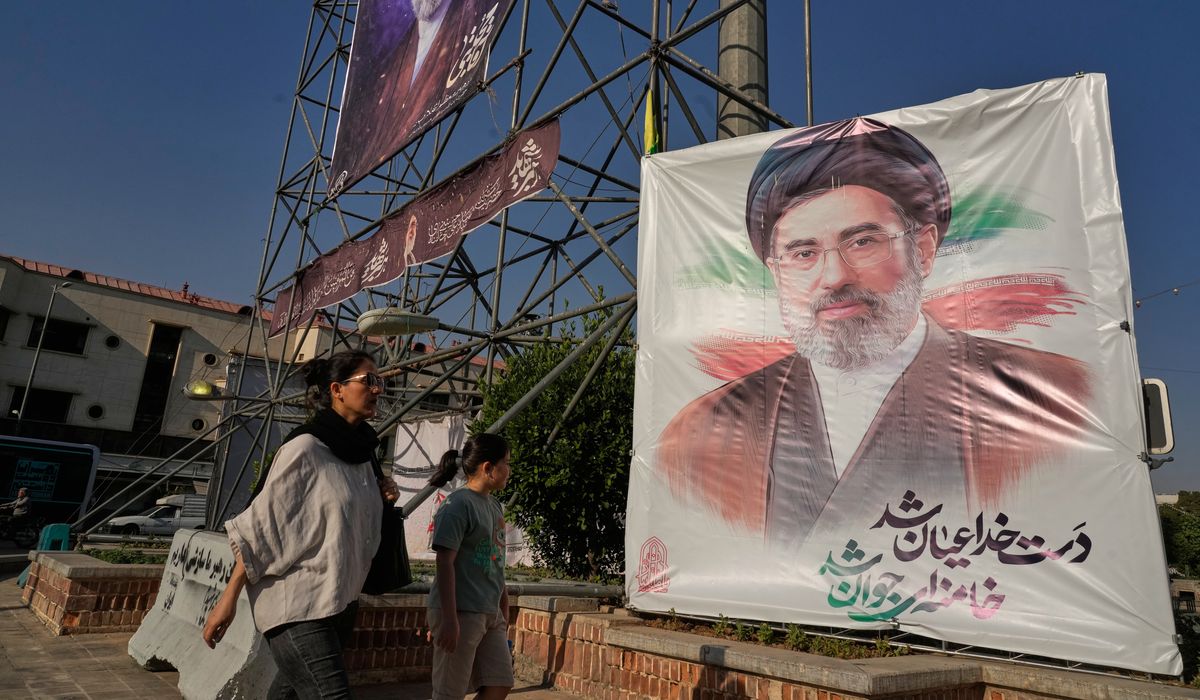
Questions about Mojtaba Khamenei’s whereabouts and influence keep surfacing, framed by a mix of sparse public appearances, state secrecy, and outside speculation; conservative observers see this opacity as part of a larger pattern of regime behavior that matters for the region and for U.S. policy.
The name Mojtaba Khamenei carries weight in Tehran even though he rarely shows himself in public. Where exactly is Mojtaba Khamenei? That precise question captures both curiosity and concern among analysts who watch Iran’s corridors of power. His low profile fuels rumors and gives the regime plausible deniability when claims of influence and direction come up.
Mojtaba is commonly identified as one of the Supreme Leader’s sons, and various reports over the years have tied him to conservative networks inside the Islamic Republic. Publicly confirmed facts about his formal role are minimal, which suits a leadership that relies on informal channels of power. For opponents of the regime, that ambiguity is not a bug but a feature: it keeps accountability thin and decision chains opaque.
From a Republican viewpoint, opacity in Tehran is dangerous because it hides who makes the real decisions and how far extremist elements can push Iranian policy. Washington needs clarity about decision-makers so it can calibrate pressure and deterrence, especially when Iran funds and arms proxies across the Middle East. If Mojtaba or any unelected inner-circle figure exerts influence, the U.S. should treat Tehran as an authoritarian system where public titles do not equal real authority.
Reports have periodically hinted that Mojtaba acts as an intermediary between the Supreme Leader’s office and hardline factions, though those accounts are often sourced to dissidents or foreign intelligence leaks. That uncertainty means analysts must weigh competing claims carefully and not accept state narratives at face value. The pattern, however, is consistent: Tehran allows certain figures to operate behind the curtain to protect the core leadership.
Inside Iran’s political culture, family ties matter and sometimes open doors to unofficial power. The Khamenei name provides access and influence, even without formal appointment to high office. Conservative policymakers in the United States argue that informal influence should be treated as a real source of power when assessing Iran’s motivations and likely actions.
This classification matters because covert influence can drive aggressive foreign policy without public accountability. If inner-circle actors encourage proxy attacks or accelerate nuclear efforts, their anonymity complicates international response. Republicans often point out that past U.S. approaches have underestimated how much behavior in Tehran is driven by behind-the-scenes actors rather than transparent ministries.
Evidence for Mojtaba’s role is a mix of anecdote, leaked documents, and pattern recognition rather than a public roster listing his authority. That means intelligence and open-source analysis must combine to produce a clearer picture. From a strategic standpoint, the U.S. should assume that opaque networks in Tehran are capable and responsive, and craft policy that does not rely on Tehran being transparent or cooperative.
Practically, the challenge for U.S. policymakers is twofold: first, to press Tehran with consistent consequences when Iranian behavior threatens U.S. interests and regional stability; second, to avoid rewarding silence or obfuscation by negotiating without clear verification mechanisms. Republicans tend to favor pressure over engagement that lacks hard guarantees, arguing that transparency should be a precondition for any serious deal.
Public curiosity about Mojtaba’s location ties into a deeper demand for accountability from a regime that shields its decision-makers. If Iran operates through shadow networks, then sanctions, intelligence cooperation with allies, and targeted actions become more important tools to expose and disrupt those networks. That approach treats secrecy as a vulnerability to be exploited rather than a mystery to romanticize.
At the end of the day, understanding who really calls the shots in Tehran is a matter of national security for the United States and its allies. Republicans believe clearer identification of actors like Mojtaba, coupled with firm policy responses, reduces the chance Tehran can pursue malign activities with impunity. The debate over Mojtaba Khamenei’s whereabouts is more than idle gossip; it is a test of how seriously the free world confronts opaque, authoritarian power.

