

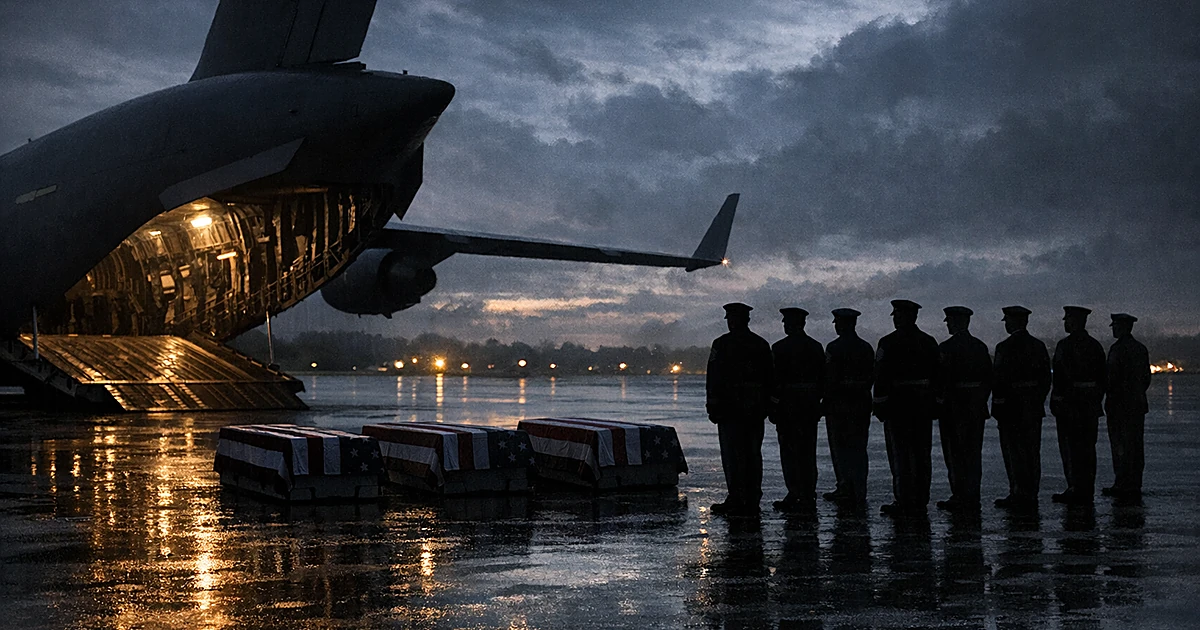
President Trump will attend the dignified transfer at Dover after three U.S. service members were killed in Iranian strikes, and he has vowed Tehran will “pay many times over.”
The White House confirmed the president’s plans Monday, with Press Secretary Karoline Leavitt posting the announcement on X after returning from maternity leave. Two of the three fallen troops have been publicly named: Army 1st Lt. Tyler James Feehan, 25, of Ewa Beach, Hawaii, and Pvt. Isabella Gonzales, 19, of Carrollton, Texas. Both were killed at Muwaffaq Salti Air Base in Jordan, while a third service member, whose name has not yet been released, died in Iraq during the controlled detonation of an Iranian drone.
This weekend’s losses raise the American death toll in the Iran conflict to at least 17 since February 28, covering multiple theaters across the Middle East. That total includes the six Army Reserve soldiers killed by a drone strike in Kuwait earlier this year, among other combat and non-combat fatalities. The escalation has stretched U.S. forces and left families waiting for answers.
The Pentagon released the identities of Feehan and Gonzales on July 17 and confirmed the third death occurred in Iraq during a detonation operation. Feehan held the rank of first lieutenant, and Gonzales was a private, nineteen years old. The military has not yet disclosed the branch or identity of the third service member killed in Iraq.
“will attend the dignified transfer of our fallen heroes tomorrow evening at Dover Air Force Base. The President and the entire White House are praying for their families.”
The dignified transfer was scheduled for Tuesday evening at Dover Air Force Base, the long-established point where American war dead are returned. A president who has made these solemn duties public before will once again stand on the tarmac as flag-draped transfer cases arrive. Families and military leaders will be there to receive the fallen.
“Every time Iran kills an American Soldier they will pay for that killing many times over!”
President Trump made that statement on his platform and directed the response through Defense Secretary Pete Hegseth, whom he labeled “Secretary of War,” and Chairman of the Joint Chiefs of Staff Daniel Caine. By naming specific leaders and extending the order to “every Leader in the Military,” the message was clear: retaliation is a matter of timing and scale, not debate. That posture reflects the administration’s public approach since the fighting intensified.
The most recent strikes followed the collapse of a memorandum of understanding between Washington and Tehran, a deal whose full terms and unraveling remain undisclosed. What is plain is the sequence: diplomacy faltered, and American forces suffered casualties. When diplomacy fails, hard choices follow and service members bear the consequences.
Earlier this year in March, President Trump attended a dignified transfer for six Army Reserve soldiers from the 103rd Sustainment Command who died in a drone strike in Kuwait. The six—Maj. Jeffrey O’Brien, Capt. Cody Khork, Chief Warrant Officer 3 Robert Marzan, Sgt. 1st Class Nicole Amor, Sgt. 1st Class Noah Tietjens, and Sgt. Declan Coady—were honored in a ceremony that brought senior officials and family to the base. That event underscored the personal cost of this widening conflict.
“It’s a very sad day. It’s the toughest thing I have to do.”
Those words were spoken by the president after that earlier transfer, and they reflect a grim ritual of leadership in wartime. The public duty of receiving the fallen resonates differently for those who must do it repeatedly. For the families it is an irreversible loss, and for the nation it is a reminder of the stakes involved.
The three deaths over the weekend represent one of the deadliest stretches for U.S. forces since late February and have heightened pressure on military and civilian leaders alike. The total American toll now stands at 17, including combat deaths in Jordan, Iraq, and Kuwait. Officials have said some fatalities were non-combat related, further complicating the picture for commanders on the ground.
The Pentagon has not specified the weapon systems used in the recent strikes, nor provided detailed circumstances about the third fatality beyond confirming it happened during a drone detonation. That lack of clarity leaves open crucial operational and legal questions for the department. Families and lawmakers are pressing for accurate, timely information.
“These soldiers engaged in the most noble mission: protecting their fellow Americans and keeping our homeland secure.”
Sen. Joni Ernst offered that tribute in March, and family members have given quieter, sharp reminders of what was lost. Joey Amor, husband of Sgt. 1st Class Nicole Amor, said simply: “She was almost home.” Those words capture the human reality behind casualty statistics.
The administration has paired military strikes with diplomatic moves, including the earlier release of an American detained in Iran for 19 months, showing a mix of pressure and negotiation. Still, the memorandum collapsed, strikes resumed, and more Americans came home in flag-draped cases. The cycle continues while key questions remain unanswered.
No date has been set for any specific retaliatory operation publically, and the Pentagon has not confirmed whether additional U.S. personnel were wounded in the weekend attacks. The identity of the third service member killed in Iraq also remains withheld for official notification purposes. Meanwhile, Iran continues to test U.S. resolve and the families at Dover already know the answer costs more than words on a screen.

