

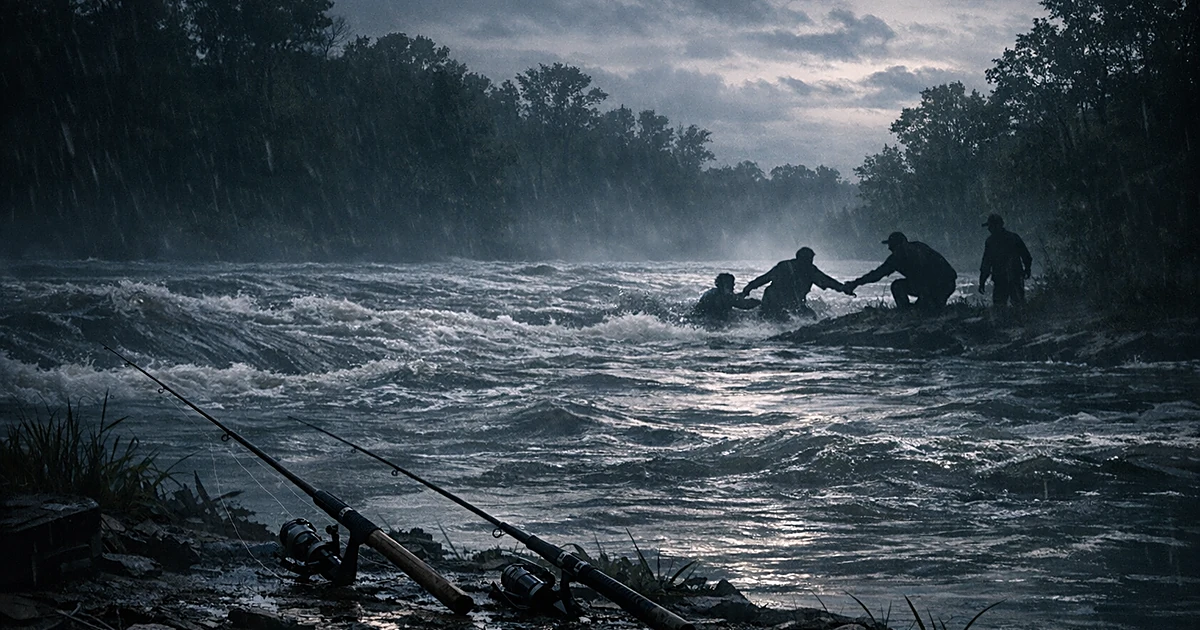
Angelina Khalimendik, 31, died after jumping into the swollen Des Plaines River to save her seven-year-old son during a family fishing trip at Independence Grove in Lake County, Illinois.
Angelina Khalimendik went into the river just after 7 p.m. when her son was swept away, and she managed to push him toward another family member before slipping beneath the surface. She was pulled from the water by a relative and bystanders and given CPR, then taken to Advocate Condell Medical Center where doctors pronounced her dead.
The Lake County Coroner’s Office later recorded the cause of death as “consistent with drowning.” Khalimendik was a Hinsdale resident and the mother of three children: an 11-year-old daughter, a 9-year-old son, and the seven-year-old boy she saved. Her husband was out of town when the current pulled her under.
Lake County Forest Preserves Police Chief Ron Davis said the area had been hammered by heavy rain in the days before the drowning, and that the river changed from a familiar summer spot into something fast-moving and dangerous. He explained how water and debris can hide hazards under the surface, turning a bank that looks safe into a trap for swimmers and waders.
“These bodies of water are flooded with not only extra water, but debris, fallen trees, branches, rocks, other things that are under the surface.”
That picture matters because the danger is often invisible to people on shore. After heavy rain the current speeds up and the water gets murky, hiding fallen branches, rocks, and other obstructions that can snag a foot or pin a swimmer. A parent who has seconds to react has no reliable way to gauge what the water will do to them.
Bystanders and family members acted quickly at Independence Grove, pulling Khalimendik free and beginning life-saving efforts before emergency crews arrived on scene. Despite those efforts, emergency doctors were unable to revive her, and the coroner’s finding closed the immediate medical question. Many practical questions about warnings or closures at the preserve remain unanswered.
Water-related deaths are not isolated to this incident. Searchers in Mississippi recently recovered the body of 18-year-old Nolan Xavier Wells after he went missing near a barrier island, and another unidentified man was pulled from the East River in New York City. These events underline how unpredictable open water can be and how often tragedies mount up across different settings.
Public health data shows the scale of the problem nationally: a CDC study found that more than 4,500 people drowned each year in the United States from 2020 to 2022. Drowning is the leading cause of death for children between the ages of one and four, a grim statistic that highlights how vulnerable young kids are around water even when adults are present.
The numbers behind those drownings are striking. Almost 40 million American adults do not know how to swim, and more than half of all American adults have never taken a single swimming lesson. Those gaps in basic skills help explain why so many drownings involve would-be rescuers who jump in on instinct and then get overwhelmed by currents, debris, or poor visibility.
Officials sometimes offer guidance on surviving if you are swept into moving water, but the advice can be nearly impossible to follow in a panicked rescue. Davis urged people to remain calm, roll onto their backs, and use arms and feet to push off obstacles while trying to angle toward shore. That guidance is sound, but a parent seeing a child disappear under water is operating on instinct and has very little time to think strategically.
“If you are swept in the water, remain calm. Try to roll over on your back. Use your arms and your feet as bumpers, pushing away at debris and branches and rocks that may be in your way, and try to get yourself in a position where you look closer to the shoreline, where you’re able to get yourself out or have people help you out safely.”
Details about whether Independence Grove posted any advisory, restricted access, or has a protocol for closing riverbank areas after sustained flooding have not been made public. The coroner’s determination that the death was consistent with drowning addresses cause but not whether preventable steps were missed. Those operational and policy questions are worth asking even as they do not change what happened to a mother who acted to save her child.
Khalimendik rescued her seven-year-old, and the child survived. That sequence—child saved, mother lost—captures the immediate human reality of the night, and it echoes other summer tragedies where instinct and love collide with raw natural force. In a country where tens of millions of adults lack basic swim skills and where public water-safety infrastructure is limited, these kinds of losses are likely to keep happening to people who step in to help.

