

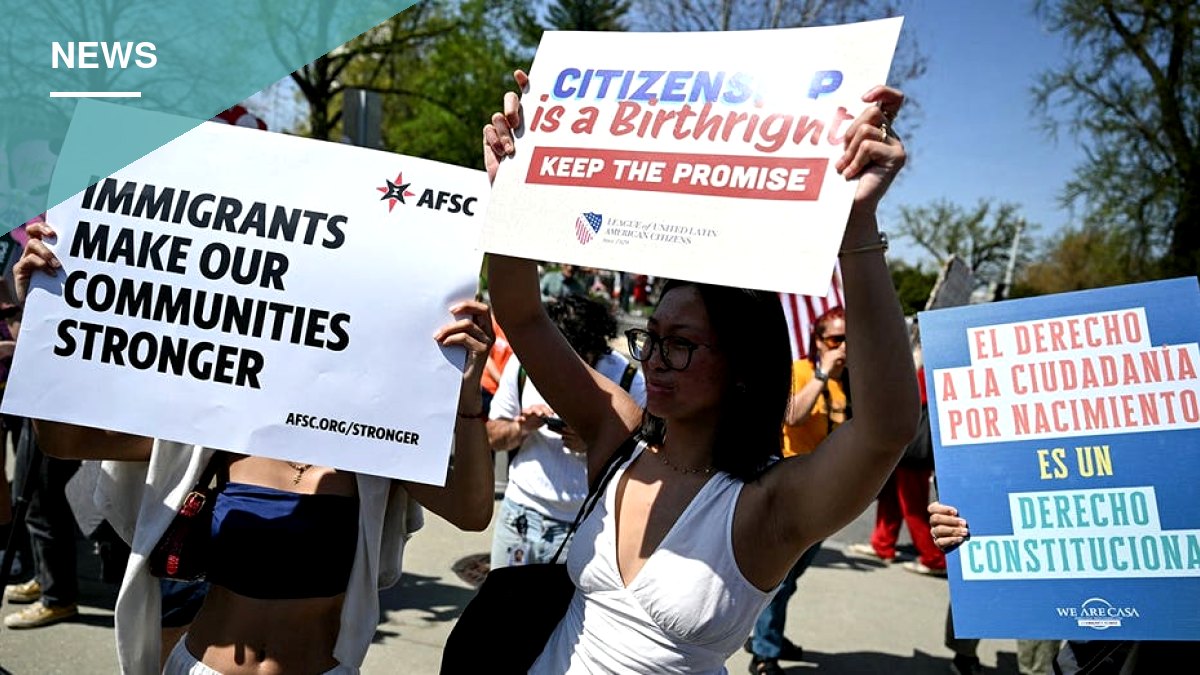
A federal judge has blocked President Donald Trump’s revised executive order narrowing birthright citizenship, marking the first court setback for the administration’s second attempt at the policy since the Supreme Court weighed in this summer.
U.S. District Judge Deborah Boardman, appointed by President Biden, issued a preliminary injunction against the Aug. 6 executive order in a 35-page ruling. The order, signed a month after the Supreme Court’s ruling in Barbara v. Trump affirming birthright citizenship, sought to deny citizenship to children whose parents are deemed “alien enemies,” including members of designated Foreign Terrorist Organizations, as well as children born to foreign parents who paid a surrogate in the U.S. to give birth, among other restrictions.
Boardman had previously blocked Trump’s original birthright citizenship order before the Supreme Court’s June ruling. That decision, a 5-4 opinion, held that children born in the United States to parents who are unlawfully or temporarily present in the country are “citizens at birth” under the 14th Amendment, though the Court acknowledged narrow exceptions, such as children of foreign diplomats or children born during a hostile enemy occupation.
“The 2026 Executive Order is almost certainly unconstitutional as applied to the certified class for the simple reason that the Supreme Court in Barbara already decided that the children in the class are citizens at birth,” Boardman wrote. “This Court must, once again, preliminarily enjoin enforcement of the President’s most recent attempt to strip the right to citizenship from them.”
The lawsuit was brought by Court Appointed Special Advocates (CASA) after the order’s signing. Boardman sided with the group’s argument that the administration takes an overly broad view of who counts as an “alien enemy,” saying the government has at times relied on “false or speculative allegations, or even tenuous markers like tattoos or family affiliations.”
Two plaintiffs illustrated the judge’s concerns: Andrea, who fled an area of Mexico controlled by a designated cartel and whose child’s father has a relative in that group, and Monica, a Venezuelan woman who worries her family could be wrongly tied to the gang Tren de Aragua.
“Children whose parents may ‘rightly or wrongfully’ be deemed by the government to be alien enemies face a credible threat of ‘being denied or stripped of their birthright citizenship… even though they do not fall within a recognized exception to birthright citizenship,'” Boardman wrote.
A legal dispute over the shape of the challenge
Not everyone finds the ruling airtight. Abhi Kambli, a former Justice Department official, told Fox News Digital that Boardman’s reasoning rests on speculation about how the administration might misapply the order rather than on the order’s lawfulness as written.
“Legally, where that falls short is that it’s a facial challenge to the entire executive order,” Kambli said. “So, in legal terms, when something’s a facial challenge, you have to demonstrate that it’s unlawful in all of its applications, and not just the edge, the borderline cases.”
Kambli added that Boardman avoided ruling on whether the alien-enemy category fits within the exceptions recognized in Barbara v. Trump, and instead accepted the plaintiffs’ worry that the government could misidentify people — as it has with groups like Tren de Aragua — and strip citizenship from their children as a result.
Boardman found that denying citizenship under the order, even temporarily, would cause irreparable harm, one of the legal standards required for a preliminary injunction. “The loss of birthright citizenship — even if temporary and later restored at the conclusion of litigation has cascading effects that will very likely leave permanent scars on the child and their family,” she wrote, citing First Circuit precedent.
Reaction from both sides
The White House dismissed the ruling as the product of judicial activism. Spokeswoman Lauren Bis said in a statement that

