

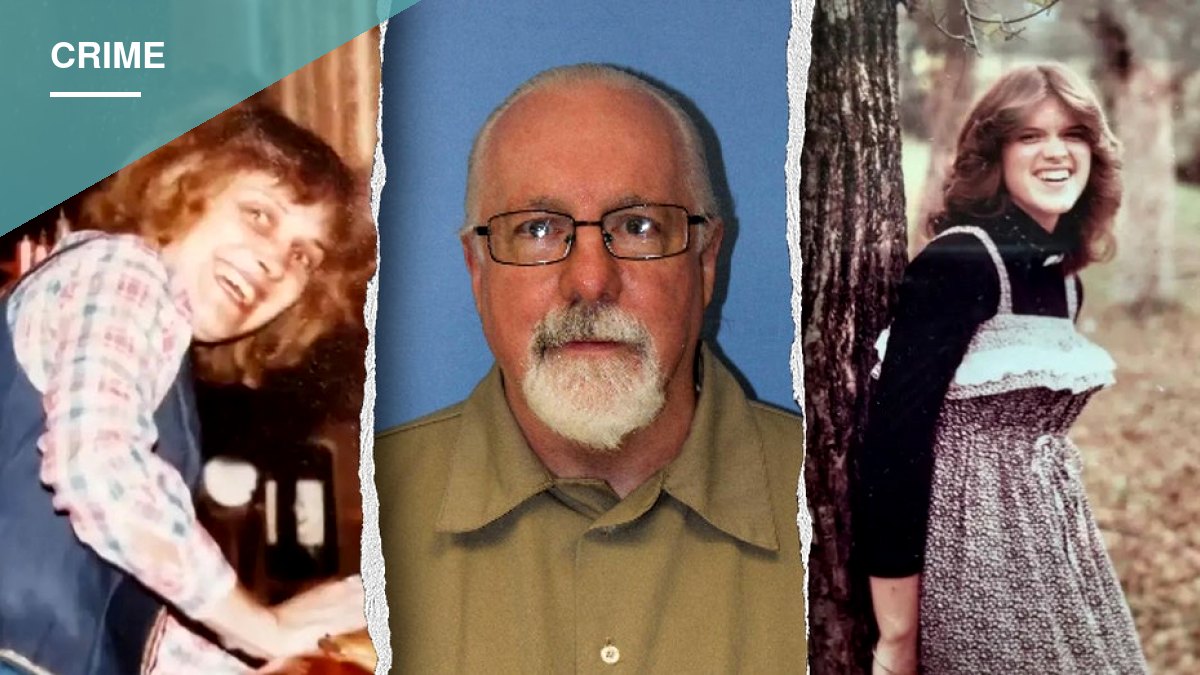
Mitchell Gaff is now serving 50 years to life in a Washington prison for two 1984 murders that went unsolved for four decades, after a detective obtained his DNA through discarded chewing gum. The case has reopened questions about how the state’s civil commitment system handled a man who had already admitted to six rapes during court-ordered psychological evaluations.
Gaff pleaded guilty in April 2026 to the murders of Judith “Judy” Weaver and Susan Vesey. A Snohomish County Superior Court judge handed down the sentence the following month.
In June 1984, Weaver was found bound, sexually assaulted and strangled in her apartment off Rucker Avenue in Everett. Gaff had also cut her clothing with a knife and set a fire at the scene, apparently to destroy evidence. Investigators initially suspected her fiancé, Bill Richards, who remained a person of interest until his death in 1994, according to KING 5 News, which reported that Weaver’s daughters had described a volatile relationship between the couple.
Vesey, found beaten and bound in her Everett home on June 2, 1984 — the morning of her 21st birthday — was identified as a second victim once DNA evidence connected Gaff to that case as well.
The Gum That Cracked the Case
In November 2023, Everett Police Department Detective Susan Logothetti submitted Weaver’s case evidence for modern DNA analysis after obtaining a sample from Gaff through a ruse involving chewing gum. Authorities arrested him in May 2024 once the DNA results came back. Police said Gaff’s own statements about the killings matched physical evidence investigators had gathered over the decades.
A Long History the State Knew About
Gaff’s record of violence predates the murders by years. In 1979, a jury convicted him of first-degree burglary and second-degree assault after he bound a woman’s hands, struck her repeatedly with a pistol and smashed her head against concrete before she managed to escape, according to a Washington Court of Appeals opinion. He received probation and work release for that crime.
While still on probation in 1984, Gaff broke into an Everett home and raped two teenage sisters, ages 14 and 16, at knifepoint. A judge imposed an exceptional 138-month sentence, revoked his probation and ordered the sentences served consecutively.
Ahead of his scheduled release, the state petitioned to commit Gaff as a sexually violent predator. During evaluations tied to that proceeding, Gaff admitted to making obscene phone calls and committing sexual assaults, including six rapes. A jury found he met the legal standard for civil commitment, and the Washington Court of Appeals upheld that finding in April 1998.
One psychologist who testified for the state diagnosed Gaff with sexual sadism and concluded he was likely to reoffend. A defense-retained expert disagreed, arguing Gaff could live safely in the community under supervision.
From Maximum Confinement to Unconditional Release
By 2005, state evaluators determined Gaff no longer needed maximum-security confinement and approved his move to a less restrictive setting. In 2006, he left the Special Commitment Center on McNeil Island for a secure halfway house in Seattle’s SoDo neighborhood under an agreement requiring GPS monitoring and supervision whenever he left the facility — and barring him from challenging his sexually violent predator status for eight years.
That arrangement held until September 2018, when a court dismissed his sexually violent predator petition and unconditionally released him from civil commitment altogether, according to a 2019 report in The Olympian. Gaff went on to live in Olympia under the alias “Sam Wise Price.”
Forensic psychologist Dr. Katherine Ramsland, who is not connected to the case, said the risk of releasing someone who had already confessed to prior assaults is straightforward. “Psychologically, if he’d confessed but discovered there’d be no consequence, he’d likely feel emboldened to potentially repeat it,” she said. On the legal difficulty of extending confinement, Ramsland added: “It’s tricky to hold them beyond their sentence, and sometimes it means having to prove they’re an imminent danger, not just a possible one.”
Detectives Searching for More Victims
Everett police are now reviewing other unsolved homicides, sexual assaults and cold cases for any connection to Gaff. “This is ongoing. I absolutely believe there are more victims,” Detective Logothetti told Fox News Digital.
Logothetti said Gaff told evaluators over the years that he deliberately altered details of his own admissions. “He said it was amusing to him to change details in his admissions, which his treatment team did not pick up on over the years,” she said.
Detectives have compared Gaff’s disclosures against unsolved cases in Washington and other states but have not identified additional victims or crimes since his 2024 arrest or his 2026 guilty pleas, Logothetti said. Gaff’s defense attorney, Heather Wolfenbarger, declined to comment.
Anyone with information about other potential victims linked to Gaff is asked to call the Everett Police Department tip line at 425-257-8450.

