
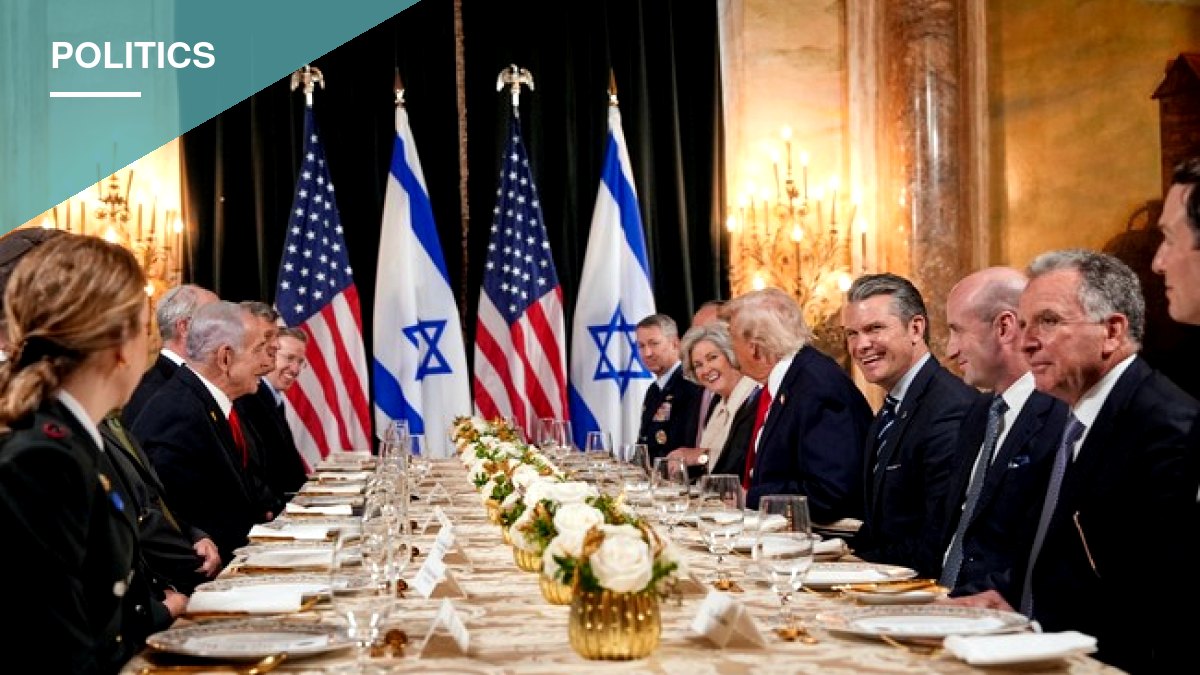
New polling released after the midterm elections shows that Republican support for Israel remains strong even as the party’s postmortem debates have focused heavily on whether U.S. involvement in the Middle East hurt candidates at the polls. The survey, commissioned by the Vandenberg Coalition and conducted by J.L. Partners, found that 77 percent of Republicans consider Israel an ally of the United States, while only 11 percent view it as an adversary.
Support is somewhat softer among younger Republicans. Among those under 30, 60 percent still call Israel an ally, compared to 31 percent who see it as an adversary.
Separate polling carried out by OnMessage, a national Republican consulting firm, on behalf of CAM Action, the advocacy arm of the Combat Antisemitism Movement, surveyed likely Republican primary voters in Iowa, New Hampshire, Nevada and South Carolina—the four early-voting states that typically carry outsized weight in choosing the party’s presidential nominee. That poll found 68 percent of respondents held a favorable view of Israel, against 17 percent unfavorable.
Carrie Filipetti, executive director of the Vandenberg Coalition, said the numbers reflect a party still oriented around deterrence even amid economic strain.
“The reality is there were a number of factors that led to the midterm results we saw. But taken all together, this poll paints a picture of Republicans who – despite significant concerns over the affordability crisis in this country – fundamentally remain champions of ‘peace through strength’ and know that protecting our homeland and our citizens from our adversaries comes first.”
Cale Brown, chair of Polaris National Security, argued that the U.S.-Israel relationship delivers concrete security benefits that sometimes get lost in political debate.
“Israel has long been a critical strategic partner of the United States. The notion that our partnership with Israel provides no direct benefit to American national security ignores decades of fruitful security and intelligence cooperation. From combating terrorism to countering radical, authoritarian regimes, Israel has played an important role in advancing U.S. strategic objectives in the Middle East.”
Affordability, Not Foreign Policy, Topped Voter Concerns
The Vandenberg survey also sheds light on what actually drove voters to the polls in the midterms. Among all surveyed voters who participated, 51 percent ranked the economy and cost of living among their top three issues. By contrast, only 17 percent cited the conflict with Iran, and just 12 percent named America’s relationship with Israel as a top concern.
Among voters who flagged affordability as a priority, 65 percent pointed specifically to grocery and food prices, while 41 percent cited gasoline prices.
Mike Martin, a former Trump National Security Council spokesman, said the results track with how voters typically weigh their choices.
“Despite the increasingly divisive discourse online, voters tend to prioritize the issues that most directly affect their everyday lives like the cost of living, their pocketbooks, and their retirement security.”
Views on Iran Remain Hawkish
The polling also found continued appetite among Republican voters for a firm approach toward Iran. Of Republicans who participated in the midterms, 71 percent said the United States should prioritize achieving its military objectives and ending the conflict on favorable terms, while 24 percent favored an immediate exit.
Corban Teague, the Vandenberg Coalition’s policy director, said the findings show voters still draw clear lines between allies and adversaries.
“This poll shows Republican voters remain clear about who are our enemies and who are our friends. They continue to back President Trump in making sure Iran never gets a nuclear bomb, and they recognize Israel is an important ally in that effort.”
Taken together, the surveys suggest that while Republicans have real reasons to scrutinize their foreign policy messaging—particularly given softer numbers among younger voters—the data does not support the idea that the party’s electorate has turned against Israel. Instead, it points to affordability as the issue most likely to shape how Republicans campaign heading toward 2028.