

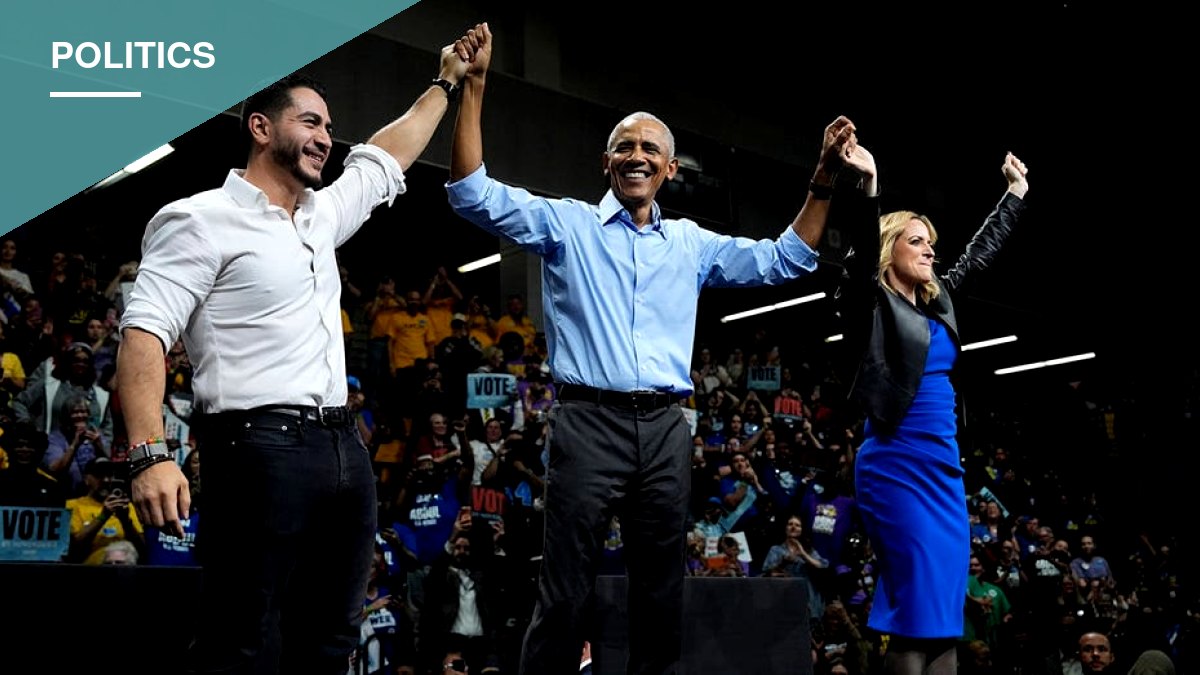
DETROIT — Supporters of Michigan Democratic U.S. Senate candidate Abdul El-Sayed say they want him to champion guaranteed income programs, a cash-assistance model spreading through cities nationwide even as critics question its price tag and effect on work incentives.
The comments came outside Cass Technical High School, where El-Sayed held a campaign rally joined by former President Barack Obama. The event was widely seen as a bid by the progressive candidate to shore up support from the Democratic establishment as he runs to succeed retiring Sen. Gary Peters, D-Mich.
Fox News Digital interviewed rallygoers leaving the venue about whether guaranteed income should be central to El-Sayed’s platform.
“I think it’s a good idea. With the prices rising and programs being cut like they are and trying to get access to them. Yeah, I think it’s a good idea. I hope he supports them,” one attendee said.
“I do, and I think the billionaires should be paying for it,” a voter identified as Dave said.
Kiana Montgomery, a publicist attending the rally, backed the idea but said she’d want conditions attached.
“I do [support it]. I think there should be parameters — exactly what people can spend it on to ensure everybody’s trying to uplift the community as a whole,” Montgomery said. “A rising tide lifts all ships, and if people are in need, we should definitely support them.”
What El-Sayed Has Proposed
El-Sayed has previously spoken favorably of direct-cash anti-poverty measures, including at the “Guaranteed Income Now” summit in Detroit. His formal campaign platform, however, centers on Medicare for All, a higher minimum wage, and expanded federal safety-net programs rather than guaranteed income itself.
At the summit, El-Sayed described a narrower pilot concept for Wayne County:
“How do we address poverty at that transition between generations in a family? We’ve got too many parents trying to do the impossible: to go to school, to raise kids, and to earn a living all at the same time,” he said. “So what we’ll be proposing … in Wayne County is a pilot to invest $500 a month in young parents who are enrolled in community college. As you try to do the impossible, we can give you a leg up — one less shift of work a week to try and be that student you want to be and that parent that you need to be for your kids.”
That summit was organized by the Economic Security Project, an advocacy group founded in 2016 that says it has helped launch more than 100 guaranteed-income pilot programs across the country. Such pilots are typically temporary and unconditional, intended to test the economic and health effects of direct cash payments rather than serve as permanent policy.
Rx Kids and the Funding Fight
The debate is unfolding alongside the expansion of Rx Kids, a public-private cash program for pregnant women and infants that is growing across Detroit and other Michigan cities. The program gives eligible pregnant women a one-time $1,500 payment followed by $500 a month for up to 12 months after birth. Organizers describe it as a targeted “child allowance” rather than universal basic income, though critics note both rely on unconditional cash transfers.
Michigan House Republicans have pressed for more oversight of Rx Kids, which has drawn nearly $400 million in combined public and philanthropic funding. House Oversight Committee Chairman state Rep. Jay DeBoyer, R-Clay Township, has criticized the absence of spending guardrails, calling unconditional cash a “redistribution of wealth” rather than a fix for systemic poverty. Republican lawmakers have also questioned administrative costs, including fees paid to GiveDirectly, the nonprofit that runs the program.
Conservative policy groups and GOP lawmakers argue these programs can discourage work and increase dependence on government. Supporters counter that data from more than 250 cash-transfer pilots in 40 states and Washington, D.C., shows reductions in infant poverty and improved health outcomes.
Detroit is one of more than 100 U.S. municipalities that have tested basic-income-style programs since 2018. With pandemic-era federal relief funds now exhausted, local officials are looking for ways to sustain cash transfers through other means. In Cook County, Illinois, for example, commissioners set aside $7.5 million in local tax dollars to make the county’s guaranteed-income program a permanent part of the budget.
Healthcare and Cash Assistance, Linked for Many Voters
Several rallygoers tied the guaranteed-income question directly to healthcare access.
“He absolutely should [campaign on it], especially being a woman and knowing what women risk, especially in healthcare, how there’s already a deference against us,” supporter Tammy Bacon said. “They don’t listen to what we need. There’s a significant need for women in healthcare and to listen to our issues, our values, and respect us and give us the care that we need without being discriminatory or presumptuous.”
Mohammed, a Bloomfield Hills resident who attended the rally, said he’d support targeted cash aid if it were well managed.
“It’s a good thing — as long as the money is being used the right way for good and for children … women, children, and pregnant women,” Mohammed said. “For people who want to get an education, that’s a good idea, too.”
El-Sayed’s campaign did not immediately respond to a request for comment.

