

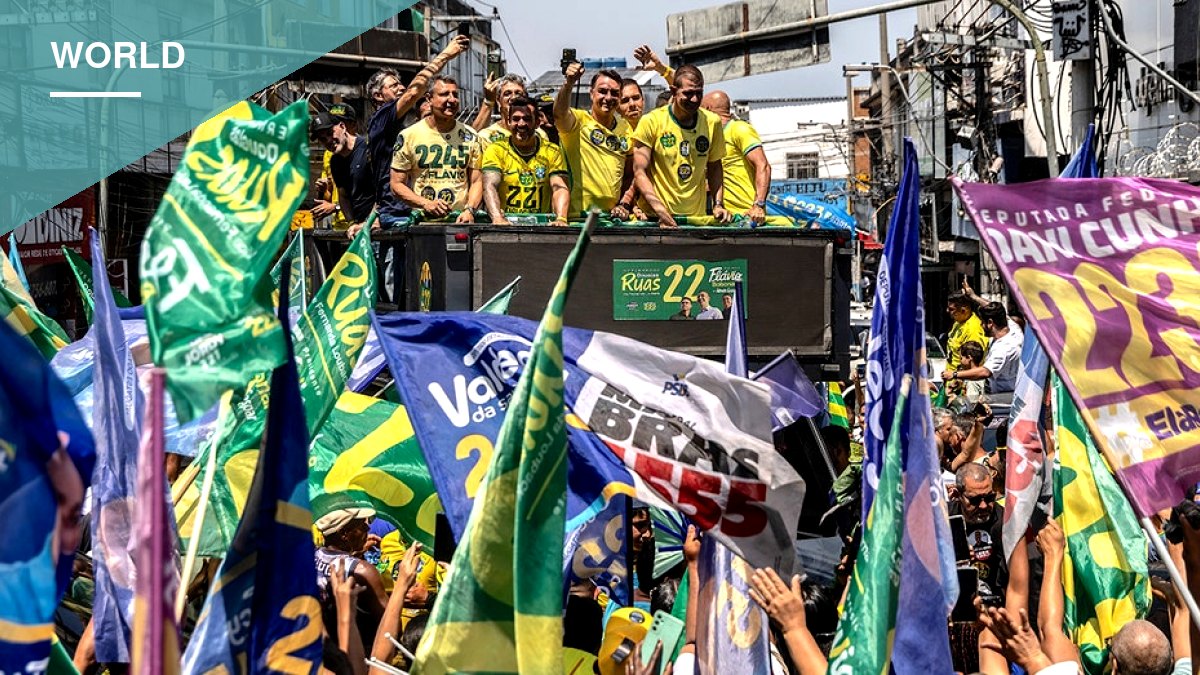
São Paulo — Brazilians vote Sunday in an election that analysts say could determine whether Latin America’s largest economy joins a regional shift away from left-wing governance, following similar political turns in Colombia, Peru and Chile.
President Luiz Inácio Lula da Silva, 80, who previously served time in prison on corruption charges tied to a bribery scandal, holds a narrow lead over Brazilian senator Flavio Bolsonaro, son of former president Jair Bolsonaro.
Neither candidate is expected to secure outright victory in Sunday’s first round. The latest Datafolha poll shows Lula at 42% and Bolsonaro at 38%, within a two-point margin of error. In a hypothetical runoff, the same poll has Lula ahead by three points. Other analysts caution that Datafolha’s track record with anti-Lula candidates has been inconsistent.
“The problem with Datafolha, which is the largest polling institute in the country, is that it tends to underestimate the force and voting intention in candidates running against Lula or the Workers Party (PT). This has been consistent for at least over a decade, and it underestimated Jair Bolsonaro’s number on the runoff of 2018 by 7%,” said Roberto Reis, an electoral strategist who works with candidates across multiple electoral tiers and tracks aggregator polling data.
Reis said aggregator sources such as MRT News and Polling Data currently show Lula leading Bolsonaro 42% to 39% heading into the first round, but Bolsonaro edging ahead 45% to 44% in a runoff scenario.
A Hemisphere-Wide Stakes
Brazil is widely seen as the last major holdout against a conservative wave that has swept much of the Western Hemisphere. While other left-leaning governments remain in Cuba, Jamaica, Mexico, Nicaragua and Uruguay, none rival Brazil’s economic weight — the International Monetary Fund ranks it the 11th largest economy in the world, and the World Bank ranks it 10th.
Bolsonaro has worked throughout the campaign to build a relationship with President Donald Trump, positioning himself as a prospective U.S. partner in the region. The two met at the White House in May to discuss organized crime, tariffs, and Brazil’s reserves of rare earths and critical minerals — resources that could reduce U.S. and European reliance on Russia and China.
Bolsonaro has also said he asked Washington to designate Brazil’s two largest criminal organizations, the First Capital Command (PCC) and Red Command (Comando Vermelho), as terrorist groups. The State Department accepted both designations on May 28, and they took effect in June under section 219 of the Immigration and Naturalization Code — a move Lula and his allies viewed as interference in Brazil’s domestic affairs.
Bolsonaro has proposed a free-trade agreement between Brazil and the United States that could eventually expand into a broader hemispheric arrangement, according to Brazilian newspaper Folha de S. Paulo. His campaign has also stressed cooperation with Washington on critical minerals as the Trump administration seeks to cut U.S. dependence on China.
Diverging Paths on China and Trade
China remains Brazil’s largest trading partner. Brazilian agricultural exports to China topped $55 billion in 2025, according to Reuters. Lula has defended maintaining close ties with Beijing as part of what he calls an independent foreign policy — one that has at times grown confrontational toward both the United States and its allies, including Israel.
Relations between Lula and Trump have been strained. Washington imposed new 25% tariffs on a broad range of Brazilian goods in July, affecting roughly $7 billion in exports. Lula’s government has challenged the tariffs and sought negotiations with limited success. The U.S. has also restricted most new permanent visa requests from Brazil, a category that can lead to green cards.
A Bolsonaro presidency would bring stated plans for closer U.S. economic and security ties, greater alignment with Israel, and a more confrontational stance toward Chinese influence in Brazil. Implementing those plans would depend on negotiations with Congress, Brazil’s bureaucracy, and powerful economic interests, particularly in agribusiness and mining.
A Lula victory would mean continuity — strong commercial ties with China, strategic distance from Washington, and the current government’s positions on Israel and Gaza, all of which stand at odds with Trump administration policy.
With the race likely heading to a second round, the outcome could shape the balance of power across the hemisphere and the future of U.S. relations with the region’s largest economy.

