

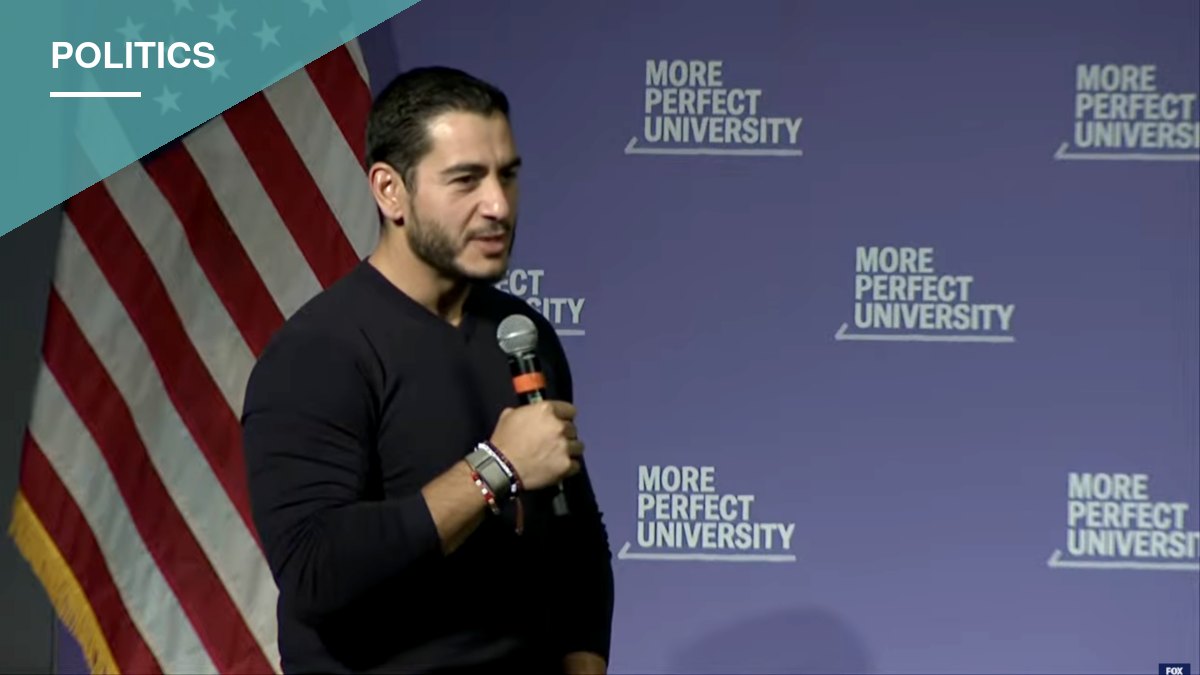
Court documents filed in 2016 show that Mariam Jukaku, the sister of Sarah Jukaku — wife of Michigan Democratic Senate candidate Abdul El-Sayed — was a plaintiff in two lawsuits challenging her alleged placement on the federal Terrorist Screening Database, according to filings reviewed by The Federalist.
The suits were brought by the Council on American-Islamic Relations (CAIR) on behalf of individuals who disputed their inclusion on the watch list. Texas and Florida have recently designated CAIR a terrorist organization. One suit sought an injunction removing plaintiffs from the database along with a declaratory judgment that their Fifth Amendment rights had been violated. The second was a class-action complaint seeking compensatory damages and legal fees from the government. Jukaku appeared at a CAIR press conference announcing the litigation.
According to the suit, Jukaku first filed a complaint with the Department of Homeland Security after noticing in 2012 that her boarding pass carried the “SSSS” designation, which flags a passenger as a “known or suspected terrorist.” She said the designation led to “extensive searches, pat downs and chemical testing,” and she speculated the listing resulted from racism or religious discrimination, as she is Muslim. She said she believed she had been removed from the list after filing her DHS complaint, though the government never confirmed either her placement on the list or her removal from it.
DHS referred The Federalist’s request for comment to the FBI, which stated it is “the U.S. government’s policy to neither confirm nor deny a person’s inclusion in the Terrorist Screening Dataset, commonly known as the terrorist watchlist.”
The Terrorism Screening Database contains more than a million names of individuals suspected of terrorism-related activity or ties to terrorism, and is used by Customs and Border Protection, the Transportation Security Administration, and local law enforcement. Some listed individuals are barred from flying domestically, while others face additional screening or location tracking.
The class-action suit was dismissed without prejudice in September 2017 after both sides agreed the case could not proceed following a U.S. Supreme Court ruling that monetary-damages claims against federal officials require “special factors.” The injunction suit was resolved in 2021, when the 4th Circuit Court of Appeals reversed a lower court’s summary judgment for the plaintiffs, concluding they had not shown infringement of constitutional liberty interests under the Due Process Clause.
Jukaku could not be reached for comment on the matter.
Background Details
Filings in the lawsuits indicate Jukaku lived in California as of 2016. Earlier news coverage — a 2003 Los Angeles Times article and a 2004 Daily Bruin article — describes a Mariam Jukaku who led the Muslim Student Association at UCLA and served as editor of the student publication Al-Talib. According to the Bruin, when federal authorities moved against several Al-Talib advertisers over alleged terror ties, the student editor defended the organizations and called similar allegations against the MSA itself “ridiculous.”
A 2007 Daily Orange article describes a Mariam Jukaku, then a Syracuse University graduate student, taking part in a Ramadan fasting event. Separate reporting from the same period describes a Syracuse student of the same name being confronted by security after photographing a Veterans Affairs hospital; she suggested her appearance was a factor, while officers cited security protocols, and CAIR suggested discrimination played a role. A 2006 Washington Post piece on demand for food meeting Islamic legal standards was bylined to a Mariam Jukaku, and a 2009 issue of Islamic Horizons lists a Mariam Jukaku as a graduate of both UCLA and Syracuse.
Wider Scrutiny of El-Sayed’s Family
El-Sayed’s family has faced repeated scrutiny during his Senate campaign. His wife’s medical practice does not accept Medicare, a point critics have raised given El-Sayed’s support for Medicare for All. Sarah and Mariam Jukaku’s father, Tayeb Jukaku, sits on the board of CAIR Michigan and has contributed $300,000 to El-Sayed’s campaign; he has also been alleged to lead a Muslim Brotherhood-linked group accused of funding Hamas, though that allegation has not been independently verified here.
El-Sayed’s half-sister, Eman Abdelhadi, was taken into custody on allegations of spitting on a police officer during an ICE protest; she has pleaded not guilty. El-Sayed’s birth mother reportedly worked for an organization designated as a terror group that supported Osama bin Laden.
El-Sayed himself has faced separate controversies in recent weeks, including a viral exchange with a Michigan University student in which he declined to condemn the Iranian regime or the Islamic Revolutionary Guard Corps, a U.S.-designated terrorist organization tied to the deaths of hundreds of American servicemembers. A document surfaced last month indicating he had backed the Muslim Brotherhood and a 2012 “purge” of media and law enforcement in Egypt. He has also expressed support for Sharia law and campaigned last week alongside Osama Siblani, an activist described as pro-Hezbollah and pro-Hamas.
El-Sayed’s campaign did not respond to a request for comment.

