

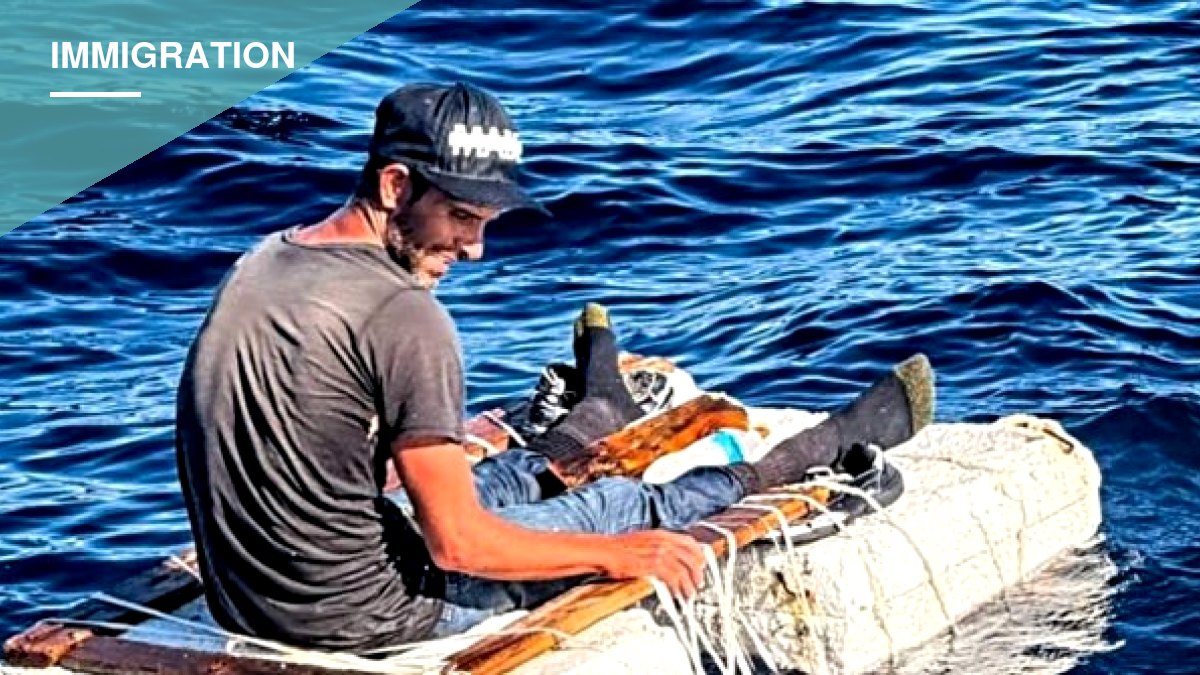
A Cuban man rescued after five days adrift on a homemade raft of wood and foam says he never intended to reach the United States, despite his own cousin telling a different story to media before he was sent back to Cuba.
Enrique René Reyes Martínez, 38, was found by U.S. Coast Guard officials on October 12 about 16 miles east of Key Biscayne, Florida. U.S. Customs and Border Protection Air and Marine Operations (CBP AMO) released a photograph of him floating alone at sea and used the moment to warn Cuban nationals against attempting the crossing, noting that thousands have died trying and that those identified as irregular migrants are returned home.
“This incident underscores the extreme danger of attempting illegal maritime migration. The open water is unforgiving, and these journeys can quickly become fatal,” CBP AMO said at the time, adding that Reyes was being processed to confirm his identity, check his health, and determine what would happen to him.
Reyes was quickly repatriated to Havana. Reports following his identification said he had departed Cojímar, Cuba, on October 8 and spent roughly five days at sea before his rescue — a journey of about 230 miles.
Speaking by phone with Miami’s Univisión affiliate over the weekend, Reyes rejected the label “balsero,” the term for Cuban rafters who flee the island’s communist government by sea, often in homemade and dangerous vessels.
“I never had the intention of leaving the country, this is just something that happened to me that was very difficult and complicated,” Reyes said. “I have life thanks to God because, who survives on a little piece of cork like that?”
Reyes said he has a seven-year-old daughter and that thoughts of seeing her again kept him going during the ordeal, which included three-meter waves and a shark he spotted swimming beneath his raft.
“I survived thanks to wanting to see my family again, my daughter, those are the things that kept me alive and I always said I wasn’t going to die at sea,” he said. “I struggled day and night with 3-meter-long waves.”
He credited his survival to staying calm and to his devotion to Our Lady of Charity, Cuba’s patron saint, whom Cubans associate with a 1612 account of three men rescued at sea and who has become a symbol for the tens of thousands who have tried to reach America by water under communist rule. Reyes praised the treatment he received from his American rescuers as “impeccable” and thanked the people who spotted him and alerted authorities. He said he does not plan to go fishing again.
Fishing is largely illegal for ordinary Cubans, as the island’s Communist Party tightly restricts activities that would let citizens access food independently, including farming and fishing. The practice is mostly confined to tourist recreational anglers and Party elites. It remains unclear whether Reyes will face any punishment from the Cuban government, either for leaving the island or for attempting to fish.
Reyes’s account differs sharply from what a cousin, Gema Castillo Reyes, told Telemundo after he was identified but before his return to Cuba. She said he had repeatedly told family he wanted to leave the country to give his daughter a better life, and she appealed to American authorities to let him stay.
“He did it out of necessity, because of levels of desperation, because of many things that were happening,” Castillo Reyes said. “Nobody takes that risk in what he did and survives to tell the tale. Truly, he deserves to stay [in the United States].”
Castillo Reyes said that while her cousin told relatives he was going fishing, “in reality his intentions were something else.” The Telemundo report did not cite any evidence supporting that claim.
The U.S. Coast Guard and immigration authorities have spent decades contending with Cubans trying to escape poverty and repression by crossing the Straits of Florida. Conditions on the island have worsened this year following the January arrest of Venezuelan dictator Nicolás Maduro, who had propped up Cuba’s tourism sector with cheap or free oil used to power generators in tourist and luxury areas. Cuba’s Communist Party abandoned maintenance of the national power grid years ago, leaving those without private generators to live without reliable electricity. Allies including China, Russia, and Iran have not made up the shortfall, and Maduro’s successor, Delcy Rodríguez, struck a deal to sell Venezuelan fuel to the United States rather than continue supplying it to Havana at a discount.

