

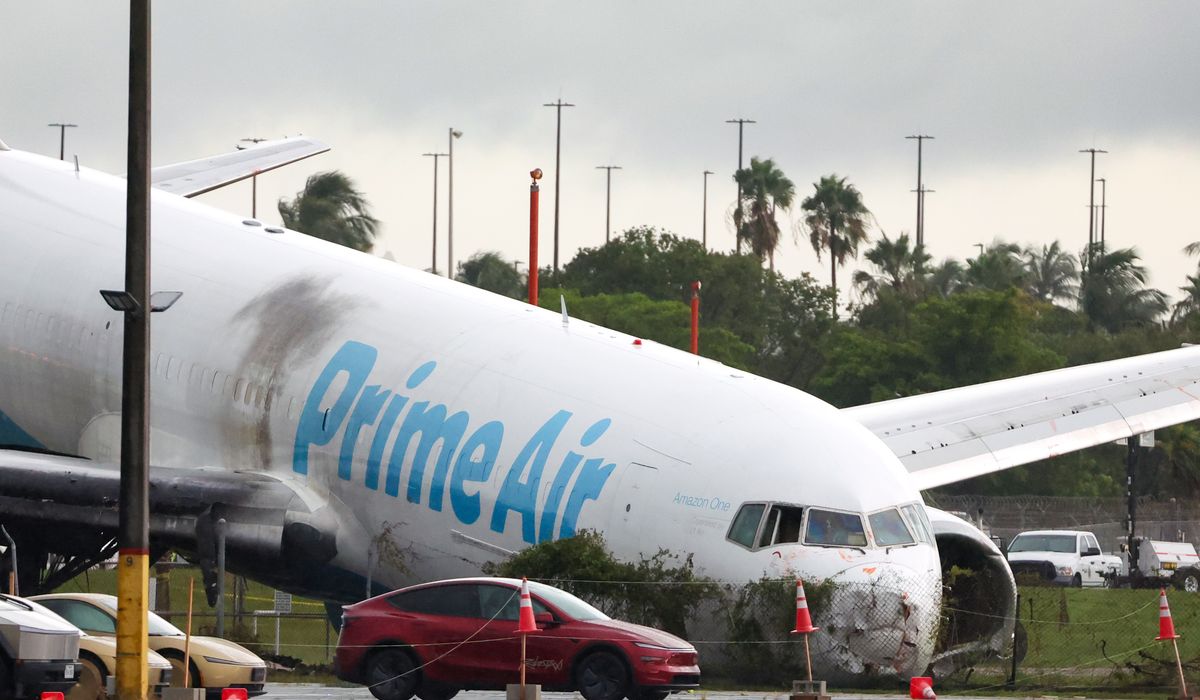
Flight data indicate an Amazon cargo jet attempted to abort an unstable landing at Miami International Airport and then collided with a van, killing five people inside, investigators say.
Officials say onboard recording and telemetry point to a late decision to reject the approach as the aircraft came in, suggesting pilots tried to go around after an unsteady touchdown sequence. That attempted maneuver preceded the aircraft striking a vehicle on the ground, and investigators are combing through data to piece together exactly what happened. The scene left the airport and nearby roads in chaos while emergency crews responded.
The collision occurred at Miami International Airport, a busy hub where runways and service roads sit close to active operations. Five people inside the van were killed in the impact, according to the information released so far, and authorities have emphasized that identification and family notifications remain ongoing. Airport operations were disrupted while first responders secured the area and officials documented the wreckage and scene conditions.
Investigators have focused on flight data and voice recordings to understand whether weather, mechanical issues, or human factors played the primary role in the aborted landing. Early statements describe the approach as unsteady, but that term covers a range of conditions from turbulence to control inputs that did not stabilize the aircraft. That leaves a wide investigative agenda: throttle and flap settings, landing gear behavior, pilot communications, and any potential alarms or warnings in the cockpit will be examined.
Authorities are also looking at ground operations and traffic control at the time of the accident to determine why a van was in the path where the aircraft came down. Airport service roads and vehicle movements are normally tightly coordinated, but investigators will review camera footage, ground radar, and dispatch logs to reconstruct vehicle routing and timing. Determining whether normal procedures were followed and whether any systems that control or restrict ground access were functioning will be a key part of the probe.
Federal and local agencies typically work together on aviation accidents like this, and that coordination appears to be under way here as well. Expect routine involvement from national investigators to lead technical analysis, while local law enforcement and airport officials handle scene control and public safety. That layered approach helps separate immediate rescue and recovery tasks from the slower, methodical evidence collection and engineering analysis that can take weeks or months.
Beyond the mechanical and operational angles, investigators will consider human factors such as crew workload, fatigue, training and communication with air traffic control. A rejected landing can be a high-stress maneuver that requires rapid, precise actions; the timing of those actions relative to aircraft altitude and airspeed is critical to safe recovery. Reviewing duty logs, recent flight history, and any indications of anomalies in cockpit systems will help reconstruct the decision timeline.
Community impact has been immediate and stark, with grief over the lives lost in the van and concern about safety at an airport that handles millions of passengers and tons of cargo each year. Local leaders and airport operators will face questions about how ground traffic and air operations intersect and whether changes are needed to reduce the chance of similar tragedies. Public briefings are likely as investigators release findings step by step, while families and neighbors process a sudden loss.
The technical phase of the investigation will include analysis of flight data recorders, maintenance history, air traffic control transcripts, and meteorological information for the time of the incident. Those pieces will be combined into a chronology that helps officials determine probable cause and, if appropriate, recommend safety improvements. For now, officials are focused on evidence, not speculation, as they work to explain how the attempt to abort that landing ended in a ground collision that cost lives.

