
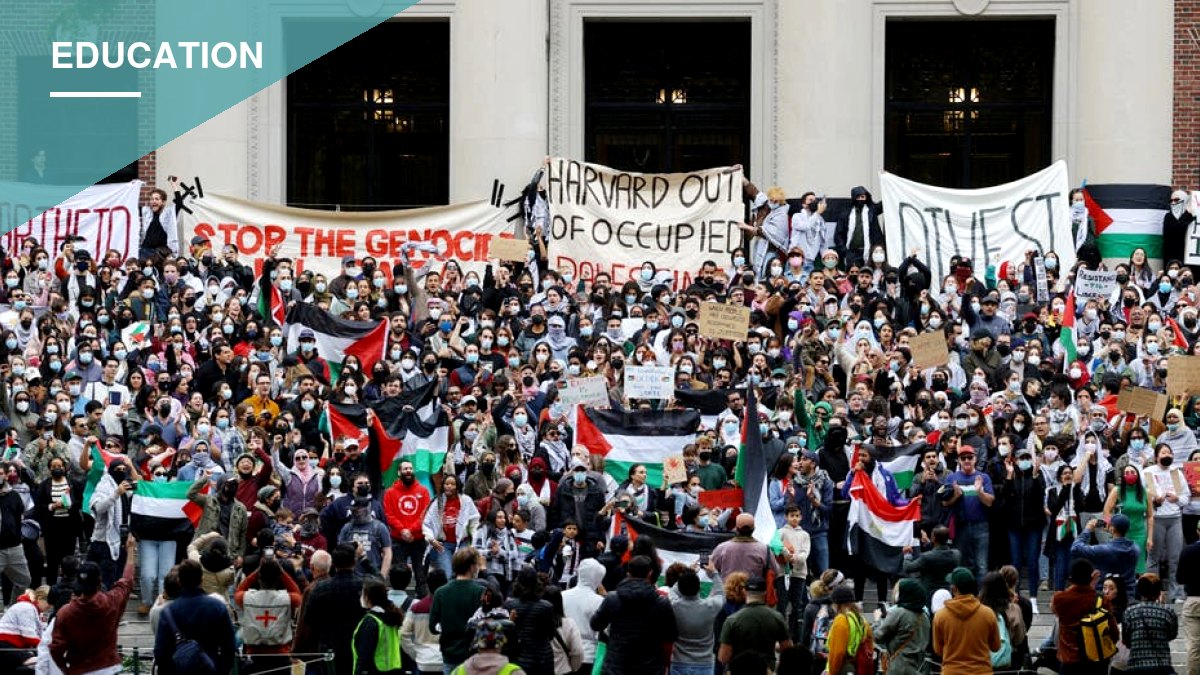
An Iranian refugee who fled the country’s 1979 revolution has published an opinion piece arguing that American universities are repeating patterns she witnessed before Iran’s Islamic Revolution, pointing to campus protests following Hamas’ Oct. 7, 2023 attack and billions of dollars in foreign funding flowing into U.S. higher education.
The author, who says she escaped Iran at age six by crossing the desert under burlap sacks while border police fired on her family’s group, writes that she arrived in America speaking no English and went on to receive a public education, earn a medical degree, and build a career. “I take it personally when American universities produce something other than patriotic Americans,” she writes.
Her essay cites a series of campus incidents since Hamas’ attack, which killed more than 1,200 Israelis and took 251 hostages into Gaza. She notes that in 2023, 34 Harvard student groups held Israel “entirely responsible” for the attack before casualty counts were final, and that a Cornell professor called the attack “exhilarating” and “energizing” at a campus rally.
She also points to Columbia University Apartheid Divest posting “Long live the global intifada!” and, on the three-year anniversary of the attacks, a protest hosted by Columbia’s Students for Justice in Palestine chapter advertised with the phrase “Glory to the martyrs, resistance until victory.” The essay references other incidents including a Students for Justice in Palestine projection reading “Glory to our martyrs” on a George Washington University library, the removal of an American flag in favor of a Palestinian flag at UNC Chapel Hill, and flag-burning near Washington’s Union Station accompanied by graffiti reading “Hamas is coming” sprayed on a national monument. She writes that none of the universities named considered expulsion over the incidents.
Foreign Funding Figures
The op-ed cites U.S. Department of Education data showing foreign sources have sent $67.6 billion to American universities since 1986, with Qatar the largest single donor at $7.7 billion. The piece notes Qatar has hosted Hamas leadership since 2012. It also references investigations during President Donald Trump’s first term that pushed universities to disclose more than $6.5 billion in previously unreported foreign funds, and states Harvard alone accepted $4.2 billion in foreign funds between 1986 and 2025.
A June report from the Jewish Institute for National Security of America (JINSA), quoted in the essay, examined how Qatar uses financial leverage to shape American campuses, noting the funding is channeled through the nominally non-governmental Qatar Foundation rather than directly from the Qatari government. JINSA’s report states: “A state that does not permit its own citizens the civil liberties it funds an American university to advocate for in America is not engaged in human rights philanthropy. It is purchasing the institutional vocabulary and academic prestige of American civil rights and deploying them in service of a political category that aligns with its foreign policy objectives.”
The essay also quotes Secretary of State Marco Rubio’s warning to foreign students on visas: “We gave you a visa to come and study and get a degree, not to become a social activist.”
The Author’s Argument
The writer argues that Iran’s own Islamic Revolution began not in mosques but on university campuses, where she says students who marched believing they could shape a revolution instead saw it weaponized by clerics. She writes that the Shah’s Iran also had “world-class universities,” and that she watched what happened “when they stopped being about education.”
She proposes that universities could instead refuse funding from countries that finance terrorist organizations and treat praise for terrorism with the same disciplinary weight as academic cheating, framing such a shift as an “America First” approach to higher education — not a slogan, she writes, but “an education that produces proud Americans.”
She affirms that the First Amendment protects broad speech rights for Americans, “no matter how vile,” while arguing that private universities retain the right to determine that praising terrorists is incompatible with campus culture.