

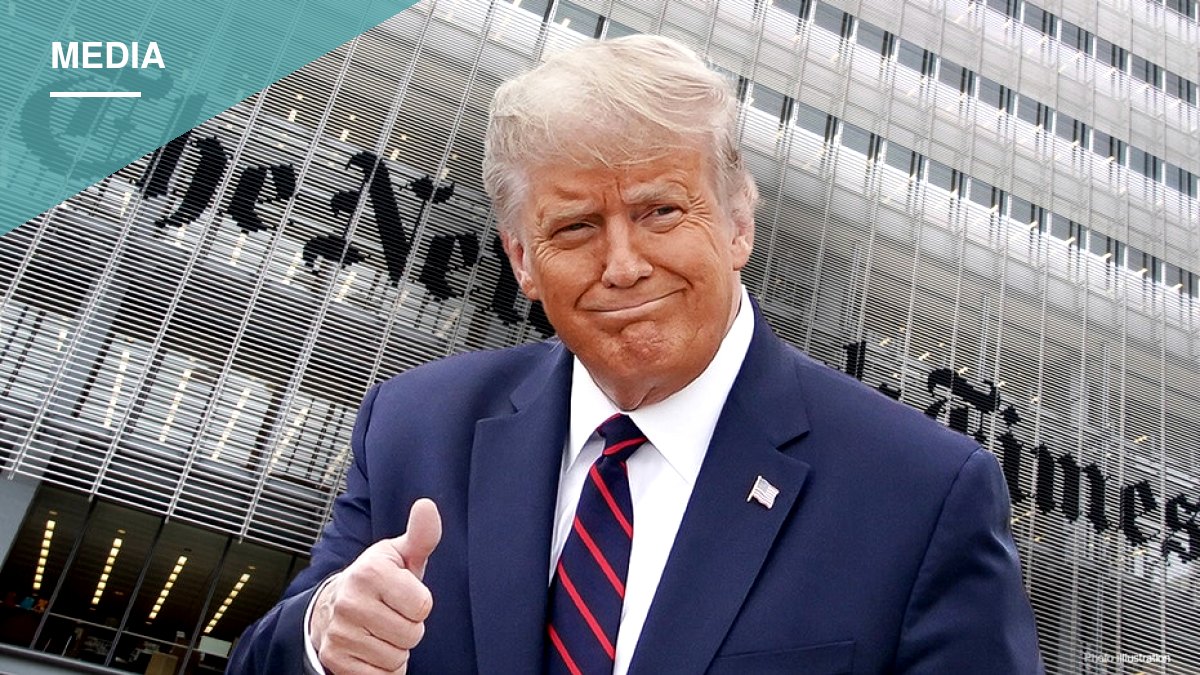
A federal judge has refused to throw out all of President Donald Trump’s $15 billion defamation lawsuit against The New York Times, allowing four counts tied to seven specific allegations of criminal conduct to move forward.
U.S. District Judge Steven D. Merryday ruled that Trump’s legal team could proceed on claims that the Times and its publisher, Penguin Random House, acted with reckless disregard for the truth, alleging what Trump’s team called “purposeful avoidance of the truth” in a book written by two Times journalists.
A spokesman for Trump’s legal team said in a statement to Fox News Digital: “President Trump continues holding the Fake News accountable for deceiving the American people. Judge Merryday has correctly denied the motion to dismiss filed by The New York Times, Penguin Publishing, and their writers, as to President Trump’s powerhouse defamation lawsuit.”
“These Defendants will now have to answer for intentionally and maliciously defaming President Trump,” the spokesman continued. “The New York Times has a long pattern of defaming President Trump in service of its leftist political agenda, and today’s momentous ruling is a victory for honesty in America.”
Book’s Claims Under Scrutiny
At issue is “Lucky Loser: How Donald Trump Squandered His Father’s Fortune and Created the Illusion of Success,” written by Times journalists Susanne Craig and Russ Buettner. Judge Merryday criticized the authors for making definitive claims of complex tax fraud and money laundering without obtaining a formal legal opinion or forensic audit, noting that accusations were leveled against Trump and his father despite no charges or convictions ever being filed.
“In other words, the facts alleged in the complaint create at least a plausible inference that the authors and the publishers knew that no reliable conclusion about violations of the tax laws, including especially the estate and gift tax laws, is possible without reliance on qualified opinion formulated after the necessary factual and legal research and analysis, which they knowingly failed to obtain,” Merryday wrote.
The court also found that the Times’ reliance on outside commentary did not satisfy standards of accuracy. One former prosecutor had said a Trump transaction “smells like a crime,” while a professor called it “suspicious.”
“Obviously, even a qualified expert offering a superficial characterization such as a transaction is ‘suspicious’ or ‘could’ violate the law or attributing to a transaction the ‘smell’ of crime or noting that a gift tax return can evade IRS scrutiny or generously giving his immensely valuable time to aid laypersons ‘lost in the weeds’ is far from a formal legal opinion sufficient to remove serious doubt about the truthfulness and accuracy of a statement accusing a specific person of fraud or tax evasion or some related crime arising from a specific transaction,” Merryday wrote.
Most Claims Still Dismissed
Despite allowing the four counts to proceed, Merryday dismissed two other counts entirely and threw out 27 additional challenged statements, ruling them non-actionable under the First Amendment protections established by New York Times Co. v. Sullivan. The judge also denied Trump’s request to amend his complaint a third time.
A New York Times spokesperson responded: “The Times is encouraged to see Judge Merryday’s dismissal of almost all claims against us. We continue to believe the remaining claim in the filing has no legal merit. We look forward to making this argument as we continue to defend ourselves against this baseless attack on The Times and the rights of the free and independent press in this country.”
Merryday has ordered the Times to file a formal answer to the surviving claims within 28 days.

