

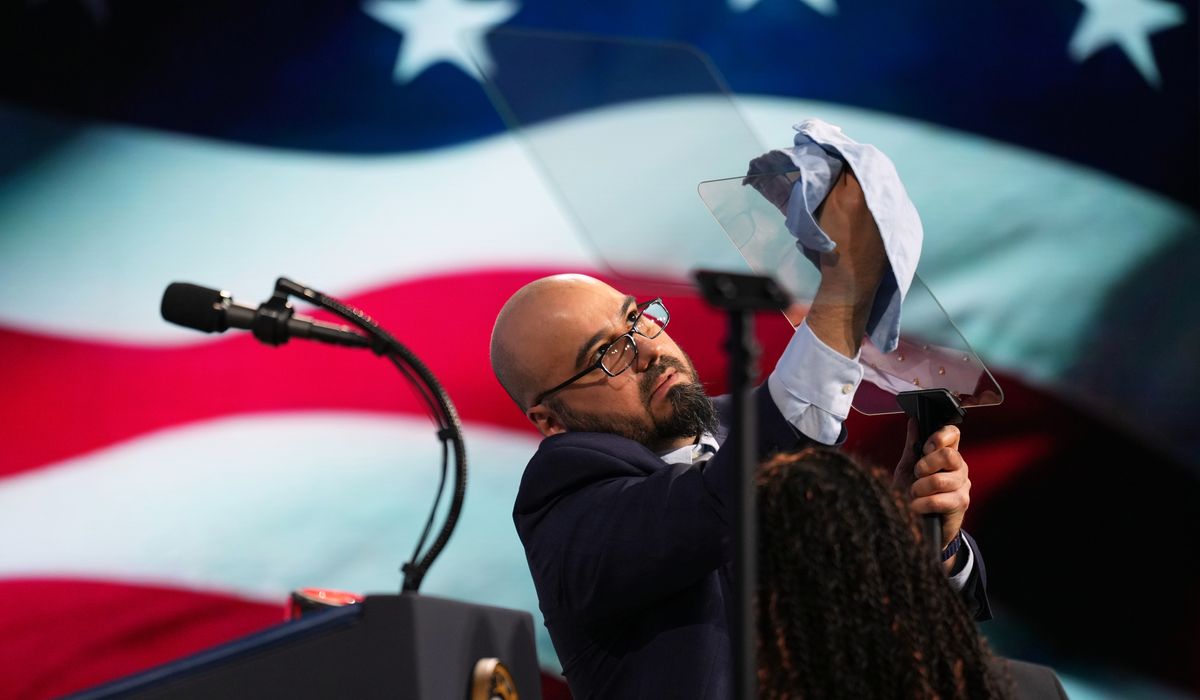
President Trump’s longtime teleprompter operator has been suspended from the prediction market Kalshi for using insider information about the president’s speeches to gain more than $100,000, a development that raises questions about access, accountability, and how markets handle sensitive political information.
The basic allegation is simple and specific: a teleprompter operator with direct, routine access to the president’s remarks used that inside knowledge to trade on Kalshi and came away with over $100,000. That raw fact matters because the operator’s role exists to support the speech itself, not to move markets, yet the number involved makes this more than a technical violation. From a Republican perspective this looks like another example where the mechanics of politics and media collide with modern finance in ways people did not foresee.
Kalshi is a regulated prediction market where traders bet on outcomes, and it enforces rules aimed at preventing trading on material nonpublic information. The operator’s access to schedules, cues, and likely phrasing created a clear advantage, and Kalshi suspended the account after the trades drew attention. Conservatives should be wary of insider trading by anyone, but also wary of one-sided enforcement that targets people close to the president while ignoring other potential abuses across the political and media ecosystem.
There are gray areas in play because a teleprompter operator’s day job is literally making sure the words appear on the screen at the right time, a service that requires knowing what will be said before it is spoken. That access is practical and necessary for the operation of presidential events, not a privilege designed to generate financial gain. The key question is whether the operator crossed from carrying out a function into using confidential knowledge to manipulate a market, and whether the punishment fits the breach.
Beyond the individual case, the incident exposes broader tensions between free markets and political communication. Prediction platforms like Kalshi can be valuable tools for gauging probabilities around public events, but they also invite new forms of insider advantage when private actors involved in politics can convert access into capital. Republicans can argue that markets should be allowed to operate, but that participants with nonpublic operational roles must be subject to clear, neutral rules that protect fairness without becoming a political cudgel.
This episode also highlights the need for transparent procedures around enforcement. Was the suspension the result of an internal audit, a tip, or pressure from outside parties watching for any irregularity tied to the president? The case calls for documented standards that apply equally to anyone with access to sensitive event information, whether they work for the White House, a campaign, or a media outlet. Republicans should insist on evenhanded treatment that shields ordinary staffers from politicized penalties while ensuring that deliberate market manipulation is deterred and punished.
The consequences for the individual and for political teams are practical as well as reputational, because the risk of market-based fallout may change how operations are staffed and how access is controlled. If routine, operational roles start carrying the specter of financial prosecution or platform bans, organizations will alter workflows and communications in ways that could hamper normal operations. That ripple effect matters for governance and for anyone who wants a functioning, non-paranoid presidency where staff do their jobs without being second-guessed for how they handle routine access to speech text and timing.
This suspension on Kalshi opens up a series of policy and enforcement questions that will need answers from the market operator, regulators, and possibly courts. Republicans will press for clear rules that protect markets and punish genuine misuse while avoiding selective enforcement tied to political affiliation or media pressure. The story is a reminder that technology, finance, and politics intersect in new ways, and those intersections need straightforward, fair ground rules that respect both free enterprise and the integrity of public communication.

