

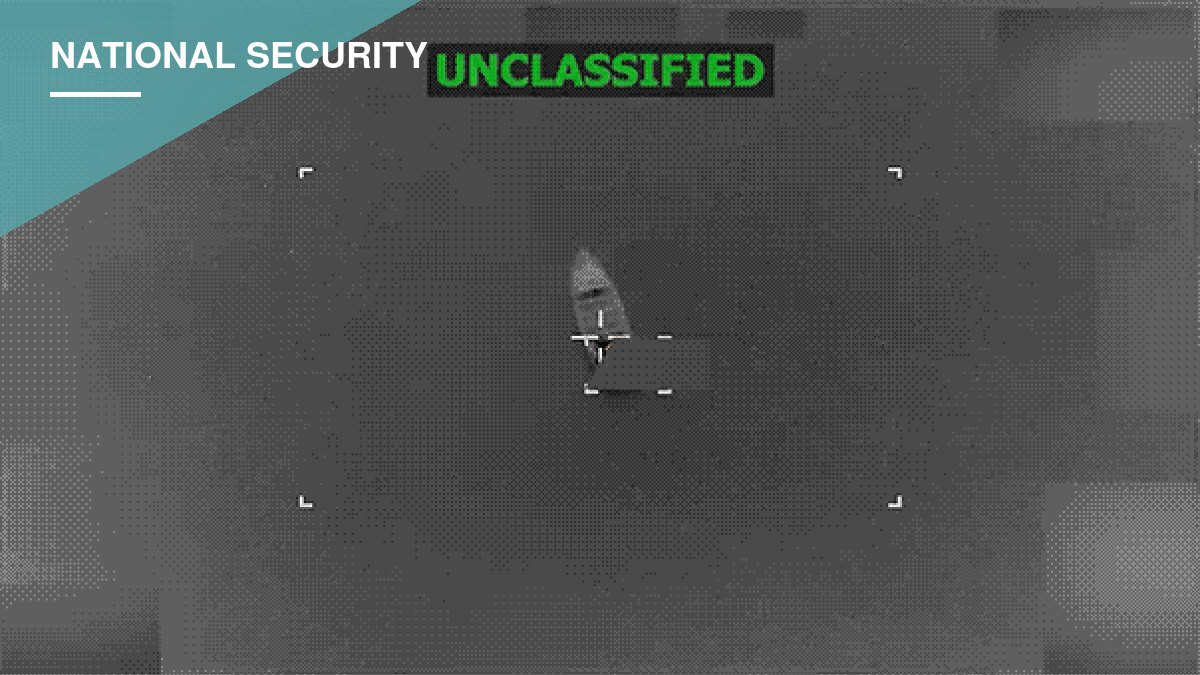
The U.S. military killed five people Tuesday in a strike on a vessel in the eastern Pacific, U.S. Southern Command announced, the latest in a monthslong campaign of lethal strikes on suspected drug-trafficking boats that has now killed at least 240 people in more than 70 strikes without a single court proceeding.
SOUTHCOM said Joint Task Force Western Hemisphere carried out the “lethal, kinetic strike” on a “go-fast vessel operating along established narco-trafficking routes in the Eastern Pacific,” citing “confirmed intelligence” of the vessel’s involvement in trafficking. The five people killed were described by the command as “narco-terrorists.” SOUTHCOM did not say precisely where the strike took place, name any of those killed, or produce evidence that the vessel carried narcotics.
Video released by SOUTHCOM shows the boat sitting in open water moments before it is consumed by a fireball.
No one killed in Tuesday’s strike, or in the roughly 70 strikes that preceded it, has been identified by name, charged with a crime, or brought before a judge. The administration’s practice of labeling suspects “narco-terrorists” and striking their vessels from the air has become routine, but the government has not released the intelligence or legal justification underlying individual strikes.
That pattern has drawn scrutiny from lawmakers, legal scholars and human rights groups, who argue the campaign amounts to the government acting as judge, jury and executioner against people suspected of a crime but never tried for one. Critics have specifically questioned the legal authority for using lethal military force against suspected traffickers outside any recognized battlefield, a step well beyond the law-enforcement interdiction and prosecution model the U.S. has historically used against drug smuggling at sea.
Secretary of State Marco Rubio said last month the administration is increasingly trying to carry out counter-narcotics operations jointly with regional allies and within the bounds of their domestic laws, telling reporters the U.S. has “the capacity to act unilaterally” but considers cooperation with allies “the most effective way to do it.” At the same time, Rubio made clear the strikes will continue: the military will “still blow up ships if need be,” he said, with each case decided “on a strike-by-strike or operation-by-operation basis.”
Not every encounter at sea has ended in a strike. SOUTHCOM has also released footage in recent months of troops boarding suspected trafficking vessels, removing their crews, and sinking the boats rather than destroying them with people aboard — a reminder that lethal force, while now common, remains a choice made case by case rather than a fixed rule.

